



















Welcome email templates for new B2B customers
Eight welcome emails for B2B suppliers: day one, the first order, account set-up, an account manager intro and a 30-day check-in.
 By the PromptLab team31 October 20265 min read
A new customer has just committed to you, and often has doubts. A good welcome email tells them who to call, what happens with the first order and what you need from them. It also sets the tone for the relationship.
These templates cover the first month: the welcome, the first order, the paperwork, an introduction to your team and a check-in. For the full process behind them, see the new customer onboarding checklist. If the new customer comes from a distributor deal, the distributor onboarding checklist fits better.
The first day
Subject: Welcome to [Our company], [Company]
Hi [First name],

Welcome, and thank you for choosing us. We're glad to be supplying [Company] with [Product].

Here is what happens next:
1. I'll send the account form and any paperwork we need by [Date].
2. Your first order can be placed as soon as that's done.
3. I'm your direct contact: [Phone] and [Email].

If you have questions in the meantime, ask me.

[Your name]
Send it the day the deal is won. Keep it to three clear next steps.
Subject: Who to call at [Our company]
Hi [First name],

To save you time, here's who handles what:

- Orders and delivery dates: [Name], [Email], [Phone]
- Invoices and payments: [Name], [Email]
- Technical questions on [Product]: [Name], [Email]
- Anything else, or if you're unsure: me

[Your name]
Use it in the first week. Buyers rarely know who to contact until something goes wrong.
Getting the paperwork done
Subject: What we need to set up [Company]
Hi [First name],

To set up your account we need:

- Your company's full name and registered address
- Delivery addresses and receiving hours
- A contact for invoices
- Your purchase order process, if you use one
- [Any other document, for example a tax or registration certificate]

If you send these by [Date], we can accept your first order straight away.

[Your name]
Use it right after the welcome. A list makes it easy for the buyer to reply in one go.
Subject: Payment terms for [Company]
Hi [First name],

I'm confirming the terms we agreed: [Payment terms, for example 30 days from invoice date], with invoices sent to [Email]. For your first orders, [any special arrangement, for example payment in advance].

If this differs from what you remember, tell me and we'll fix it before the first order.

[Your name]
Use it before the first order, so nothing about money surprises either side.
The first order
Subject: Your first order: how it works
Hi [First name],

When you place your first order, here's the sequence:

1. You send the order to [Email or channel]. Please include [Product code, quantity, delivery address].
2. We confirm it within [Time], with the dispatch date.
3. We ship and send tracking.
4. The invoice follows on [Day].

The usual lead time for [Product] is [Number] days. If you need it faster, tell me early.

[Your name]
Use it when the buyer is about to order. It removes the guesswork that makes a first order stressful.
Staying in touch
Subject: Meet [Name], your account manager
Hi [First name],

I wanted to introduce [Name], who looks after day-to-day service for [Company]. [Name] will handle order questions, deliveries and anything that needs a fast answer.

I'll stay involved on [Pricing, planning or new products]. You can reach either of us anytime.

[Your name]
Use it when the person who sold the account isn't the person who will serve it.
Subject: How did your first delivery go?
Hi [First name],

Your first delivery arrived on [Date]. How did it go? I'd like to know about anything: packaging, paperwork, product or timing.

If something wasn't right, tell me and I'll fix it. If everything was fine, a one-line reply is enough.

[Your name]
Use it a few days to two weeks after delivery. Catching a problem now keeps it from becoming a reason to leave.
Subject: One month in, [First name]
Hi [First name],

It's been a month since your first order, so I wanted to check in. Is everything working the way you expected? Is there anything about [Product] or how we work together that you'd change?

If you'd like, I can send a short list of products that customers like yours often add as a second order.

[Your name]
Use it a month after the first order. Offer one useful next step, not a hard sell.
How to personalise them
- Use the deal's own words. If the buyer said they switched for faster lead times, repeat that promise in the first-order email.
- Give names and numbers, not departments. "Call Sam on [Phone]" works better than "contact our customer service team".
- Match the channel. If the buyer wrote to you on WhatsApp or Telegram, a short message there can follow the welcome email.
- Send one thing at a time. A welcome email that asks for six documents and a call gets ignored.
Send them from your CRM
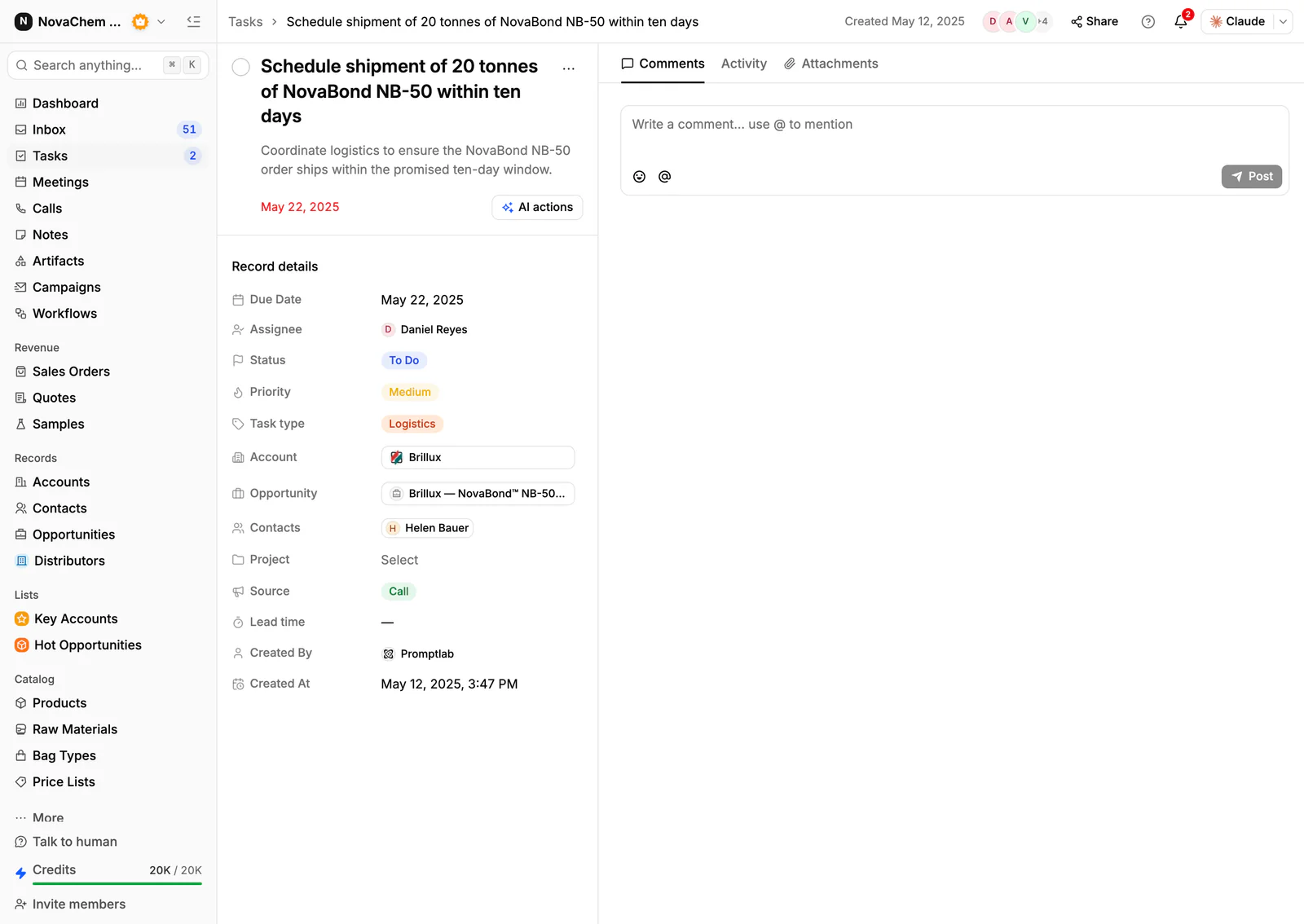
The welcome sequence is easy to start and easy to drop in week two. Give each email a task with a date on the new account, so the 30-day check-in still goes out when the rep is busy with the next deal.
Frequently asked questions
When should I send a welcome email to a new B2B customer?
The day the deal is won, while the decision is fresh. Follow with the paperwork request and the first-order email within the same week.
What should a B2B welcome email include?
A thank-you, the next steps, your direct contact details and what you need from the buyer. Keep it short and avoid attachments in the first message.
Should the welcome email come from sales or customer service?
From the person the buyer already knows, usually the salesperson. Then introduce the service contact in a second email, so the buyer knows who to call day to day.
How many emails is too many in the first month?
Four or five is plenty: welcome, paperwork, first order, post-delivery and a 30-day check-in. Each should have one purpose and one question.
Can I automate welcome emails?
You can automate the reminder. In PromptLab a workflow can create a task when a deal changes stage, so the rep sends a personal email on time. A buyer in a new relationship usually values a message that reads as written by a person.