










Margin and markup calculator
Enter your unit cost and a price or target margin to get selling price, gross margin, markup and profit. Includes a margin to markup table.
 By the PromptLab team6 October 20264 min read
Turn a unit cost and a price, or a unit cost and a target margin, into selling price, margin, markup and profit.
Margin and markup calculator
Gross margin
30%
(Price − cost) ÷ price
Markup
42.9%
(Price − cost) ÷ cost
Profit per unit
$1.80
Total profit
$1,800
On 1,000 units
How to use the margin and markup calculator
- Enter your unit cost: what one unit (a kilo, a drum, a box) costs you landed.
- Choose how you want to work. Pick I know the price and enter a selling price, or pick I want a margin and enter a target gross margin as a percentage.
- Optionally enter a quantity to see the total profit on a whole order.
With a price, you get the gross margin, the markup, the profit per unit and the total profit. With a target margin, you get the selling price first, then the markup, gross margin, profit per unit and total profit.
Margin and markup are not the same thing
Both describe the same profit, measured against a different base.
- Gross margin = (price − cost) ÷ price. It's the share of the selling price you keep.
- Markup = (price − cost) ÷ cost. It's how much you add on top of cost.
When you sell above cost, markup is always a bigger percentage than margin. A 50% margin is a 100% markup, not a 50% one.
The price from a target margin is: price = cost ÷ (1 − margin).
Common margins and their markups
The conversion is markup = margin ÷ (1 − margin).
| Gross margin | Equivalent markup |
|---|---|
| 10% | 11.1% |
| 20% | 25% |
| 25% | 33.3% |
| 30% | 42.9% |
| 40% | 66.7% |
| 50% | 100% |
| 60% | 150% |
A worked example
A distributor buys a resin at $4.20 a kilo and sells it at $5.60.
- Profit per unit: $5.60 − $4.20 = $1.40.
- Gross margin: $1.40 ÷ $5.60 = 25%.
- Markup: $1.40 ÷ $4.20 = 33.3%.
- For a 10,000 kg order: 10,000 × $1.40 = $14,000 profit.
Now work the other way. The same $4.20 cost with a 30% target margin gives a price of $4.20 ÷ 0.70 = $6.00.
A common mistake
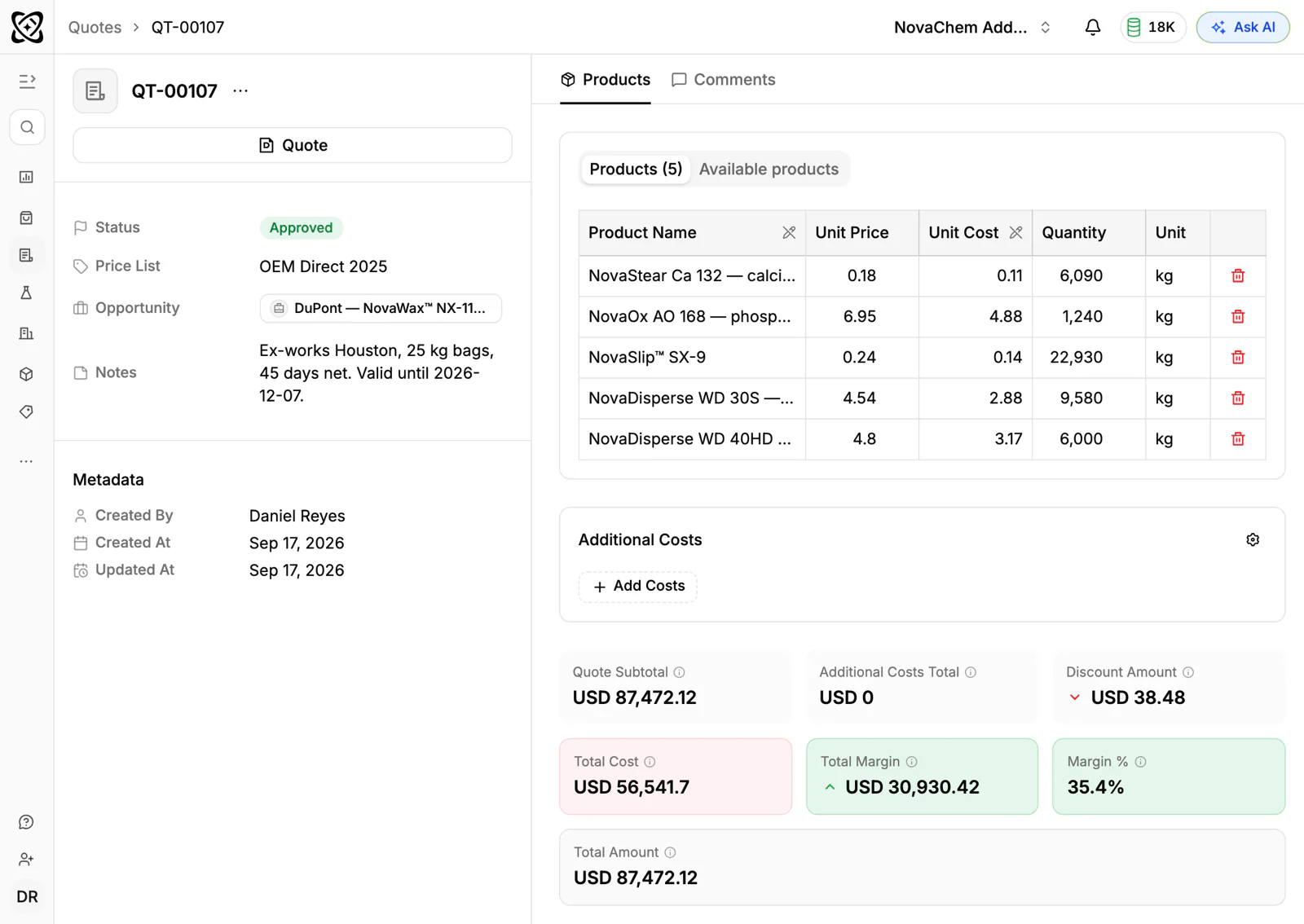
A rep adds "30% on cost" to $4.20 and quotes $5.46. That's a markup of 30%, but the margin is only $1.26 ÷ $5.46 = 23.1%. If your target is a 30% margin, a 30% markup falls short. Use the table above, or the calculator's I want a margin mode.
What a good result looks like
A good margin is one that covers your overheads and leaves a profit, and that depends on your product. Commodity items usually carry thinner margins than technical or custom products. Set a floor margin for each product line and watch for quotes that fall below it.
Check the margin per line, not only on the order total. A strong line can hide a weak one.
How to improve your margin
- Reprice with the right base. Quote from a margin target, not a flat markup.
- Watch discounts. A small discount costs more margin than it seems. At 25% margin, a 5% price cut takes the margin to about 21.1%.
- Review cost changes. When raw material costs move, update prices before the next quote.
- Use customer price lists. Give each account the price that suits its volume instead of one-off discounts.
See also how to write a sales quote and how to manage customer-specific price lists.
When to use each mode
Use I know the price when a buyer has already named a price and you want to know what you keep. Use I want a margin when you're building a quote and need to know what to ask.
For a price list, work in target margin. Pick the margin you need on each product family, calculate the price from the cost, and round to a sensible figure. Then check what the rounding did to the margin.
Keep one rule in mind when you talk to the team: always say which one you mean. "Thirty per cent" means two different prices depending on whether it is margin or markup.
If your CRM or spreadsheet only shows one of the two, add the other as a column. Seeing both side by side stops the mix-up before a price goes out. The calculator shows both for every result, so use it as a quick check on a price you've been given.
Frequently asked questions
What is the difference between margin and markup?
Margin is profit as a share of the selling price. Markup is profit as a share of cost. The same sale gives a smaller margin figure than markup figure.
How do I get a 30% margin?
Divide your cost by 0.70. A $10 cost gives a price of about $14.29. Adding 30% to cost would only give a 23.1% margin.
Is gross margin the same as net margin?
No. Gross margin only subtracts the cost of the product. Net margin also subtracts overheads such as salaries, freight not in your cost, and rent.
Should I include freight in the unit cost?
Yes, if you pay it. Use the landed cost, including freight and duty, or the margin will look better than it really is.
Can the calculator handle a discount?
Enter the discounted price as your selling price. The margin and profit then show what you keep after the discount.