








How to write a sales quote that wins the order
What a winning B2B product quote contains: line items, incoterms, validity, MOQ, lead time and payment terms, with a worked example and a checklist.
 By the PromptLab team6 October 20265 min read
A winning B2B quote for physical products answers every question a buyer would otherwise email you about. It lists each product with a clear price per unit, states the incoterm, the minimum order quantity, the lead time, the payment terms and how long the price is valid. If the buyer can approve the quote without sending a single question back, you have written it well.
Quotes lose orders in two ways: they arrive late, and they leave something open. This guide covers what to put in a product quote, in what order, and how to protect your margin while you write it.
What a B2B product quote must contain
The anatomy of a winning quote
Step by step: build the quote
- 1
Start from the customer's price list
If this customer has agreed prices, quote from them. Prices pulled from a list are right the first time, and the products are already the ones they buy. See how to manage customer price lists.
- 2
List each line with unit, pack and quantity
Write "500 kg" and "25 kg bags" separately. Buyers compare quotes line by line, and a vague unit costs you the comparison.
- 3
Check your margin on each line
Look at unit cost against unit price before you send. Know your floor, the lowest price you can accept, so a discount in negotiation is a decision, not a slip.
- 4
Add costs outside the lines
Freight, handling and certification go in as their own lines, so the buyer sees what the goods cost and what moving them costs.
- 5
State the incoterm and place
"FCA Rotterdam" or "DAP Lyon" says who pays for what and when risk passes. "Delivered" alone does not.
- 6
Set the validity, MOQ and lead time
Prices move with raw materials. Say how long yours holds, the smallest order you will ship, and how many weeks it takes.
- 7
Send it the same day
A quote that arrives the day after the call looks organised. One that arrives next week looks like you are not that keen.
The terms that decide the order
Incoterms
An incoterm says where your responsibility ends. EXW means the buyer collects from your door. DAP means you deliver to their site, import duties not included. Quote the term your buyer expects, with the named place, and add a second option if you can offer one.
Validity
Seven to thirty days is common, depending on how volatile your inputs are. State the date, not "30 days", so nobody argues about when it started.
MOQ and lead time
Put both on the quote even if you mention them on the website. A buyer comparing three quotes needs all three in one place. If lead time depends on stock, say what is in stock and what is made to order.
Payment terms
State the terms and currency. For example, "30 days net, EUR", or, for a first order, half in advance and the balance before shipping. First-time customers often start on tighter terms.
A worked example
Say a plastics distributor quotes a compounder for 2 tonnes of a polypropylene grade.
| Line | Quantity | Unit price | Unit cost | Line total |
|---|---|---|---|---|
| PP copolymer, grade A | 2,000 kg | $1.85/kg | $1.52/kg | $3,700 |
| Freight to customer, DAP | 1 | $240 | $210 | $240 |
The goods line has a margin of $0.33 a kg, which is $660 on the line. Freight adds $30, so the quote carries $690 of margin in total. Valid until 31 October. MOQ 1 tonne. Lead time 10 days from order. Payment 30 days net.
Everything the buyer needs is on one page. And you can see that a 5% discount on the goods ($185) would cut the goods margin from $660 to $475. That is your trade-off to decide, before the call.
Mistakes that cost orders
- Leaving freight "to be confirmed". The buyer cannot compare your total with a competitor's.
- Quoting from an old price list. You win the order, then lose the margin.
- No validity date. You are bound to a price from three months ago.
- Lines without product codes. The buyer has to retype them into their own system. Give every line a clear code.
- Silence after sending. Follow up in two days. The quote follow-up email templates give you wording, and how to speed up quote to order shows how to close the gap.
How PromptLab helps
In PromptLab you create a quote, link it to the deal and link the customer's price list, so the available products and prices are the ones they agreed. Each line shows unit price and unit cost side by side, and the summary shows total cost, total margin and margin percentage as you edit.
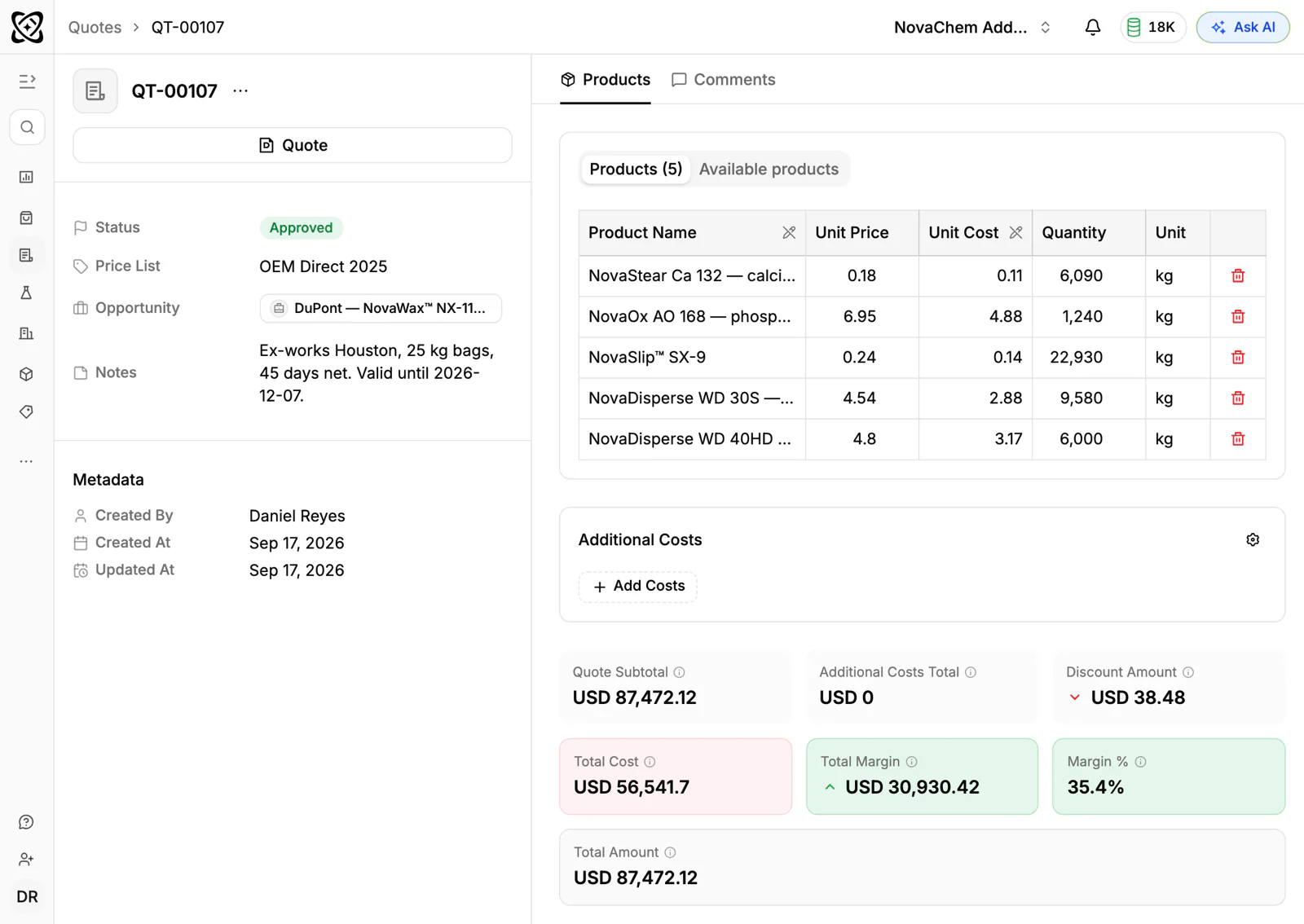
Add freight, handling and discounts in the same total. The quote moves through Draft, Pending and Approved, so everyone sees which numbers are final, and it attaches to the deal automatically. When the customer accepts, you raise the sales order with its trade terms and payment schedule, then create the invoice from the same record.
A workflow can create a task when a quote changes status, so the follow-up never depends on memory. Margin guidance is only as good as your product costs, so keep the catalogue current. More on the quotes and samples page.
Frequently asked questions
What should be included in a B2B sales quote?
Line items with unit prices, packaging, costs outside the lines, the incoterm and place, MOQ, lead time, payment terms, currency, a validity date and how to accept. Add any specification or certificate the buyer asked for.
How long should a quote be valid?
Seven to thirty days is typical for products whose raw materials move. Put the expiry date on the quote. For stable products you can quote for longer, but never leave it open.
What is the difference between a quote and a proforma invoice?
A quote is an offer that the buyer can accept. A proforma invoice is a document used for payment or customs before shipping, often after the order. Many teams send the quote first and issue the proforma on acceptance.
Should I show my margin to the customer?
No. Margin is for you. Show the customer unit prices and costs they pay. Your CRM should show margin internally so you know your floor while you negotiate.
How fast should I send a quote?
The same day for standard products, within two days for anything needing a specification check. The quicker quote often gets the first conversation about the order.