



















CRM for laboratory supplies distributors
How laboratory supplies distribution sells, from catalogue numbers and certificates to grant-year budgets, standing orders and quotes, and a CRM setup.
 By the PromptLab team24 October 20267 min read
A laboratory supplies distributor needs a CRM that understands that the person who orders and the person who uses are different, and that both care about different things. The lab manager wants the right grade, the right certificate and delivery before the experiment. Procurement wants the right price on the right purchase order.
In PromptLab, each lab, department or institution is an account with its own price list, quotes sit on deals, trial products go in as sample requests and sales orders show what was bought. The wider distributor view is on the distributors page.
How does a laboratory supplies distributor actually sell?
Customers are university departments, research institutes, hospital and clinical laboratories, quality control labs in factories, environmental and food testing labs, biotech start-ups and school science departments. The product list is long: glassware, plasticware, pipette tips, vials and filters, reagents and chemicals, consumables for instruments, small equipment, safety items and spare parts.
Most of it is a repeat purchase. A lab running the same assay every week uses the same tips, the same plates and the same reagents. The first sale is often a quote against a catalogue number. The thousandth is a standing order.
There are three kinds of people on the account. The scientist or lab manager specifies the product and cares about grade, purity and compatibility. The purchasing or stores team places orders against budget codes. And a department head or principal investigator approves bigger spends. A rep who knows only one of them is exposed.
Why do catalogue numbers, grades and certificates matter?
Lab products are specified tightly. The same solvent comes in several grades, and the same filter in several pore sizes and materials. A buyer who writes down the wrong catalogue number gets the wrong product, and a lab that gets the wrong product loses a day.
That is why distributors are asked for documents. A certificate of analysis shows the results for a specific batch, and a safety data sheet covers handling, storage and hazards. Buyers often ask for them before a purchase or alongside delivery, and a quality-managed lab may need them on file. See what is a certificate of analysis.
Some items travel differently. Reagents may need cold storage in transit, and some chemicals have special shipping rules. These are your logistics team's calls. The CRM's job is to record what the customer was promised and the delivery conditions they asked for.
How do budgets, grants and purchasing rules shape the sale?
Lab buying follows money. A university department may have a fiscal year, a grant that must be spent before it ends, and a purchasing office that insists on a quote or a purchase order for anything above a set amount. A hospital lab may buy through a central supplies department.
Some institutions run preferred supplier lists or framework agreements, negotiated after a tender. If you are on the list, individual labs order from you at agreed prices. If you are not, a scientist who likes your product still can't buy it easily. Winning the listing is a project, and keeping labs ordering from it is the daily job.
The calendar matters: end-of-year spending, new grants arriving and new academic terms are predictable moments for a rep to call. Put the dates on the account as fields so you can plan the calls.
When are samples and trials used?
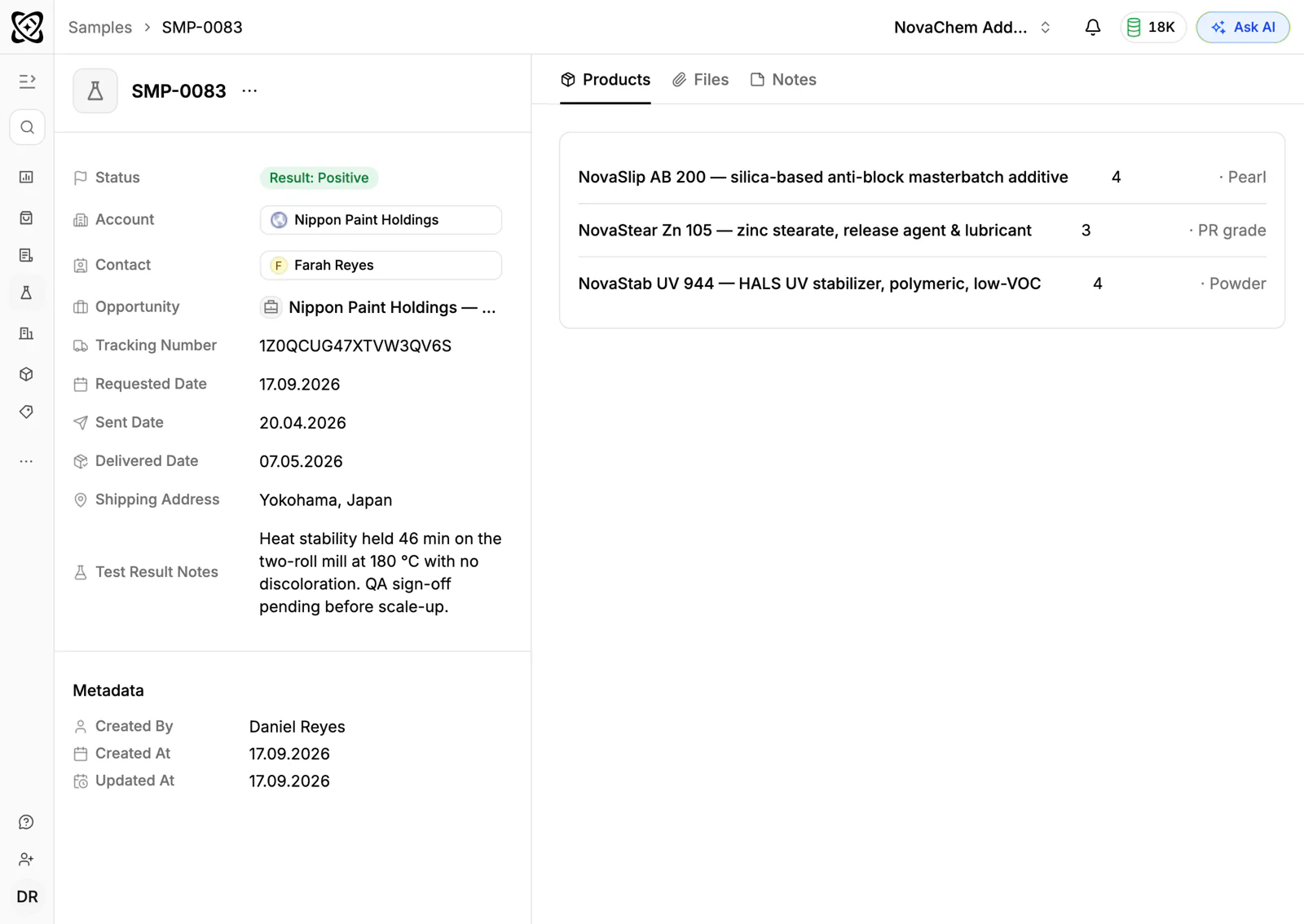
Consumables are rarely sampled, but some products are. A new brand of filter, a pipette tip that fits a specific instrument, or a column for a particular method can be sent as a trial. The scientist runs it on their method and decides. How to track product samples covers the routine.
For equipment, the equivalent is a demonstration or short loan. Track the product, the lab, the person using it, the date and the verdict, as you would for any sample.
What pipeline stages fit laboratory supplies?
PromptLab has one deal pipeline with stages you set. Use a deal field for the type of deal, such as new lab, preferred-supplier listing, equipment quote or standing order set-up, and save a view for each. Everyday reorders don't need a deal. They are sales orders on the account.
| Stage | Entry condition |
|---|---|
| Enquiry | A scientist or buyer has asked for a product or price |
| Spec confirmed | Catalogue numbers, grade and pack sizes are agreed |
| Documents sent | Certificates and safety data sheets are logged as sent |
| Trial or demo | A sample or demo is out, with a verdict due |
| Quote sent | A quote is with the buyer, with a price list applied |
| Approved | The buyer has accepted and the quote is marked Approved |
| First order | A sales order exists |
| Standing order | The lab reorders on a rhythm |
Pick the loss reason on lost deals. Timing, Competitor and Price are different problems, and the win and loss dashboard shows which is growing. A note on the deal can add the detail, such as a stock-out.
What must the CRM track?
- The people on each account: scientist, stores or purchasing, and approver, each with a role.
- Price lists per customer, because an institution with a framework, a commercial lab and a school do not pay the same.
- Documents sent, such as certificates and safety data sheets, with the version.
- Budget dates, such as fiscal year end or grant end, as fields on the account.
- Quotes, with their status as Draft, Pending or Approved, and the validity written in the quote's Notes field.
- Order history by product, so you see which consumables a lab buys and which it has stopped buying.
How do you set this up in PromptLab?
- 1
Add the stages and a deal-type field
Put the stages above into the pipeline and add a deal field for the type of deal. Save a view for each, so the equipment specialist and the consumables team see only their own deals.
- 2
Store the documents on the account
Attach certificates and safety data sheets as documents on the account, and note which batch or version went to whom.
- 3
Create price lists for institutions
Build a customer price list for each institution, framework or segment and quote from it. Add the validity period in the quote's Notes field, since there is no expiry field.
- 4
Add budget fields
Add account fields for fiscal year end and next big purchase window. Build a view of accounts whose year ends in the next quarter, and give each a task.
- 5
Create tasks from quote status
Build a workflow: when a quote changes status to Pending, create a task for the rep to ring the buyer. Add another that notifies the team in Slack when a quote is Approved.
- 6
Connect the inbox
Many labs email purchase requests, and some message on WhatsApp. Connect your mailbox and your WhatsApp Business number so every request lands on the account in the shared Inbox.
How does PromptLab compare for laboratory supplies sales?
Swipe the table sideways to see every CRM →
| Checked on 30 September 2026 | PromptLab |  Salesforce |  HubSpot |  Attio |
|---|---|---|---|---|
| Pricing | ||||
| Paid plans, a month | $11.99 – $99per seat | $25 – $550per seat | $7 – $150per seat | $35 – $79per seat |
| Number of plans | 3 | 5 | 4 | 4 |
| Free trial | ||||
| Billing | Billed monthly | Billed annually | Billed annually, plus a $1,500–$3,500 onboarding fee | Billed annually; free plan for 3 seats |
| Import from CSV and Excel | ||||
| Sales management | ||||
| Deal pipelines | ||||
| Quotes | From$100/month | Add-on | ||
| Sales orders | From$100/month | |||
| Sample tracking | ||||
| Price lists | From$100/month | |||
| Meetings and calls | ||||
| Meeting recording and transcripts | Add-on | From$90/month | From$79/month | |
| AI meeting summaries | Add-on | From$79/month | ||
| AI follow-up email drafts | Add-on | From$90/month | From$79/month | |
| Meeting scheduler and call dialer | From$23.99/month | Add-on | ||
| AI and automation | ||||
| CRM fields filled in from calls | From$195/month | From$90/month | From$79/month | |
| Connect Claude or ChatGPT (MCP) | From$195/month | |||
| Workflow automation | ||||
| API and webhooks | From$23.99/month | From$195/month | ||
| Conversations | ||||
| Gmail and Outlook email sync | ||||
| WhatsApp conversations | Add-on | Add-on | ||
| Telegram conversations | ||||
| Save LinkedIn profiles | Via marketplace | From$150/month | Via marketplace | |
| Privacy and security | ||||
| Single sign-on (SSO) | From$99/month | From$150/month | Enterprise plan |
Salesforce Sales Cloud is the most configurable CRM there is, with five editions from $25 to $550 a user a month, billed annually. For a team selling products, quotes and price lists start at $100, call recording is a $50 add-on, and building it usually takes an admin or partner. It doesn't model samples.
HubSpot is the most polished all-in-one suite, with a Starter plan from $7 a seat a month, billed annually. Quoting is an add-on, sales orders and price lists aren't there, and Professional and Enterprise add a $1,500 to $3,500 onboarding fee. Attio is one of the best-designed new AI-native CRMs, with up to three seats free, but quotes, price lists and orders are for you to build. See the Salesforce and Attio comparisons.
Frequently asked questions
What should a CRM for a laboratory supplies distributor include?
It should hold price lists per institution, quotes, sales orders, the people at each lab and the documents you sent. PromptLab includes quotes, price lists, sales orders and sample tracking on every plan, from $11.99 per user per month.
Does the CRM replace my catalogue and stock system?
No. Your catalogue and stock system stay the master for the full range and live availability. Add the products you quote to PromptLab, so quotes, price lists and sales orders can use them.
How do I handle certificates of analysis in a CRM?
Keep the master copies in your quality system and attach the version you sent to the account as a document. Then any rep can see what a lab already has.
How do I time calls around grant and budget cycles?
Add budget dates as account fields, build a view of accounts whose year ends soon, and create a task for each. The call then lands before the money is spent elsewhere.
Is there a free trial?
Basic and Professional come with a 14-day free trial. There is no free plan.