








CRM for chemical companies
How chemical sales really works, the pipeline stages that fit, and how to set up a CRM for samples, specs, price lists and repeat orders.
 By the PromptLab team6 October 20266 min read
A chemical company needs a CRM that keeps samples, specifications, quotes and customer price lists on the same record as the buyer. A generic sales CRM tracks a deal moving through stages. A chemical sale is a deal plus a technical evaluation plus a purchasing negotiation, and each of them has its own owner and its own calendar.
In PromptLab, sample tracking, customer price lists, quotes and sales orders are ready on the first plan, and data sheets and certificates sit on the account as documents. The chemicals page shows the same workflow on screen.
How does a chemical sale actually work?
Most chemical deals begin with a technical question, not a price. A formulator wants a binder with a lower viscosity. A plant wants a solvent that passes its own internal limits. The first conversation is with R&D or quality, and procurement only joins once something has passed the lab.
That means three buyers sit behind one account:
- R&D or the formulation chemist, who decides whether the grade works.
- Quality and regulatory, who ask for the technical data sheet, the safety data sheet and the certificate of analysis.
- Procurement, who negotiates price, packaging, incoterms and payment terms.
A rep who only knows the procurement contact will lose to a rep who has the chemist's mobile number. Your CRM has to hold all three contacts on the account, with a note on what each one cares about.
What happens between the first sample and the first order?
The sample is the centre of the sale. A rep sends 500 grams or a 20 litre pail, the customer runs it in a trial batch, and weeks later someone says yes or no. If nobody chases, the sample sits on a shelf and the account goes cold.
Typical steps after the sample ships:
- The customer confirms receipt and runs its first trial.
- The chemist reports back, often with a request for a tweak or a second grade.
- A second sample ships, sometimes in a larger quantity for a pilot run.
- The customer approves the grade internally, which can take months.
- Procurement asks for a quote on a trial order, then a contract volume.
Every one of these hand-offs is a place where a deal quietly dies. The CRM's job is to make the next step visible, with a date.
What pipeline stages fit a chemical company?
Keep the stages tied to things the customer does, not to how the rep feels. A pipeline that works for most chemical sellers looks like this:
| Stage | What has to be true to enter it |
|---|---|
| New enquiry | A buyer has asked about a grade or an application |
| Technical qualification | You know the application, the volume and who approves |
| Sample sent | A sample is logged on the deal with a ship date |
| Under evaluation | The customer confirmed receipt and is running trials |
| Approved | The grade passed and a purchasing contact is involved |
| Quote sent | A quote for a trial order or a volume is out |
| Won or lost | The order landed, or you recorded why it did not |
Add a loss reason on the last stage. "Customer chose a cheaper supplier" and "grade failed on viscosity" lead to very different next moves, and you can only tell them apart if the reason is a field, not a sentence buried in an email.
What must a chemical CRM track?
Beyond contacts and deals, the record needs the product facts that decide the sale.
- Grades and applications. Which grade did the customer test, for which application, and what was the result?
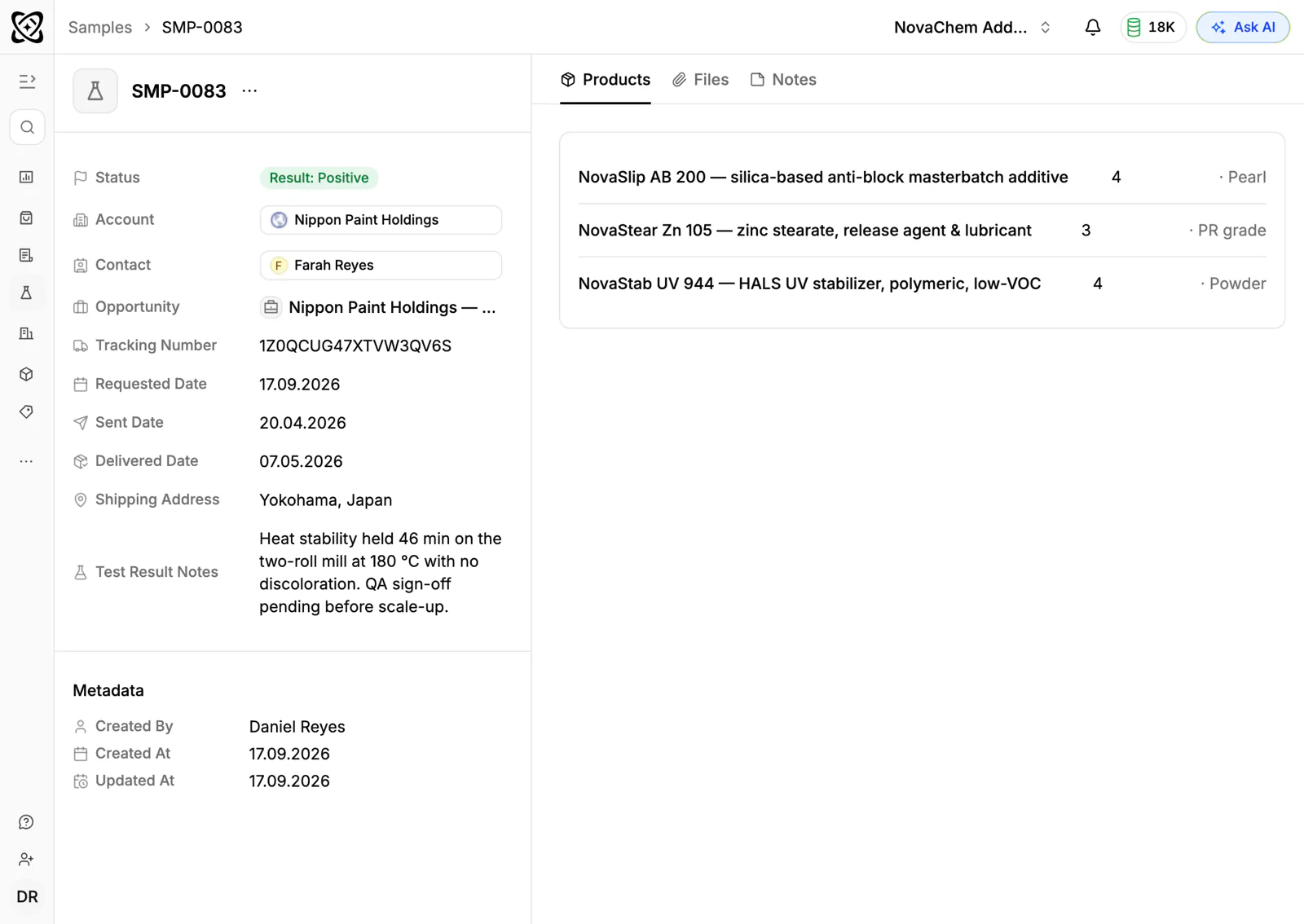
- Samples. Who has it, since when, how much, and what feedback came back.
- Documents. The data sheet, safety data sheet and certificates you sent, attached to the account, so nobody has to dig through a sent folder.
- Customer price lists. One customer pays one price per grade and pack size, another pays a different one. The quote should pull from the right list.
- Sales orders. The approved quote becomes the order, so repeat volumes are visible next to the original deal.
- Conversations. Email, calls, and the WhatsApp or Telegram messages where many overseas buyers actually reply.
How do you set this up in PromptLab?
Everything below works on the Basic plan at $11.99 per user per month.
- 1
Build the pipeline
Create a pipeline with the seven stages above. Name them in the customer's terms, so "Under evaluation" means the customer is trialling your grade right now.
- 2
Add the fields that decide the sale
Add fields for application, grade of interest, expected annual volume and loss reason. Put the approving contact on the account so the chemist and the buyer are never mixed up.
- 3
Load your price lists
Create a customer price list for each key account, with grades and pack sizes. Quotes pick from the list, so a rep never types a price from memory. See how to manage customer-specific price lists.
- 4
Log every sample the day it ships
Use sample tracking to record the grade, quantity, ship date and contact. Follow the routine in how to track product samples, and set a task for the feedback call a week out.
- 5
Connect the channels buyers use
Connect your WhatsApp Business number and your company Telegram bot to the shared Inbox, next to Gmail, Outlook or IMAP email. Buyers message first on Telegram, and every thread lands on the right account.
- 6
Record the evaluation meetings
Turn on meeting recording for Google Meet, Zoom and Microsoft Teams. The summary and action items attach to the account, so a technical call in March is still readable in September.
How does PromptLab compare for chemical sales?
Swipe the table sideways to see every CRM →
| Checked on 30 September 2026 | PromptLab |  HubSpot HubSpot |  Zoho CRM Zoho CRM |  Salesforce Salesforce |
|---|---|---|---|---|
| Pricing | ||||
| Paid plans, a month | $11.99 – $99per seat | $7 – $150per seat | $14 – $52per seat | $25 – $550per seat |
| Number of plans | 3 | 4 | 4 | 5 |
| Free trial | ||||
| Billing | Billed monthly | Billed annually, plus a $1,500–$3,500 onboarding fee | Billed annually | Billed annually |
| Import from CSV and Excel | ||||
| Sales management | ||||
| Deal pipelines | ||||
| Quotes | Add-on | From$23/month | From$100/month | |
| Sales orders | From$23/month | From$100/month | ||
| Sample tracking | ||||
| Price lists | From$23/month | From$100/month | ||
| Meetings and calls | ||||
| Meeting recording and transcripts | From$90/month | Via marketplace | Add-on | |
| AI meeting summaries | Add-on | |||
| AI follow-up email drafts | From$90/month | From$23/month | Add-on | |
| Meeting scheduler and call dialer | From$23.99/month | Via marketplace | Add-on | |
| AI and automation | ||||
| CRM fields filled in from calls | From$90/month | From$40/month | From$195/month | |
| Connect Claude or ChatGPT (MCP) | From$195/month | |||
| Workflow automation | ||||
| API and webhooks | From$23.99/month | From$195/month | ||
| Conversations | ||||
| Gmail and Outlook email sync | ||||
| WhatsApp conversations | Add-on | Add-on | ||
| Telegram conversations | ||||
| Save LinkedIn profiles | From$150/month | From$23/month | Via marketplace | |
| Privacy and security | ||||
| Single sign-on (SSO) | From$99/month | From$150/month | From$40/month |
HubSpot's marketing tools are the strongest of the three, which helps if formulators find you through technical content. Its free CRM and $7 Starter plan, billed annually, are cheap ways in, but quoting sits in the separate Revenue Hub, there are no sales orders or price lists, and recording an evaluation call starts on Sales Hub Professional at $90 a seat a month, also billed annually.
Zoho CRM covers the commercial end better, with quotes, sales orders and price books from $23 a user a month, billed annually. It doesn't model samples, though, and writes no AI summary of a technical call. Salesforce can be built to fit almost any chemical process, sample objects and approval flows included, if you have an admin or a partner to build them. Quotes and price lists start on Pro Suite at $100 a user a month, billed annually. The Salesforce comparison goes through it line by line.
Frequently asked questions
What is the best CRM for a chemical company?
Look for sample tracking, customer price lists, quotes and sales orders on the first plan, plus a shared inbox that includes the messaging apps your buyers use. PromptLab includes all of these on every plan from $11.99 per user per month. If you resell rather than make, read our list of the best CRMs for chemical distributors.
Can a CRM track samples sent to customers?
Yes, if it has sample tracking as a record. PromptLab logs each sample against the deal and account, with status and customer feedback. HubSpot, Zoho CRM and Salesforce do not model samples as a record, going by their plan pages as we checked them.
How do I manage different prices for different chemical customers?
Keep a customer price list per account and quote from it. PromptLab has customer price lists on every plan, so the quote shows the agreed price for each grade and pack.
Does PromptLab work with WhatsApp and Telegram for overseas buyers?
Yes. The shared Inbox takes your WhatsApp Business number and your company Telegram bot, alongside email. On Telegram the buyer messages your bot first.
How long do chemical sales cycles run, and can a CRM help?
They vary by application and approval route, and some run for months. A CRM cannot shorten the customer's testing, but it keeps every sample, meeting and document on one timeline so no follow-up is missed.
Sources
Prices and features of other CRMs come from each vendor's own pages, on the dates below.
- HubSpot, checked on 30 September 2026: Sales Hub pricing, Revenue Hub quote software, WhatsApp integration, MCP servers, Single sign-on (SSO)
- Zoho CRM, checked on 30 September 2026: Pricing, Features, WhatsApp integration, MCP
- Salesforce, checked on 30 September 2026: Sales Cloud pricing, Sales Engagement pricing, Agentforce MCP support