



















CRM for pharmaceutical ingredients suppliers
How pharma ingredient suppliers sell, from samples, CoAs and supplier qualification to quotes and reorders, and a CRM setup that tracks each step.
 By the PromptLab team24 October 20267 min read
A pharmaceutical ingredients supplier needs a CRM that records what a customer has asked for, what you sent and where they are in their own qualification. The sale is slow and document-heavy: the buyer will not order until their quality team accepts you, and that decision rests on paperwork and samples, not on a sales call.
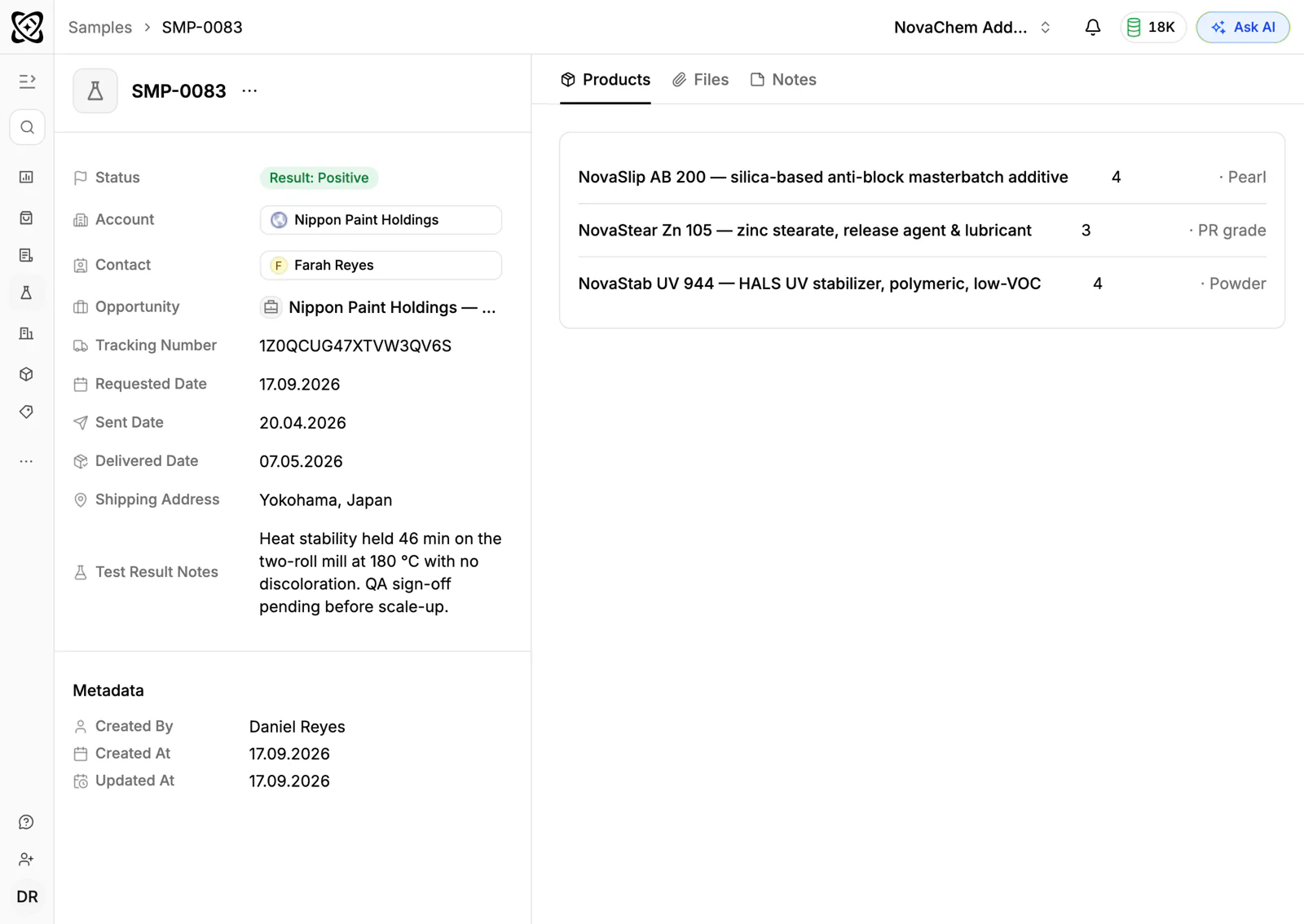
In PromptLab, samples are tracked as sample requests, each customer has a price list, and quotes, sales orders and documents sit on the same account. The chemicals page covers the wider picture for material suppliers.
How does a pharmaceutical ingredients supplier actually sell?
Suppliers of active ingredients (APIs) and excipients sell to manufacturers of medicines, supplements and related products, and often through distributors and agents who hold stock or cover a region. The buyer is typically not one person. Procurement negotiates, but R&D, quality assurance and regulatory affairs each have a say.
The R&D contact wants a sample to test in a formulation. Quality wants documents and a view of how you make and control the material. Regulatory wants to know what supports their filing. Procurement wants price, lead time and security of supply. A rep who only talks to procurement meets the other three late, and often at the wrong moment.
For that reason the CRM must hold the buying group, with each person's role.
What are samples, documents and supplier qualification?
A pharma ingredient sale is built from documents. The usual ones are a specification, a certificate of analysis for the batch or a typical one, and a safety data sheet. Customers often add questionnaires about your site and quality system, and ask for audit access. For some materials, a supplier also keeps regulatory support files that the customer can reference. Which documents apply to which material and market is a matter for your regulatory and quality team. See what is a certificate of analysis.
Many ingredients are tested against a pharmacopoeial monograph, such as those in the US, European or other national pharmacopoeias. A buyer will say which one they need, and the specification you quote has to match.
Next comes supplier qualification. The customer's quality team decides whether to add you as an approved supplier, through a questionnaire, a document review and sometimes an audit. Qualification can take a long time and ends in a yes, a no or a request for more. Once you are approved, a change of supplier is a project for the customer, so they tend to stay. It also means you must tell them in advance about changes to your process or site, under the terms of your quality agreement.
Samples sit inside all of this. A sample goes to R&D for a lab trial or to quality for testing, comes with a CoA and a batch number, and should be logged with the batch. The result is a verdict you need on the account.
Why do reorders and security of supply matter?
Once qualified, buyers reorder on a rhythm tied to their production plans. They care about reliable lead times, consistent quality batch to batch and early warning of anything that will delay delivery. A late order matters more than a slightly higher price.
That makes the account history valuable. A rep who can see the last order, the usual quantity and the open quote can spot a customer who has slowed and ask why. It is also how you notice that a second source has been qualified.
What pipeline stages fit a pharma ingredients sale?
PromptLab has one deal pipeline with stages you set. Mark each deal with a field for the customer type, such as manufacturer or distributor, and save a view for each. Distributor deals skip the qualification stages their route does not use.
| Stage | Entry condition |
|---|---|
| Enquiry | A buyer has named an ingredient, grade and use |
| Documents sent | Specification, CoA and SDS are logged as sent, with versions |
| Sample out | A sample is logged with batch number and purpose |
| Sample result | The customer's feedback is recorded on the sample |
| Qualification | The customer's quality team is reviewing you |
| Approved supplier | The customer has accepted you for this material |
| Quote sent | A priced quote is out, with lead time in its notes |
| First order | A sales order has been created |
| Repeat supply | The account is ordering on a pattern |
What must the CRM track?
- The buying group: R&D, quality, regulatory and procurement contacts, each with a role.
- Material, grade and specification requested, including the pharmacopoeia named.
- Documents sent, with the version and the date.
- Samples, each with a ship date, a batch number, a status and the customer's result.
- Qualification status per account and per material, with the date and the contact.
- Price lists per account. Pack size, quantity and distributor terms change the price.
- Order history by material, so a rep sees what each account buys and what it stopped buying.
How do you set this up in PromptLab?
- 1
Build stages, a customer-type field and qualification fields
Add the stages above, a deal field for customer type, and account fields for qualification status, material and date. Save a view for each customer type.
- 2
Add the whole buying group
Import accounts and contacts from CSV or Excel, then add R&D, quality and regulatory contacts to each account with their role, so the right person gets the right document.
- 3
Log every sample with its batch
Create a sample request for each sample, linked to the account and the deal, with the batch number in its notes or a custom field, and a status. Record the customer's result as feedback. How to track product samples covers the routine.
- 4
Attach the documents you sent
Store the specification, CoA and SDS you sent as documents on the account, and note the version. Keep the master copies in your quality system, not in the CRM.
- 5
Quote from the account's price list
Build quotes from the customer's price list by pack size, with line discounts where agreed. Put lead time and validity in the quote's Notes field, as a quote has no expiry field. Create the sales order as its own record when the customer confirms.
- 6
Automate the chasing
Use workflow automation to create a task when a sample's status changes, so the result is chased, and when a deal moves stage. Connect your mailbox in the shared Inbox so the whole team sees the thread.
How does PromptLab compare for pharmaceutical ingredients suppliers?
Swipe the table sideways to see every CRM →
| Checked on 30 September 2026 | PromptLab |  Salesforce |  HubSpot |  Attio |
|---|---|---|---|---|
| Pricing | ||||
| Paid plans, a month | $11.99 – $99per seat | $25 – $550per seat | $7 – $150per seat | $35 – $79per seat |
| Number of plans | 3 | 5 | 4 | 4 |
| Free trial | ||||
| Billing | Billed monthly | Billed annually | Billed annually, plus a $1,500–$3,500 onboarding fee | Billed annually; free plan for 3 seats |
| Import from CSV and Excel | ||||
| Sales management | ||||
| Deal pipelines | ||||
| Quotes | From$100/month | Add-on | ||
| Sales orders | From$100/month | |||
| Sample tracking | ||||
| Price lists | From$100/month | |||
| Meetings and calls | ||||
| Meeting recording and transcripts | Add-on | From$90/month | From$79/month | |
| AI meeting summaries | Add-on | From$79/month | ||
| AI follow-up email drafts | Add-on | From$90/month | From$79/month | |
| Meeting scheduler and call dialer | From$23.99/month | Add-on | ||
| AI and automation | ||||
| CRM fields filled in from calls | From$195/month | From$90/month | From$79/month | |
| Connect Claude or ChatGPT (MCP) | From$195/month | |||
| Workflow automation | ||||
| API and webhooks | From$23.99/month | From$195/month | ||
| Conversations | ||||
| Gmail and Outlook email sync | ||||
| WhatsApp conversations | Add-on | Add-on | ||
| Telegram conversations | ||||
| Save LinkedIn profiles | Via marketplace | From$150/month | Via marketplace | |
| Privacy and security | ||||
| Single sign-on (SSO) | From$99/month | From$150/month | Enterprise plan |
Salesforce is the most configurable CRM there is, with five editions from $25 to $550 a user a month, billed annually. Quotes and price lists start at $100, call recording is a $50 add-on, and samples aren't modelled, so tracking them means a custom object someone has to build. HubSpot is the most polished all-in-one suite, with a Starter plan from $7 a seat a month, billed annually. Quoting sits in the separate Revenue Hub, and sales orders, samples and price lists aren't there.
Attio is one of the best-designed of the new AI-native CRMs, with up to three seats free. Quotes, price lists and orders are left for you to build, and call recording waits for a plan at $79 a seat a month, billed annually. See the Salesforce and HubSpot comparisons.
Frequently asked questions
What should a CRM for a pharmaceutical ingredients supplier include?
It should hold the buying group, sample tracking with batch numbers, documents sent, customer price lists, quotes and sales orders. PromptLab ships quotes, sales orders, price lists and sample tracking on every plan, from $11.99 per user per month.
Can a CRM track sample batches and CoAs?
It can record which batch you sent and which document version the customer holds, on the sample and the account. Keep the master documents in your quality system. PromptLab is a CRM and does not replace one.
How do I track a customer's supplier qualification?
Use account fields for status, material and date, and a stage in the deal. Notes and tasks carry the follow-up with the customer's quality team.
Can I record calls with a customer's quality team?
Yes. PromptLab records meetings on Google Meet, Zoom and Microsoft Teams, with a transcript, an AI summary and a follow-up email draft. Action items become CRM tasks. Check your own policies and local rules on recording first.
Is there a free trial?
Basic and Professional come with a 14-day free trial. There is no free plan.