



















CRM for rubber products manufacturers
How rubber products makers sell, from drawings, compounds and tooling quotes to sample approval and blanket orders, and a CRM setup that tracks each step.
 By the PromptLab team24 October 20267 min read
A rubber products manufacturer needs a CRM that keeps the drawing, the compound, the tooling quote and the sample approval on the same account as the deal. The sale rarely turns on price per part alone. It turns on whether your part fits, seals and lasts in the customer's application, and whether you can prove it before they commit.
In PromptLab, each OEM or distributor is an account with its own price list, first-off parts go in as sample requests, quotes sit on the deal and sales orders on the account. The wider factory view is on the manufacturers page.
How does a rubber products manufacturer actually sell?
Rubber makers usually sell through two routes. Custom parts go straight to an OEM or an industrial buyer: seals, gaskets, grommets, bellows, hoses, mounts, sheet and profiles, moulded or extruded to the customer's drawing. Standard parts such as O-rings, seals and profiles often go through distributors and stockists, who sell them on to maintenance and repair buyers.
On the custom side, the enquiry arrives as an RFQ with a drawing, an annual volume and a request for a price. The rep needs to know the material, the hardness, the operating conditions and whether new tooling is needed. A good quote answers all of that, and a bad one guesses.
On the standard side, the distributor cares about stock, lead time and margin. A distributor who cannot get your part this week will sell someone else's.
What are compounds, tooling and sample approval?
Custom rubber parts start with a compound: the rubber type and its recipe, such as EPDM, nitrile, silicone or fluoroelastomer, with a hardness often given on the Shore A scale. The choice depends on temperature, chemicals, pressure and how long the part must last. Your technical team decides it. The CRM's job is to record what was agreed.
Then comes tooling. A moulded part needs a mould, and the mould is a cost and a lead time before the first part exists. Some customers pay for the tool, some expect it spread over part prices, and some own it. Whatever the arrangement, it must be written down on the deal.
Then comes sample approval. You make first-off parts and the customer measures and tests them. Many industrial customers have a formal approval step before production, and automotive buyers may ask for documentation such as a PPAP submission. Whether a customer needs one is for the customer and your quality team to say. What the sales rep needs is the status: sent, being tested, approved, rejected.
Why do blanket orders and reorders matter?
Once a part is approved and in production, it tends to stay. A customer who has qualified your seal does not want to repeat the test with someone else. That makes the first approval the hard part, and the years of reorders the reward.
Many OEM buyers place a blanket order or share a forecast, then release quantities as they need them. That makes it easy to lose sight of the account, because nothing new has been quoted. A rep who can see the account's last release, and sees that none has come for a while, can ring before a second supplier is qualified. See what is a blanket purchase order for how those work.
What pipeline stages fit a rubber products sale?
PromptLab has one deal pipeline with stages you set. Give it the stages custom parts go through, and mark standard-part and distributor deals with a deal field. Then save a view for each. Standard-part deals skip the drawing and tooling stages.
| Stage | Entry condition |
|---|---|
| RFQ received | A drawing, volume and application are on the deal |
| Feasibility | Your technical team has confirmed the compound and the process |
| Quote sent | Part price, tooling and lead time are in a quote |
| Tooling ordered | The customer has accepted the tooling cost |
| First-off samples | Parts are logged as a sample request with a date |
| Sample approved | The customer's result is recorded on the sample |
| First order | A sales order has been created |
| Series supply | Releases or reorders arrive on a pattern |
What must the CRM track?
- Drawings and revisions attached to the deal, so everyone quotes from the current one.
- Compound and hardness on the deal or the product, as agreed by your technical team.
- Annual volume and the quoted price breaks, as the price depends on the run.
- Tooling cost, owner and lead time, as a separate line on the quote.
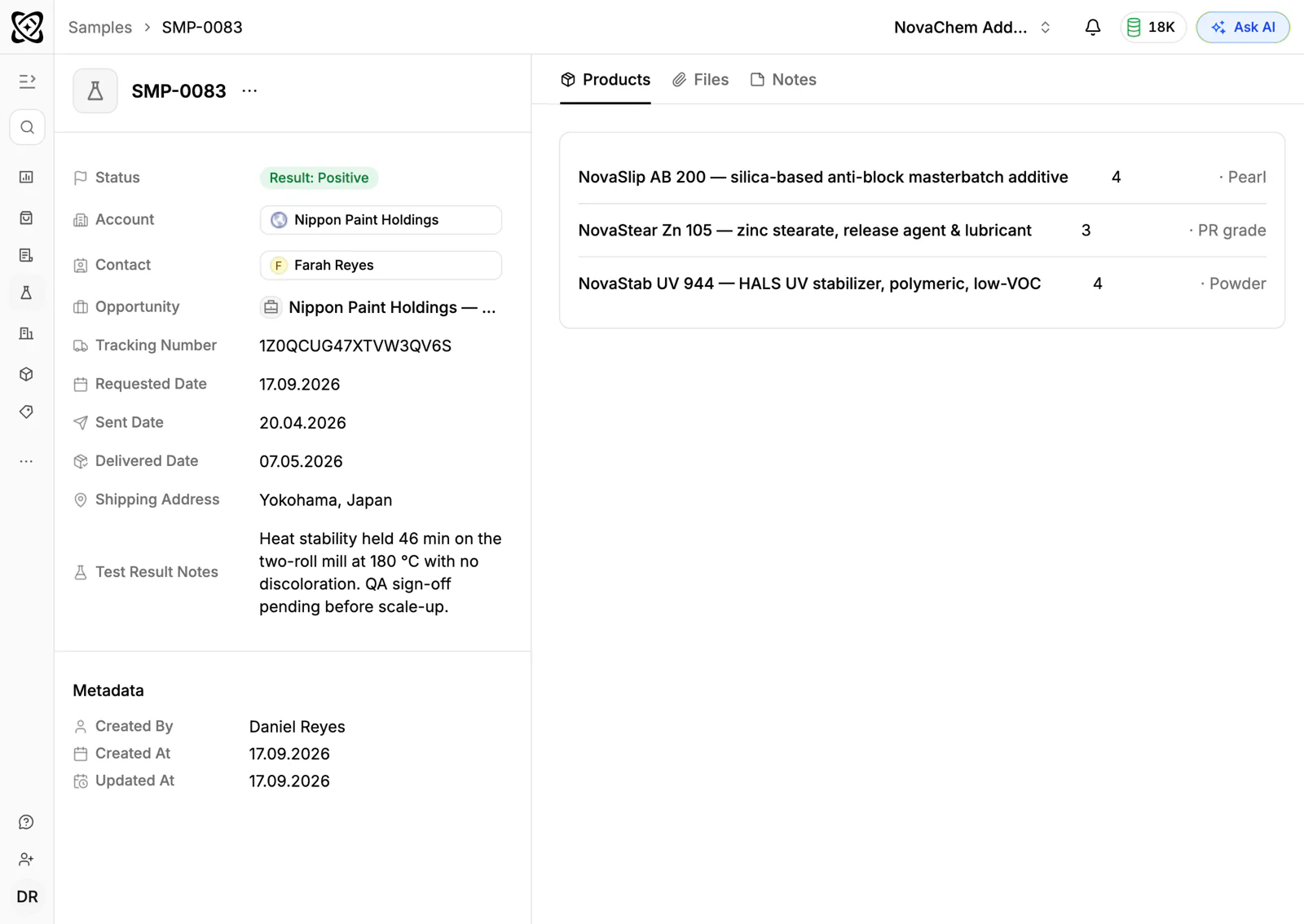
- First-off samples, each with a ship date, a status and the customer's measurement or test result.
- Price lists per account, because an OEM, a distributor and a repair shop pay different prices for the same part.
- Order history by part, so a rep sees what an account buys and what it stopped buying.
How do you set this up in PromptLab?
- 1
Add stages and a deal field for the route
Add the stages above and a deal field for custom or standard parts. Save a view for each, so the custom team and the distributor team each see their own deals.
- 2
Attach the RFQ and the drawing
Store the drawing and any customer specification as documents on the account, and note the revision. The next rep then sees what was quoted against.
- 3
Quote part and tooling as lines
Add your parts as products, and add the tooling as a product of its own, so it sits on the quote as a separate line. Build the quote from the customer's price list, apply line discounts for volume, and write price breaks, lead time and validity in the quote's Notes field. A quote has no expiry field.
- 4
Log first-off samples
Create a sample request for each batch of first-off parts, linked to the account and the deal. Record the status and the customer's feedback when it arrives. How to track product samples goes through the routine.
- 5
Create the sales order and watch the pattern
Create the sales order as its own record when the customer confirms. Later orders show what the account really buys, which is the basis for a reorder call.
- 6
Automate the nudges
Use workflow automation to create a task when a sample's status changes, so a rep chases the test result. Connect your mailbox, WhatsApp Business number and company Telegram bot in the shared Inbox, as purchasing and engineering often prefer chat.
How does PromptLab compare for rubber products manufacturers?
Swipe the table sideways to see every CRM →
| Checked on 30 September 2026 | PromptLab |  Zoho CRM |  Salesforce |  HubSpot |
|---|---|---|---|---|
| Pricing | ||||
| Paid plans, a month | $11.99 – $99per seat | $14 – $52per seat | $25 – $550per seat | $7 – $150per seat |
| Number of plans | 3 | 4 | 5 | 4 |
| Free trial | ||||
| Billing | Billed monthly | Billed annually | Billed annually | Billed annually, plus a $1,500–$3,500 onboarding fee |
| Import from CSV and Excel | ||||
| Sales management | ||||
| Deal pipelines | ||||
| Quotes | From$23/month | From$100/month | Add-on | |
| Sales orders | From$23/month | From$100/month | ||
| Sample tracking | ||||
| Price lists | From$23/month | From$100/month | ||
| Meetings and calls | ||||
| Meeting recording and transcripts | Via marketplace | Add-on | From$90/month | |
| AI meeting summaries | Add-on | |||
| AI follow-up email drafts | From$23/month | Add-on | From$90/month | |
| Meeting scheduler and call dialer | From$23.99/month | Via marketplace | Add-on | |
| AI and automation | ||||
| CRM fields filled in from calls | From$40/month | From$195/month | From$90/month | |
| Connect Claude or ChatGPT (MCP) | From$195/month | |||
| Workflow automation | ||||
| API and webhooks | From$23.99/month | From$195/month | ||
| Conversations | ||||
| Gmail and Outlook email sync | ||||
| WhatsApp conversations | Add-on | Add-on | ||
| Telegram conversations | ||||
| Save LinkedIn profiles | From$23/month | Via marketplace | From$150/month | |
| Privacy and security | ||||
| Single sign-on (SSO) | From$99/month | From$40/month | From$150/month |
Zoho CRM is the value pick among the big generalists: free for three users, paid plans from $14 a user a month, billed annually. Quotes, sales orders and price books start at $23. Samples aren't modelled at any tier.
Salesforce is the most configurable CRM there is, with five editions from $25 to $550 a user a month, billed annually. Quotes and price lists start at $100, and call recording is a $50 add-on. Samples aren't modelled, so tracking them means a custom object someone has to build. HubSpot has a Starter plan from $7 a seat a month, billed annually, but quoting sits in the separate Revenue Hub, and sales orders, samples and price lists aren't there. See the Salesforce and Zoho CRM comparisons.
Frequently asked questions
What should a CRM for a rubber products manufacturer include?
It should hold RFQs with drawings, quotes with tooling lines, first-off sample tracking, customer price lists and sales orders. PromptLab ships quotes, sales orders, price lists and sample tracking on every plan, from $11.99 per user per month.
Can I track first-off samples and approvals in a CRM?
Yes. Log each batch as a sample request with a date, a status and the customer's result, linked to the account and the deal. PromptLab's sample tracking is built for that loop.
How do I quote tooling and parts together?
Add the tooling to the quote as its own product line beside the part prices, and note who owns the tool and the lead time in the Notes field. Build the quote from the customer's price list so the part prices stay consistent.
How do I keep sight of a blanket order account?
Create each release as a sales order, so you can see the last order date and the pattern. A gap in releases is your prompt to call.
Is there a free trial?
Basic and Professional come with a 14-day free trial. There is no free plan.