



















How to measure sales rep performance
Measure sales rep performance with a few results, activity and quality measures, compared fairly. Learn which numbers matter and how to review them with a rep.
 By the PromptLab team29 October 20265 min read
To measure sales rep performance, track a small set of numbers in three groups: results (won revenue, win rate), activity (meetings, quotes sent, samples shipped, follow-ups done) and quality (how well calls and deals are run). Compare each rep to their own past and to a fair target, not just to each other, and talk through the numbers with them every month. Five or six measures you review are better than twenty you ignore.
This guide is for sales leaders at manufacturers and distributors who manage reps and want to know who needs help and who needs a bigger patch. It covers which measures to use, how to set them fairly and how to run the review. It's about measuring work, not about ranking people for the sake of it.
Why measure at all
Without numbers, a team judges reps by whoever is loudest or most recently seen. With numbers, you can see that a rep who looks busy sends few quotes, or that a quiet rep converts almost every sample into an order. Good measures also help the rep: they show where to spend the next hour.
Bad measures do damage. If you count only calls, reps make easy calls. If you count only revenue, they chase the same three customers and ignore new ones. Pick measures that together push in the right direction.
The three groups of measures
Results
These say what the rep produced.
- Won revenue in the period, against target.
- Win rate: deals won out of deals closed. See what is win rate.
- Average order value: won revenue divided by the number of won orders.
- Pipeline coverage: open pipeline compared with the target left to hit.
Activity
These say what the rep did, and they lead the results.
- Meetings held with buyers.
- Quotes sent.
- Samples shipped, and samples that were followed up.
- Tasks completed on time, and overdue follow-ups.
- New accounts and contacts added.
Quality
These say how well the work was done, and they are the hardest to see.
- How discovery calls and deal meetings go. A call scorecard turns this into something you can discuss.
- Whether a deal record is complete and up to date.
- Lost-deal reasons, and how well they're recorded. See how to analyse lost deals.
Step by step: build a fair scorecard
- 1
Choose five or six measures
Take two from results, two or three from activity and one from quality. Write down what each one means so nobody argues about the definition later.
- 2
Set targets that fit the territory
A rep with a mature region and a rep opening a new one shouldn't have the same revenue target. Adjust for the size of the territory, the stage of the accounts and how long the rep has been in the job.
- 3
Pull the numbers from the CRM, not from memory
If the numbers come from what reps remember, you measure memory. Use the records: deals, quotes, samples, meetings and tasks.
- 4
Compare against the rep's own past first
Look at each rep's trend over three months before comparing them to others. Improvement matters as much as rank.
- 5
Hold a monthly review of thirty minutes
Go through the numbers together, ask what's getting in the way, and agree one thing to change. Keep it as coaching, not a trial.
- 6
Revisit the measures twice a year
If a measure is being gamed, or no longer fits, replace it.
A made-up example
Say a rep has 20 closed deals in the quarter: 8 won and 12 lost. The win rate is 8 divided by 20, which is 40 percent. Their average order is $5,000, so won revenue is 8 times $5,000, or $40,000.
A second rep closed 10 deals and won 5, a 50 percent win rate, with an average order of $12,000, so $60,000 won. The second rep wins more of what they close and sells bigger orders, but has fewer deals. The first rep might need help moving up the order size. The second might need more pipeline. The same numbers give two different coaching conversations.
Fair measurement tips
- Don't compare unlike territories. Compare to the rep's target and trend.
- Count team effort. If another person did the technical work, don't leave them out.
- Avoid a single number. Rank on a mix, so reps can't win by gaming one.
- Share the numbers openly. Reps trust measures they can see and check.
- Link to coaching. Use the call recordings and scorecards to show how, not just how many. See how to coach sales reps with call scorecards.
Common mistakes
- Counting activity alone. Calls made don't equal deals won.
- Surprise reviews. Reps should know the measures in advance.
- Judging after a quarter in a new territory. Give new reps a fair ramp-up.
- Leaving out lost deals. A lost deal with a recorded reason teaches more than a win.
- Using numbers as a punishment. The review then becomes a defence, and the data gets worse.
How PromptLab helps
PromptLab has reports and dashboards on pipeline and revenue on every plan, with a report builder that can group deals, quotes, samples, meetings and tasks by owner, so you can review each rep. Deals, quotes, samples, meetings and tasks are all records in the CRM, so the activity measures come from real data. Lost deals need a loss reason (Price, Competitor, Timing, No budget, Product fit or Other), which makes the loss pattern easy to read.
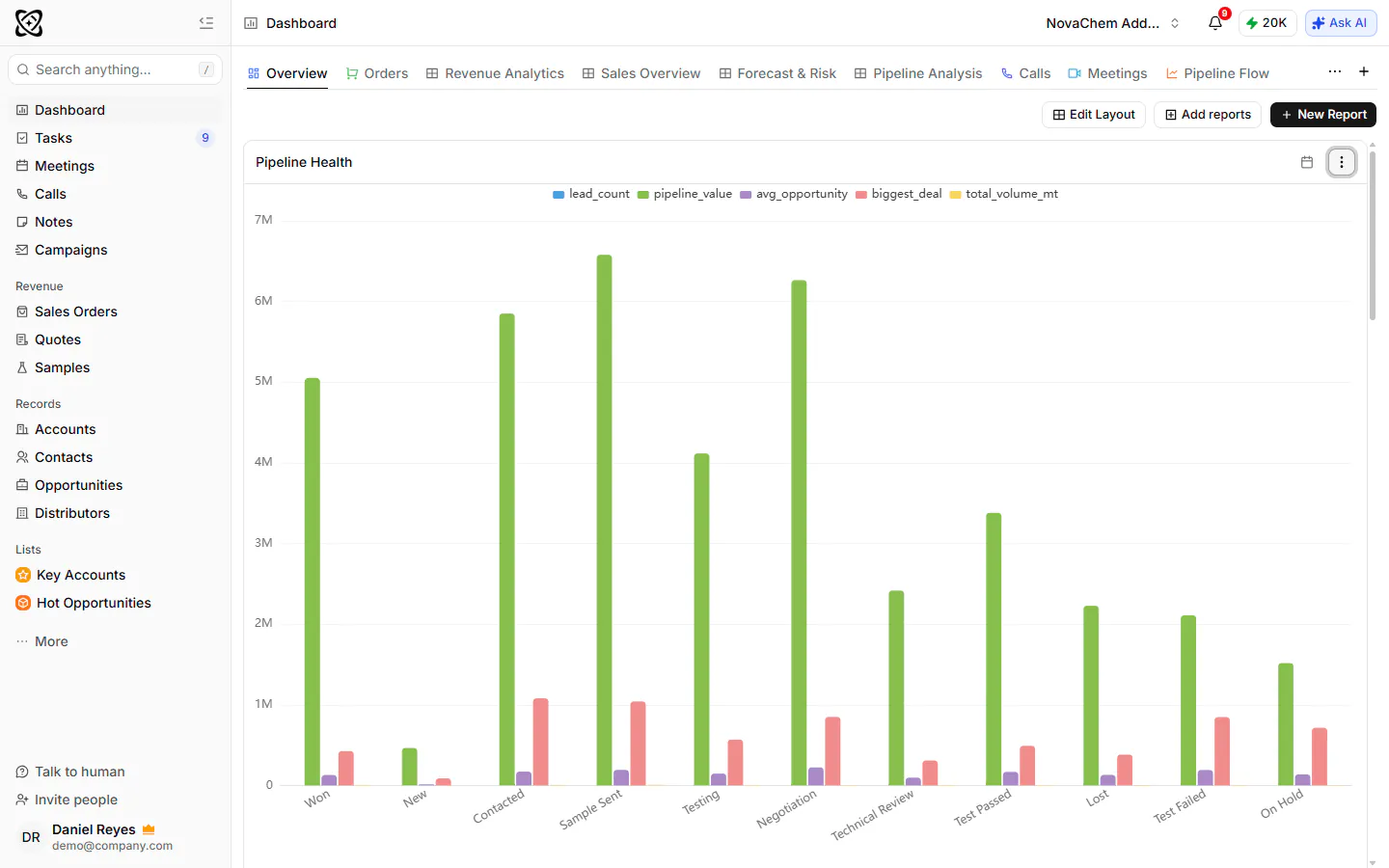
For quality, meeting recordings, transcripts and AI summaries give you the real call to coach from. On Professional, the rep call scorecard in Reports adds an AI call rating, skills and funnel against the team average.
Frequently asked questions
What are the best metrics for measuring sales rep performance?
Use a few from three groups: results such as won revenue and win rate, activity such as meetings, quotes and samples, and quality such as how calls are run. Five or six measures reviewed regularly beat a long list that nobody reads.
How do I measure reps fairly across different territories?
Compare each rep to their own target and trend, and adjust targets for the size and maturity of the territory and the time in the job. Ranking unlike territories against each other misleads.
How often should I review sales rep performance?
A short monthly review with each rep, plus a look at the team numbers in your weekly sales meeting. Revisit the measures themselves twice a year.
Should I measure activity or results?
Both. Results show what happened, and activity shows what is likely to happen next. Counting only one pushes reps the wrong way, so use a mix.
Can a CRM show me how well a rep runs calls?
In PromptLab, meeting recording, transcripts and AI summaries are on every plan, so you can listen to the real call. On Professional the call scorecard adds an AI call rating and skills for coaching.