











How to follow up after a trade show
A step-by-step plan for following up trade show leads when you sell physical products: sort, send, ship samples and book the next call within a week.
 By the PromptLab team6 October 20266 min read
The best trade show follow-up is fast, specific and sorted by buying intent. Within 48 hours, every lead gets a message that refers to what you actually talked about. Within a week, the serious ones have a sample on its way or a call in the diary.
Most teams do the opposite. They come home with a box of cards and a spreadsheet, send one identical email to everyone, and lose the thread by the second week. If you sell chemicals, coatings, plastics, ingredients or packaging, the lead is only warm until the buyer's next supplier visit. This guide shows how to turn a stand full of conversations into samples, quotes and orders.
Why trade show leads go cold
A show can give you 40 conversations in three days. By the time you are back at your desk, you remember six of them well. Notes are on the back of cards, in phone photos, or in a rep's head.
Product buyers also move on a schedule. A formulator who asked for a sample on Tuesday will test whatever arrives first. Speed matters more than polish.
Step 1: Capture the right detail at the stand
Follow-up quality is decided at the stand, not afterwards. Agree a short set of fields every rep records for every lead, even if it is only a line each:
- The product or grade they asked about
- Their application and rough annual volume
- What they want next: sample, quote, call or just the data sheet
- Who else is involved in the decision
Step 2: Get every lead into the CRM in one day
Do not let the list live in a spreadsheet for a week. Load it the evening of the last show day, or the morning after you return. PromptLab imports from CSV and Excel, or from a file you pick in Google Drive, so a badge-scanner export in either format goes straight in.
Put the show name and year in a source field on the deal, and add it as a custom field if you don't have one. That one entry lets you pull up every show lead later and see which reached a sample, a quote or an order. If the lead has a LinkedIn profile, the Chrome extension saves it to the CRM.
Step 3: Sort leads into three tiers
Not every lead deserves the same effort. Sort them by what they asked for, not by how friendly they were.
| Tier | What they asked for | Your response |
|---|---|---|
| A: Ready | A quote, a sample or a meeting | Personal reply within 24 hours, sample or quote started |
| B: Interested | Data sheets, "send me information" | Tailored email within 48 hours, call booked |
| C: Browsing | A card swap, a friendly chat | Short thank-you, added to the newsletter list |
Say you met 40 people: 8 might land in tier A, 16 in tier B and 16 in tier C. Tier A gets nearly all of your first week.
Step 4: Send follow-up that proves you listened
- 1
Reply within 48 hours
Send the message while the stand is still fresh. Mention the product, the application and one thing they said. A buyer who reads their own words back knows a person wrote it.
- 2
Attach one useful thing
One data sheet, one spec sheet or one safety data sheet for the grade they asked about. Not the whole catalogue.
- 3
Offer a single next step
"Shall I send a 1 kg sample of grade X this week?" beats three options. Make the next step easy to say yes to.
- 4
Log it on the lead
The email, the date and the promised next step go on the record, so anyone on the team can see what was said.
For ready-to-copy wording, use the trade show follow-up email templates. If the buyer prefers WhatsApp, you can continue there, and selling to B2B buyers on WhatsApp covers how.
Step 5: Turn sample requests into tracked samples
For product sellers, the sample is the real conversion event. Create a sample record the day the request comes in, with the product, quantity, shipping address and the contact. Then follow it through to the customer's test result. The full process is in how to track product samples.
Set a task for the day after the expected delivery: "Did the sample arrive? When will you test it?" Many deals are decided in that call.
Step 6: Book the call and move leads into a pipeline
Every tier A and B lead becomes a deal in a pipeline with a clear first stage. If you have not built your stages yet, start with how to build a B2B sales pipeline.
Give each lead a next action and a date. A lead with no dated task is a lead you will forget. Then review the show leads together, once a week, for four weeks.
Trade show follow-up, first week
How PromptLab helps
We built PromptLab for teams that sell physical products, so a show lead does not have to move between three tools. Import the list, record the show as the source, and work each lead as an account and a deal in your pipeline. Email capture from Gmail, Outlook or your own mail server logs the replies automatically.
When a buyer asks for a sample, you create the sample record and follow it from Requested through Sent and Delivered to Under Evaluation and the result. When they ask for a price, the quote attaches itself to the deal.
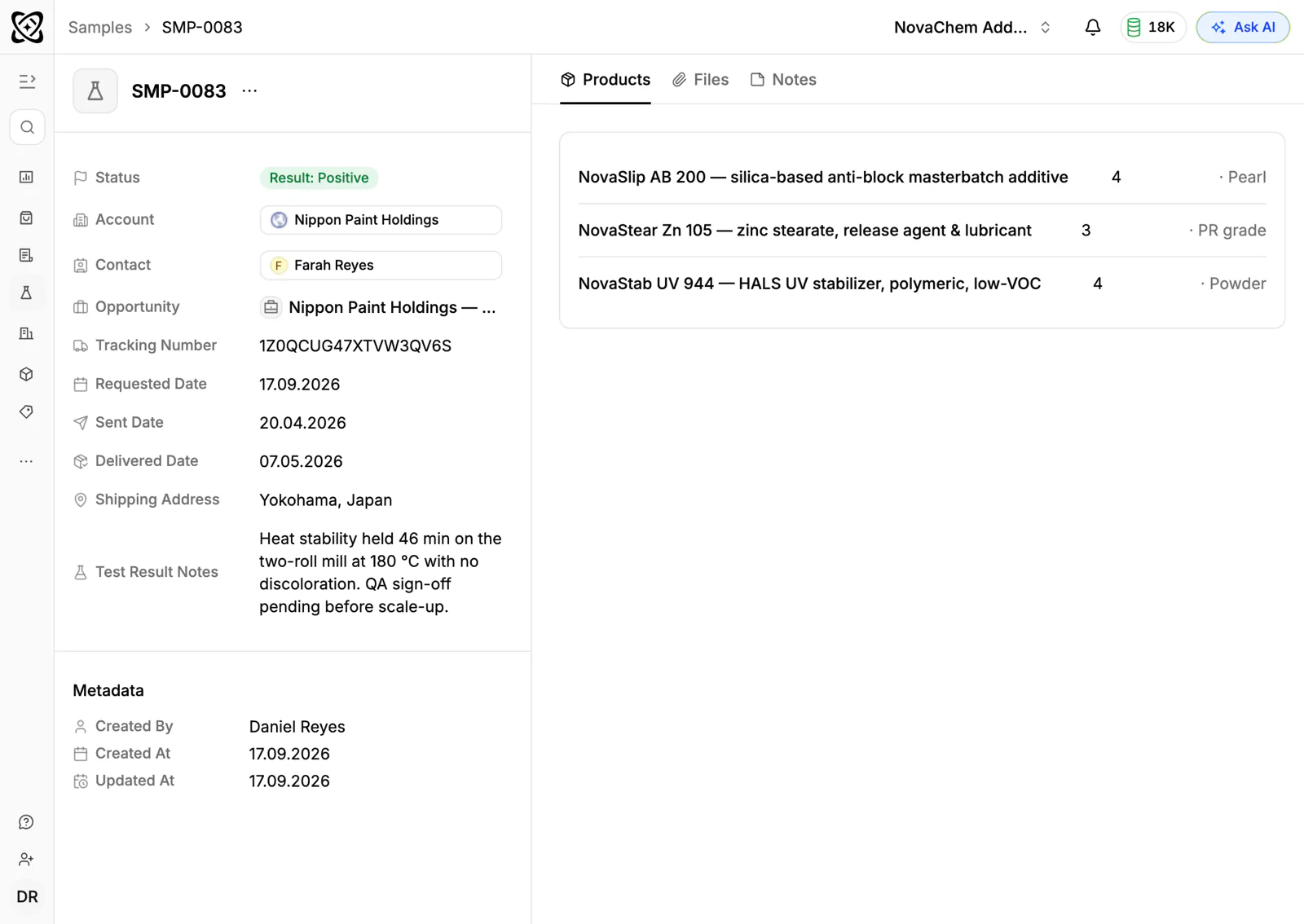
A workflow can create a task for you when a deal changes stage, so a tier A lead never waits on someone remembering. When the follow-up call happens on Google Meet, Zoom or Microsoft Teams, PromptLab records it and drafts the follow-up email from what was said. Our quotes and samples page shows the whole flow, and pricing lists every plan.
Frequently asked questions
How soon should you follow up after a trade show?
Within 48 hours for everyone, and within 24 hours for leads who asked for a quote or sample. Buyers compare suppliers while the show is fresh, and the first useful reply often sets the order of the shortlist.
What should a trade show follow-up email include?
A reference to your conversation, one relevant document, and a single next step such as a sample or a call. Keep it short. The aim is to get a reply, not to re-pitch the whole range.
How many times should you follow up with a trade show lead?
Plan on three or four touches over four weeks: the first reply, a sample or quote check-in, a call, and a final nudge. Stop when they say no or when the sample result is in. Each touch should add something new.
Should I call or email trade show leads?
Email first for tier B leads and anything involving documents. Call tier A leads who asked for a quote, once the email has gone, because you can settle specification questions in one conversation.
How do I track which leads came from the show?
Record the show name and year as the deal source at import. Later you can filter by that source and see which leads moved on to a sample, a quote or an order.