



















Meeting request email templates for B2B sales
Eight meeting request emails for B2B sellers: a first meeting, after a sample, after a trade show, a quarterly review, a plant visit and a quiet account.
 By the PromptLab team16 October 20265 min read
A good meeting request is short, gives a reason, and offers a clear next step. Buyers rarely refuse a meeting because they dislike meetings. They refuse because they cannot see what it is for or how long it will take.
These templates cover the meetings product sellers ask for most: a first call, a conversation after a sample, a catch-up after a trade show, a quarterly review, a plant visit and a quiet account. Each names a purpose and a length. For what to do once the meeting is booked, read how to prepare for a sales meeting.
New contacts
Subject: [15 minutes] on [Topic] for [Company]
Hi [First name],

I work with [Type of company] on [Specific problem, for example consistent supply of coating resins]. I noticed [Company] [Specific reason you are writing].

Could we speak for 15 minutes on [Day] or [Day]? I would like to learn how you buy [Product category] today and tell you where we might help. If it is not your area, I would be grateful for a pointer to the right person.

[Your name]
Use it for a first contact who has not heard from you. Our cold email templates cover the opening email before this one.
After a sample or a trade show
Subject: Reviewing the [Product] trial results
Hi [First name],

Now that you have had the [Product] sample for a few weeks, would you be open to a 20-minute call to go through the results? I would like to hear what worked, what did not, and what you would need to see before a larger order.

I am free on [Day] or [Day]. If your lab prefers to send the figures first, that works too.

[Your name]
Use it once the trial should be finished. See sample follow-up emails for the steps before it.
Subject: Following up from [Show name]
Hi [First name],

It was good to meet you at [Show name] and talk about [Topic]. You mentioned [Specific detail from the conversation].

I would like to follow that up properly. Could we have a 20-minute call on [Day] or [Day]? I will bring [Price list, samples or technical data] relevant to what you described.

[Your name]
Send it within a few days of the show, while the conversation is fresh. More in our trade show follow-up emails.
Existing customers
Subject: [Quarter] review: [Company] and [Your company]
Hi [First name],

It is time for our quarterly check-in. I would like to look at what you bought, how deliveries went, and what is coming up for you in the next quarter.

Could we book 30 minutes in the week of [Date]? I will send a one-page summary of your orders beforehand, and I would value your view on [Specific topic, for example lead times].

[Your name]
Use it with accounts that matter. A summary sent ahead makes the call useful rather than polite.
Subject: Visiting your site in [Month]
Hi [First name],

I will be in [Region] on [Dates] and would like to visit your plant, if that suits you. I would like to see how you use [Product] on the line and meet the people who handle it.

Would [Day] or [Day] work? I can bring [Samples, documents or a colleague from technical]. If a visit is not possible, a video call is fine.

[Your name]
Use it when you have a reason to be nearby, and say how long you need.
Subject: New [Product] range and your price list
Hi [First name],

We are adding [New product] to the range, and I think it suits your [Application]. We have also updated the price list for your account.

Could we spend 20 minutes going through both on [Day] or [Day]? I will send the details beforehand so you can read them first.

[Your name]
Use it when you have something specific and useful to show.
Quiet accounts
Subject: Checking in, [First name]
Hi [First name],

We have not spoken since [Month], and I would like to know how things are going on your side. Has anything changed in your volumes, your specification or your suppliers?

A 15-minute call would be enough. Would [Day] or [Day] suit you? If now is not a good time, tell me when to check back.

[Your name]
Use it when an account has gone quiet but is not lost. For accounts that stopped ordering, see our win-back email templates.
Subject: Moving our call on [Date]
Hi [First name],

I am sorry, but I need to move our call on [Date] because [Short reason]. Could we do [New day and time] or [Alternative] instead?

I will keep the agenda the same: [Topic]. Thank you for your flexibility.

[Your name]
Use it as early as you can. Offer two new times, not an open question.
How to personalise them
- Give a reason. "To review the trial" is a reason. "To touch base" is not.
- Say how long. Fifteen or twenty minutes is easier to accept than "a call".
- Offer two times. A choice of two is quicker to answer than an open diary.
- Mention the time zone. If the buyer is abroad, write times in their zone.
- Send what you promised. If you say you will send a summary, send it before the call.
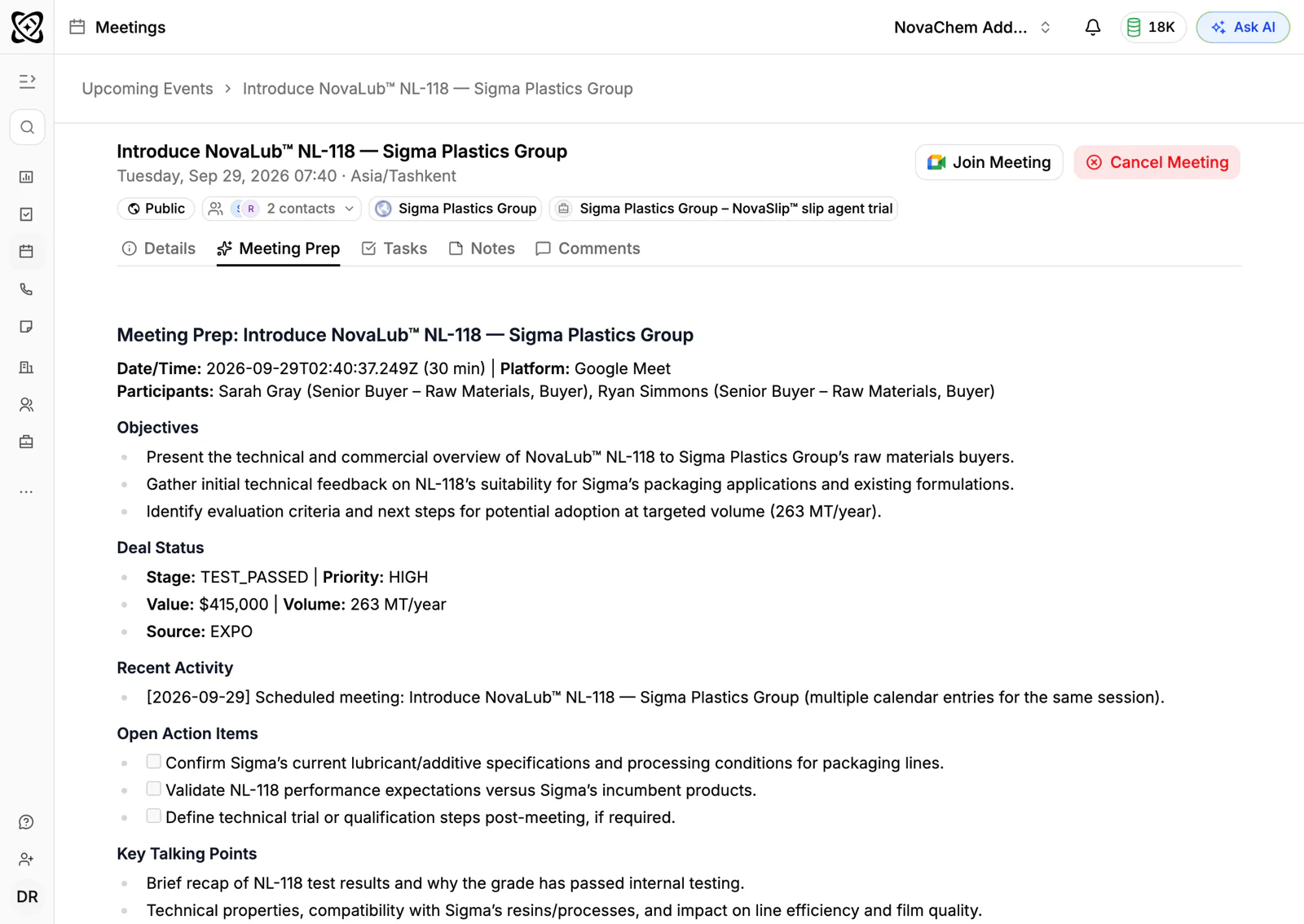
Send them from your CRM
Frequently asked questions
How long should a meeting request email be?
Four to six lines. State who you are, why you are writing, how long the meeting takes and two possible times. Anything longer reads like a pitch.
What subject line works for a meeting request?
One that names the purpose and the length, such as "15 minutes on packaging supply for [Company]". Avoid vague lines like "Quick chat".
Should I suggest times or ask for theirs?
Suggest two. It saves a round of emails and shows you respect their time. If you share a booking link, offer it as an alternative, not the only option.
What if the buyer does not answer the meeting request?
Send one short follow-up after three or four working days, then try another channel such as a phone call or WhatsApp if they have used it with you. Do not send the same email twice.
What should I send after the meeting?
A short summary of what was agreed, the next step and who owns it, within a day. Our follow-up email after a meeting templates cover this.