



















What is customer lifetime value?
Customer lifetime value (CLV) is the total a customer is worth to you over the years they buy. Here is the formula, a B2B example, and how to raise it.
 By the PromptLab team24 October 20263 min read
Definition
Customer lifetime value (CLV)
Customer lifetime value is the total revenue, or gross profit, a customer brings you over the whole time they keep buying from you. It shows what a customer is worth, not just what one order is worth.
A buyer who places one order of $8,000 looks small. A buyer who places six orders of $8,000 a year for five years is worth thirty times that in sales. CLV puts a number on the second kind of customer.
Why customer lifetime value matters
CLV tells you how much it makes sense to spend to win and keep a customer. If a customer will bring $72,000 in gross profit, a few sample shipments and a quick quote turnaround are easy to justify.
It also shows the true cost of losing an account. A customer who leaves takes all their future orders with them, not only the next one. See customer churn.
How to calculate customer lifetime value
The simple version for a business with repeat orders:
- Revenue per year = average order value × orders per year.
- Lifetime revenue = revenue per year × years as a customer.
- CLV (lifetime gross profit) = lifetime revenue × gross margin.
This version does not discount future years and does not subtract the cost of serving the account, so treat it as a clear first estimate. You can run your own numbers in the customer lifetime value calculator.
Revenue or profit?
Some teams quote CLV as lifetime revenue. Profit is the better choice, because it counts only what you keep. Use the gross margin on the products that customer actually buys, not the company average.
An example from product sales
A packaging manufacturer's typical customer places orders worth $8,000, six times a year. Gross margin is 30% and customers stay about five years.
- Revenue per year: $8,000 × 6 = $48,000.
- Lifetime revenue: $48,000 × 5 = $240,000.
- Lifetime gross profit (CLV): $240,000 × 0.30 = $72,000.
Now see which lever matters. A seventh order each year lifts CLV to $84,000. A sixth year as a customer lifts it to $86,400. Both are small changes to a relationship, and both add real profit.
How to raise customer lifetime value
- More reorders: follow up before a customer runs out, not after.
- Longer relationships: talk to accounts that have gone quiet.
- Better margin: use customer price lists and watch discounts.
- Bigger orders: raise average order value with larger packs and related products.
Related terms
- Average order value: one of the CLV inputs.
- Gross margin: turns revenue into profit.
- Customer churn: the rate at which customers leave.
- Key account management: how teams look after high-value customers.
How PromptLab handles it
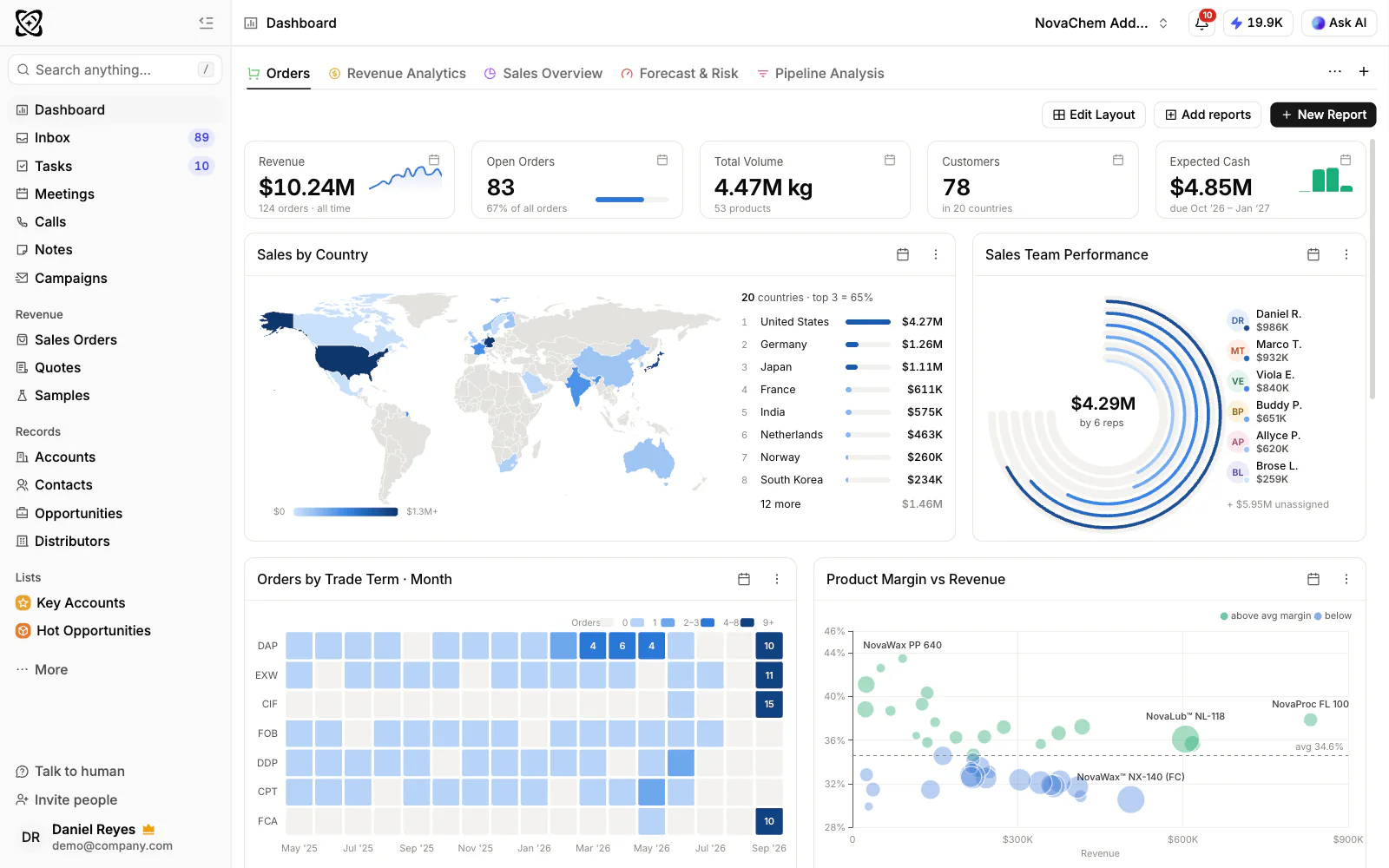
PromptLab holds the inputs for CLV: sales orders for order value and frequency, quotes with the margin on each line, and the email, WhatsApp, Telegram and meeting history on each account. Use the report builder and Ask AI to pull the figures, then run them through the calculator.
Frequently asked questions
How do you calculate customer lifetime value?
Multiply average order value by orders per year to get yearly revenue. Multiply by the years the customer stays, then by gross margin to get lifetime gross profit. With $8,000 orders, six a year, five years and 30% margin, that is $72,000.
Is CLV based on revenue or profit?
Both are used. Profit is more useful because it shows what you keep after the cost of the goods. The calculator on this site shows lifetime revenue and lifetime gross profit.
How do I estimate how long a customer stays?
Look at your own accounts. See how long customers who started a few years ago kept ordering, and use a cautious average. If you are unsure, test two or three values.
Should I calculate CLV for every customer?
Start with segments, such as by industry or order size, and compare each segment's CLV with what it costs to win it.
What is the difference between CLV and average order value?
Average order value is one order. CLV is every order from that customer over the whole relationship, usually turned into profit.