



















What is gross margin?
Gross margin is the share of sales revenue left after the direct cost of the goods sold. Here is the formula, a worked example, and how it differs from markup.
 By the PromptLab team24 October 20263 min read
Definition
Gross margin
Gross margin is the share of revenue you keep after paying the direct cost of the goods you sold. The formula is (revenue − cost of goods sold) ÷ revenue, shown as a percentage.
If you sell a drum of resin for $100 and it cost you $70, your gross margin is 30%. It is one of the first numbers sales and finance teams check when they look at whether a price is healthy.
Why gross margin matters
Revenue says how much you sold. Gross margin says how much of it is left to pay for salaries, rent, marketing and profit. Two products with the same sales can leave very different amounts behind.
For a team that sells products, margin also guides pricing. It tells a rep how far a discount can go before an order stops being worth taking.
How gross margin works
Gross margin uses two figures:
- Revenue: what the customer pays for the goods.
- Cost of goods sold (COGS): the direct cost of those goods. For a distributor this is the purchase price plus inbound freight and duty. For a manufacturer it is usually materials, direct labour, packaging and the production overheads that go into the goods.
Gross profit = revenue − COGS. Gross margin = gross profit ÷ revenue.
Gross margin does not subtract operating costs such as sales salaries or office rent. Net margin does, along with interest and tax. If you are unsure which one someone means, ask.
Gross margin versus markup
Both describe the same profit, measured against a different base. Margin divides by the selling price. Markup divides by the cost.
So the same sale gives a bigger markup than margin. A 50% margin is a 100% markup. The price for a target margin is cost ÷ (1 − margin), so a $10 cost and a 30% margin gives about $14.29. Adding 30% to cost gives $13.00, which is only a 23.1% margin.
An example from product sales
A distributor buys a resin at $4.20 a kilo and sells it at $5.60.
- Gross profit per kilo: $5.60 − $4.20 = $1.40.
- Gross margin: $1.40 ÷ $5.60 = 25%.
- Markup: $1.40 ÷ $4.20 = 33.3%.
- On a 10,000 kg order: 10,000 × $1.40 = $14,000 gross profit.
Now a buyer asks for a 5% discount, so the price drops to $5.32. The profit per kilo falls to $1.12 and the margin to about 21.1%. A 5% price cut took a fifth of the gross profit: $0.28 of the $1.40. Use the margin and markup calculator to test your own numbers.
Related terms
- Margin and markup calculator: turn cost and price into margin and markup.
- Customer price list: where agreed prices, and so margins, are set per account.
- Sales quote: where the margin on each line should be checked before it is sent.
- Customer lifetime value: uses gross margin to show what a customer is worth in profit.
How PromptLab handles it
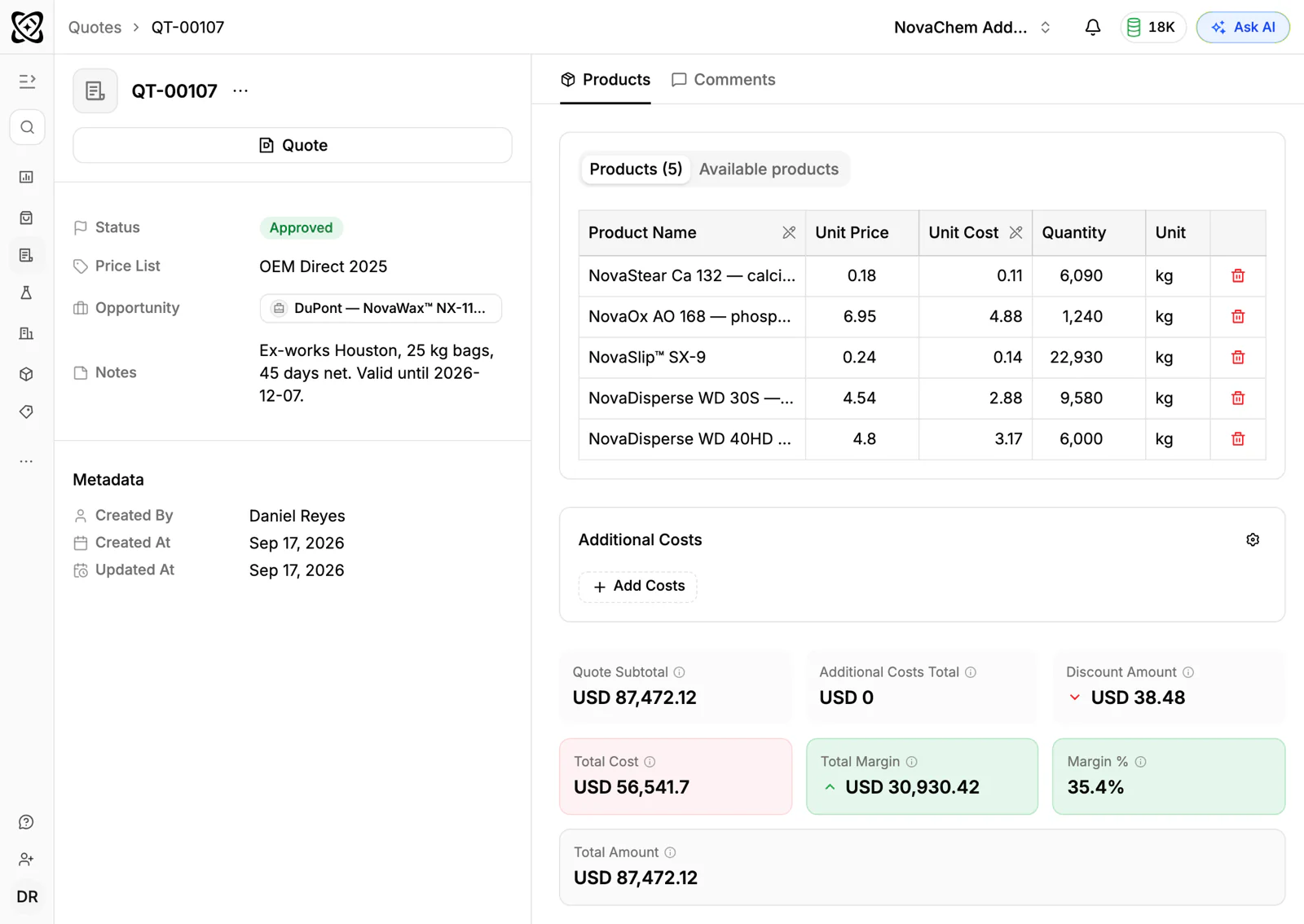
PromptLab shows the margin on each line of a quote, so a rep sees it before the quote goes out. Quotes are built from products and customer price lists, with line discounts. The margin is worked out from the cost price on each product, so keep those costs in line with the figures your finance team uses.
Frequently asked questions
How do you calculate gross margin?
Subtract the cost of goods sold from revenue, then divide by revenue. If you sell for $200 and the goods cost $140, the gross profit is $60 and the gross margin is 30%.
What is the difference between gross margin and markup?
Gross margin is profit as a share of the selling price. Markup is profit as a share of cost. For the same sale, markup is the larger percentage.
Is gross margin the same as net margin?
No. Gross margin only subtracts the cost of the goods sold. Net margin also subtracts operating costs such as salaries and rent, plus interest and tax.
What counts as cost of goods sold?
The direct cost of the goods you sold. For a distributor that is usually the purchase price plus freight and duty paid on the way in. Your finance team sets the exact definition.
What is a good gross margin?
It depends on the product. Commodity items usually carry thinner margins than technical or custom products. Set a floor margin for each product line and watch for quotes that fall below it.