









What is a CRM?
A CRM is software that keeps every customer, deal and conversation in one place. Here is what it does and what a B2B product seller should expect from one.
 By the PromptLab team6 October 20263 min read
Definition
CRM
A CRM (customer relationship management system) is software that stores every account, contact, deal and conversation in one shared place, so a sales team always knows who it is selling to and what has already been said.
If your team runs on spreadsheets, inboxes and memory, you already have a CRM. It is just a bad one. A real CRM replaces that pile with one record per customer that everyone can see and update.
Why a CRM matters
Deals in product sales last weeks or months. A buyer asks for a sample, then a quote, then a revised quote, then goes quiet. Without one shared record, the next rep who picks up the thread starts from zero.
A CRM fixes three things. Nothing falls through the gaps between reps. A manager can see what is really in the pipeline. And a rep walking into a call can read the history in a minute instead of digging through email.
What a CRM stores
Most CRMs organise data the same way:
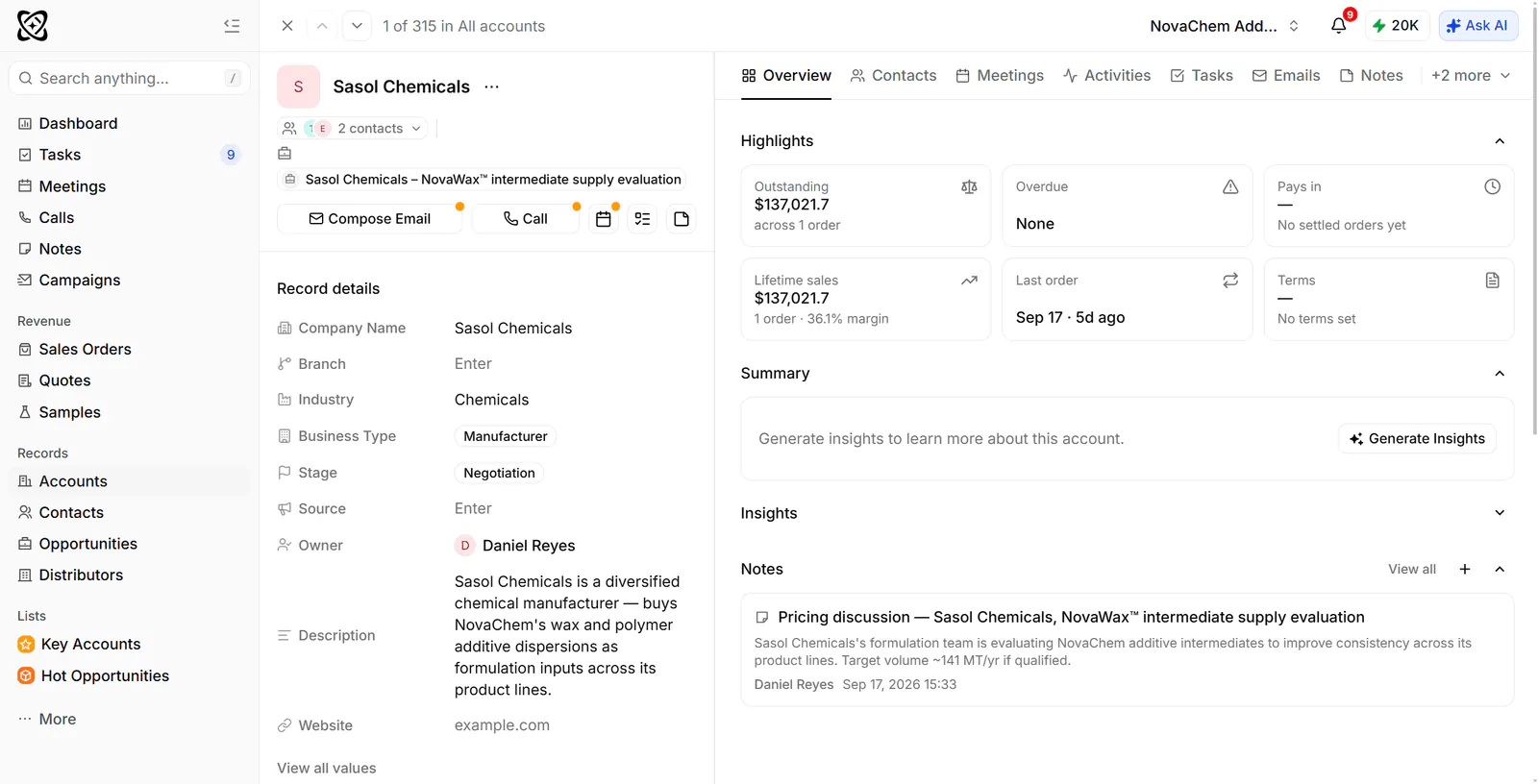
- Accounts: the companies you sell to, such as a paint maker or a plastics converter.
- Contacts: the people at those companies, such as the buyer and the lab manager.
- Deals: each possible sale, moving through stages in a sales pipeline.
- Activities: emails, calls, meetings, messages and tasks, attached to the account.
- Documents: spec sheets, quotes and contracts.
How a CRM works day to day
A rep opens an account, sees every deal and message on one screen, and adds a task for tomorrow. A manager opens the pipeline and sees which deals sit in which stage. The owner opens a report and sees revenue.
The hard part has always been getting data in. Reps dislike typing, and older CRMs often stay half-empty because of it. Newer ones capture email and meetings automatically, which is why people now talk about an AI-native CRM.
An example from product sales
Say you sell a solvent-free coating to industrial contractors. A contractor emails asking for a sample. In a CRM, that email lands on the account. The rep creates a deal, logs the sample, and later sends a quote. When the buyer replies on WhatsApp three weeks later, the whole story is one click away.
For many product teams, a general CRM stops there. They also need quotes, customer price lists and sales orders, and those are often missing or kept for higher plans.
Related terms
- Sales pipeline: the stages a deal moves through.
- AI-native CRM: a CRM built around AI from the start.
- Quote-to-order: the step from an accepted quote to an order.
- Lead scoring: ranking leads by how likely they are to buy.
How PromptLab handles it
We built PromptLab as a CRM for B2B teams that sell physical products. Accounts, contacts, deal pipelines, tasks and documents come standard. So do quotes, sales orders, sample tracking and customer price lists, on every plan.
Frequently asked questions
What does CRM stand for?
Customer relationship management. It names both the practice of managing customer relationships and the software that supports it.
Is a spreadsheet a CRM?
It can work for a handful of customers. It breaks once several people share it, because it cannot capture email, send reminders or show a pipeline. Our guide to moving from spreadsheets to a CRM covers the switch.
Who uses a CRM?
Sales teams most of all, but also account managers, customer service and owners who want to see revenue. Anyone who talks to customers benefits from the shared history.
Does a small business need a CRM?
If more than one person talks to customers, or deals take longer than a few days, yes. A small team gets the most from a simple CRM that captures email and meetings without extra typing.
How much does a CRM cost?
It varies by vendor and plan. PromptLab starts at $11.99 per user per month for Basic. There is no free plan, but Basic and Professional come with a 14-day free trial.