



















What is EXW (Ex Works)?
EXW (Ex Works) means the seller makes goods available at its own premises and the buyer pays for and carries the risk of everything after. How it works.
 By the PromptLab team31 October 20264 min read
Definition
EXW (Ex Works)
EXW is an Incoterms 2020 rule under which the seller delivers by making the goods available at a named place, usually its own factory or warehouse. The buyer arranges and pays for collection, export clearance, carriage and everything after, and carries the risk of loss from that point.
EXW asks the least of the seller of all 11 rules. The seller packs the goods and has them ready. The buyer, or the buyer's forwarder, comes to collect. If you want the full list of rules first, read what are Incoterms.
This is a general explanation, not legal or customs advice. Check the ICC's own text for your shipment.
Why EXW matters
For a seller, EXW is the simplest quote to give: you price the goods and your packing. It suits a buyer who already has a forwarder.
It also moves a lot of risk to the buyer. The buyer pays for freight, handles export paperwork and bears any loss in transit. Buyers who are new to importing sometimes ask for a different rule for that reason.
What the seller does under EXW
- Makes the goods available at the named place, such as "EXW Seller's warehouse, Rotterdam".
- Packs the goods in a way that suits the transport, and marks them.
- Tells the buyer when the goods will be ready, and gives it the information it needs to collect them, such as the weights and the pallet sizes.
- Supplies the commercial invoice and any other evidence of conformity the contract requires.
The seller is not required to load the goods on the buyer's vehicle. If the seller does load, it does so at the buyer's risk and expense unless the contract says otherwise. Where the seller is better placed to load, FCA is usually the better rule, because under FCA loading at the seller's premises is the seller's job.
What the buyer does under EXW
- Collects the goods and loads them.
- Clears the goods for export and pays any export duties.
- Pays the main carriage and arranges any insurance. Neither side has to insure under this rule.
- Clears the goods for import, pays import duties and taxes, and carries the cost and risk of everything after collection.
Because the buyer clears export, EXW can be awkward when the buyer is abroad and has no way to do that. FCA is usually the better rule in that case, because under FCA the seller clears the goods for export.
Where risk passes
Risk passes when the goods are placed at the buyer's disposal at the named place, not loaded. If a pallet is dropped while the buyer's driver loads the truck, that loss belongs to the buyer.
An example from product sales
Say a packaging maker sells 10 pallets of cartons to a buyer in another country for $12,000 EXW the maker's warehouse. The buyer's forwarder collects on an agreed day. The buyer pays for the truck, the export paperwork, the sea freight and the import duties.
Now the buyer asks for FOB at the port instead. The maker must also pay for haulage to the port, loading and export clearance. Say that costs $650. The FOB price is $12,650. Same goods, different job for the seller, so a different price. See FOB for that rule.
Common mistakes with EXW
- Leaving the place off. "EXW" alone is not enough. Name the place, such as the factory gate or a specific warehouse.
- Assuming the seller loads. Loading is not a seller duty under EXW unless the contract adds it.
- Forgetting export clearance. The buyer handles it, so check the buyer can.
How EXW changes the price you quote
An EXW price covers the goods, packing and your margin. Anything the seller adds later, such as loading or a trip to the port, moves you towards FCA or FOB and needs a higher price. If your quotes also need a delivered price, work out the landed cost the buyer will really pay, so your EXW offer is fairly compared with a delivered one.
Related terms
- Incoterms: the 11 rules EXW belongs to.
- FOB: the seller also clears export and loads the vessel.
- DDP: the other end of the scale, where the seller delivers cleared for import.
- Landed cost: what the buyer pays once every cost after collection is added.
How PromptLab handles it
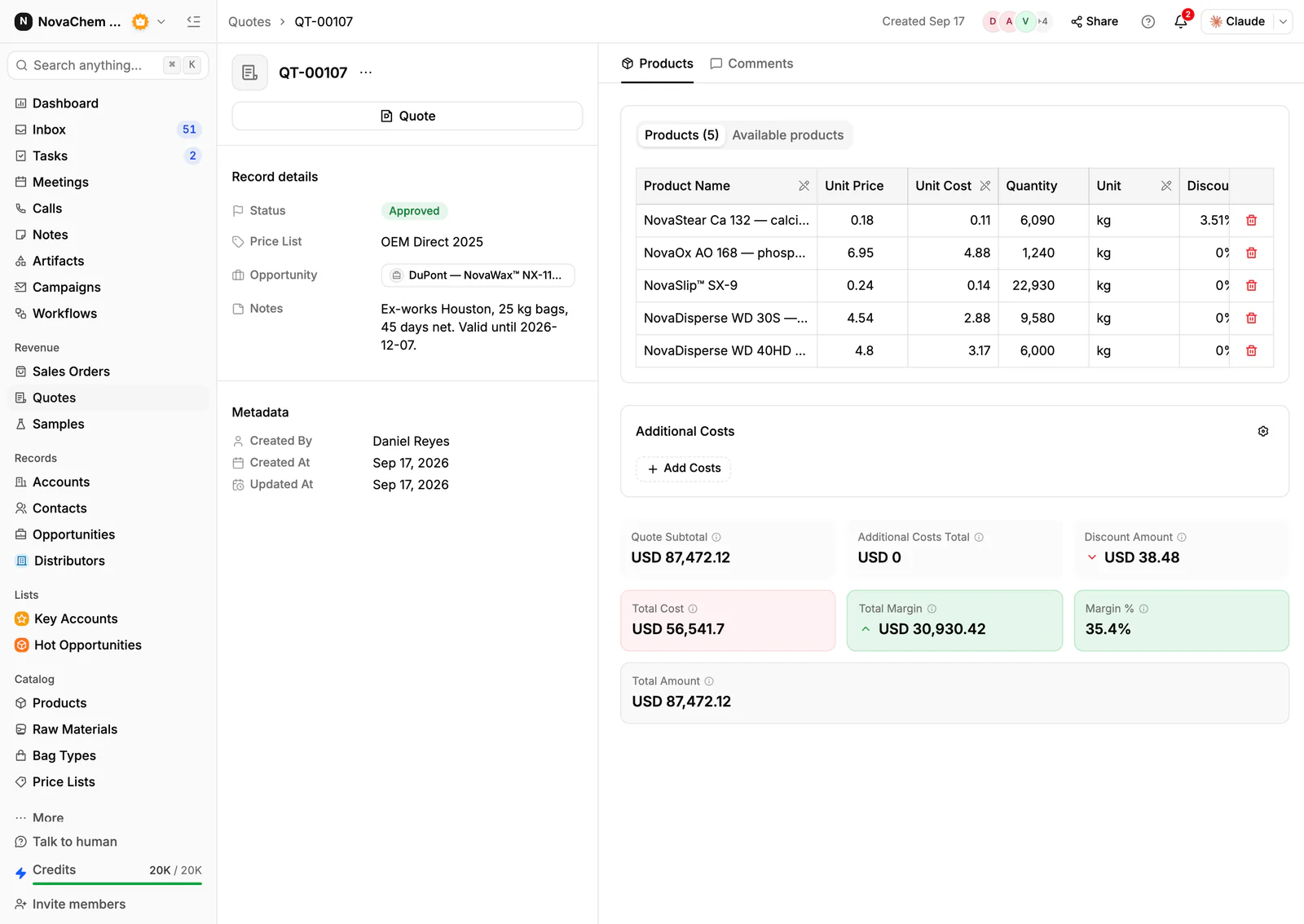
Record the agreed rule on the sales order: its trade terms field lists the 11 Incoterms 2020 rules, and an account can keep its usual terms, which fill in when you pick that account on a new order. Write the named place in the order's notes and the quote's notes, and keep the quote, the order and the email thread on the same account.
Frequently asked questions
What does EXW mean?
EXW means Ex Works. The seller makes the goods available at its own premises or another named place, and the buyer takes over cost and risk from there.
Who pays for export clearance under EXW?
The buyer. The seller may help if asked, but at the buyer's risk and expense. If the buyer cannot clear export, FCA is often the better choice.
Does the seller load the truck under EXW?
Not unless the contract says so. The default under EXW is that the buyer loads, and the risk of loading is the buyer's.
Is EXW cheaper for the buyer?
The seller's price is lower, since it covers less. The buyer then pays for carriage, clearance and everything else, so the total can be higher or lower than a delivered price.
Can EXW be used for any kind of transport?
Yes. EXW is one of the rules for any mode of transport, including road, rail, air and sea.