



















CRM for composites manufacturers
How composites sales works, from data sheets and qualification trials to programmes and repeat orders, and a CRM setup that tracks samples and quotes.
 By the PromptLab team29 October 20265 min read
A composites manufacturer needs a CRM that keeps materials, trials and approvals on the account. Customers rarely buy a fibre or a resin on the strength of a price list. They buy once the material has passed their own tests and fits their process.
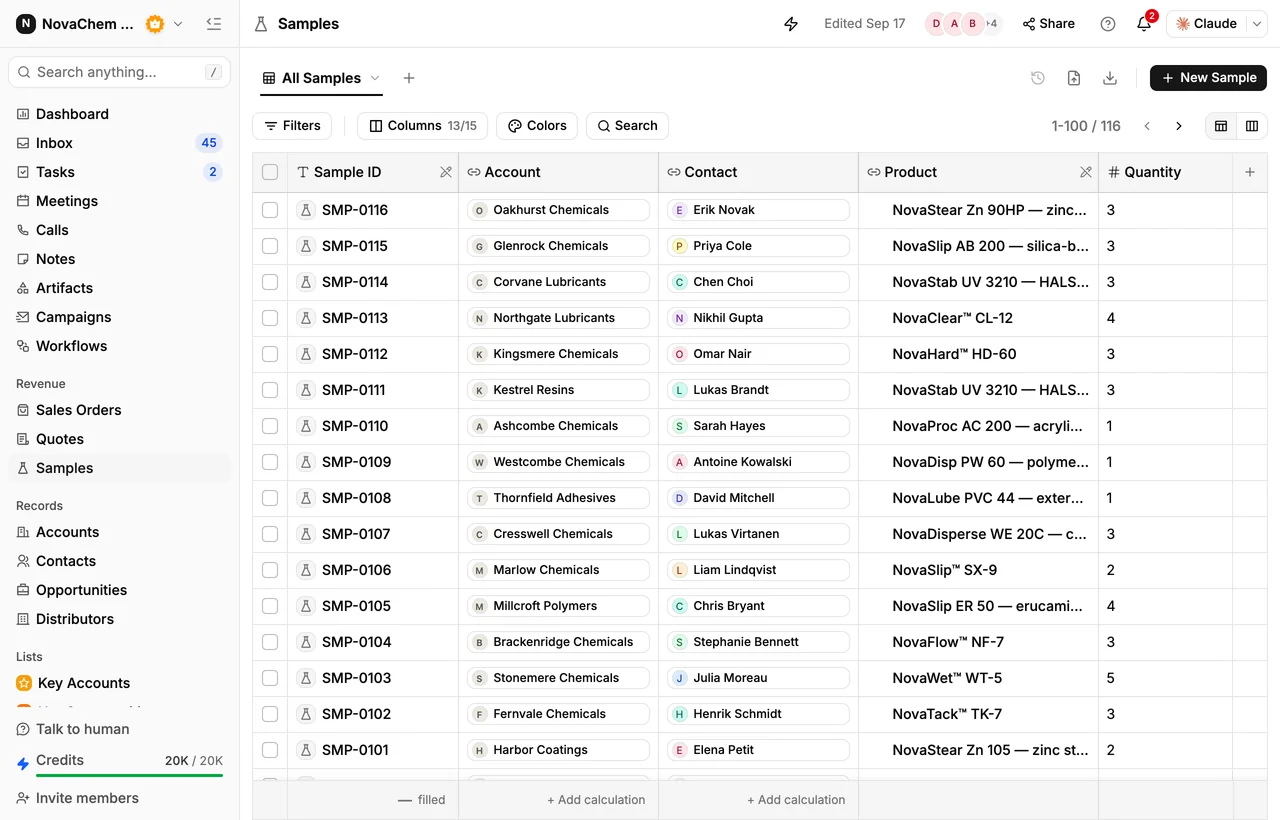
In PromptLab, trial material goes in as sample records with feedback, each customer's agreed prices sit in a customer price list, and programmes are deals in one pipeline. Quotes, sales orders and conversations sit on the account. The wider factory view is on the manufacturers page.
How does a composites sale actually work?
Composites are made from a reinforcement, such as glass, carbon or aramid fibre, and a matrix, usually a thermoset resin or a thermoplastic. A supplier may sell raw fibre, fabrics, resins, prepregs, core materials or finished parts. Customers sit in marine, wind, transport, construction, sporting goods and other fields, each with its own requirements.
The buyer is typically an engineer or a materials specialist, with procurement behind them. They ask about mechanical properties, cure cycle, handling and compatibility with the process they already run. A change of material can mean new tests, new tooling settings and sometimes a formal qualification.
So the first meeting is technical. A rep, often with an application engineer, listens to the part and the process, and proposes a material. The customer then wants data and a trial.
What are data sheets, trials and qualification?
A technical data sheet (TDS) lists what a material is and how it behaves. A safety data sheet (SDS) covers handling and storage. Buyers ask for both early. See what is a technical data sheet and what is a safety data sheet.
A trial is a small amount of material the customer tests on their own process. Some materials, such as prepregs, are stored cold and have a limited working life out of storage, so a trial roll has to be shipped and used with that in mind. Check the handling rules with your own technical team.
Then comes qualification. Many customers have a specification or an approved-materials list, and getting on it can take several rounds of testing. Once you are approved, the customer often buys for the life of the programme, and a competitor has to repeat the same work to displace you.
Why do programmes and repeat orders matter?
A composites account is often won on a programme: a boat model, a blade design, a vehicle platform. The first order is small, a trial batch or a pre-series, and volumes rise if the programme goes ahead. Say a customer starts with a few rolls for a prototype, then orders monthly once the part is in production. The CRM should show the account's order history by material, so a rep sees when volume starts to climb, and when it stops.
It also matters who else is involved. The engineer who specified the material, the buyer who orders it and the quality manager who signs off the batch are three people with three concerns. All three belong on the account.
What pipeline stages fit a composites manufacturer?
PromptLab has one deal pipeline with stages you name. Mark each deal's market or route with a field, such as marine, wind or distributor, and save a view for each.
| Stage | Entry condition |
|---|---|
| Enquiry | A customer has described a part, a process or a problem |
| Data sheets sent | TDS and SDS are logged as sent, with the version |
| Trial material out | A sample is logged with a date and a test plan |
| Trial result | The customer's feedback is recorded on the sample |
| Qualified | The material is on their specification or approved list |
| Pre-series order | A sales order exists for the first batch |
| Series supply | Orders arrive on a schedule |
What must the CRM track?
- Samples and trials, each with the material, the lot or roll, the process, the test and the result.
- Documents sent, kept in the Files tab of the account, so the next rep knows which data sheet the engineer has.
- Qualification status, held in custom fields: specification, approval date and approving contact.
- Price lists per account. A boat builder, a distributor and a tier-one supplier pay different prices for the same fabric or resin.
- Order history by material, to show when a trial turns into volume.
- Contacts by role, such as engineer, buyer and quality.
How do you set this up in PromptLab?
- 1
Set up stages and a market field
Add the stages above and a deal field for the market. Save a view for each.
- 2
Log every trial as a sample
Record each trial with the material, the contact and the test plan. Put the engineer's result in the sample's feedback. How to track product samples covers the routine.
- 3
Attach data sheets and approvals
Keep the master documents in your quality system and attach the version you sent in the Files tab on the account.
- 4
Add qualification fields
Add custom fields for specification, approval date and approving contact, so a saved view shows which accounts you must protect.
- 5
Build price lists and quote from them
Create a customer price list for each key account, by material and pack size. Quotes use them. See how to manage customer price lists.
- 6
Automate the follow-up
Create a workflow that fires when a sample changes status and creates a task for the owner to ask for results. Add one that posts to Slack when a deal reaches Qualified.
How does PromptLab compare for composites sales?
| Checked on 30 September 2026 | PromptLab |  Salesforce |  Zoho CRM |
|---|---|---|---|
| Pricing | |||
| Paid plans, a month | $11.99 – $99per seat | $25 – $550per seat | $14 – $52per seat |
| Number of plans | 3 | 5 | 4 |
| Free trial | |||
| Billing | Billed monthly | Billed annually | Billed annually |
| Import from CSV and Excel | |||
| Sales management | |||
| Deal pipelines | |||
| Quotes | From$100/month | From$23/month | |
| Sales orders | From$100/month | From$23/month | |
| Sample tracking | |||
| Price lists | From$100/month | From$23/month | |
| Meetings and calls | |||
| Meeting recording and transcripts | Add-on | Via marketplace | |
| AI meeting summaries | Add-on | ||
| AI follow-up email drafts | Add-on | From$23/month | |
| Meeting scheduler and call dialer | From$23.99/month | Add-on | Via marketplace |
| AI and automation | |||
| CRM fields filled in from calls | From$195/month | From$40/month | |
| Connect Claude or ChatGPT (MCP) | From$195/month | ||
| Workflow automation | |||
| API and webhooks | From$23.99/month | From$195/month | |
| Conversations | |||
| Gmail and Outlook email sync | |||
| WhatsApp conversations | Add-on | ||
| Telegram conversations | |||
| Save LinkedIn profiles | Via marketplace | From$23/month | |
| Privacy and security | |||
| Single sign-on (SSO) | From$99/month | From$40/month |
Salesforce Sales Cloud is the most configurable CRM there is, with five editions from $25 to $550 a user a month, billed annually. For a team selling products, quotes and price lists start at $100, call recording is a $50 add-on, and building it to fit usually takes an admin or partner. Zoho CRM has quotes, sales orders and price books from $23 a user a month, billed annually. Sample tracking is not built in at any tier, so trial material would go untracked.
See the Salesforce and Zoho CRM comparisons.
Frequently asked questions
What should a CRM for a composites manufacturer include?
It should hold samples or trials, quotes, customer price lists and sales orders, with custom fields for qualification. PromptLab has these on every plan from $11.99 per user per month.
Can I track material trials in a CRM?
Yes. Treat each trial as a sample with a material, a date and the customer's result. PromptLab's sample tracking keeps each round on the account.
How do I record which customers have approved my material?
Add custom fields on the account for specification, approval date and approving contact, then save a view of approved accounts.
Where should I keep data sheets?
Keep the master copies in your quality system, and attach the version you sent in the Files tab of the account.
Is there a free trial?
Basic and Professional come with a 14-day free trial, with no card needed. There is no free plan.