



















CRM for flavours and fragrances suppliers
How flavour and fragrance sales works, from briefs and sample rounds to documents and reorders, and how to set up a CRM that tracks every submission.
 By the PromptLab team16 October 20266 min read
A flavour or fragrance supplier needs a CRM that keeps briefs, sample rounds and customer feedback on the account, not in a perfumer's inbox. The sale rarely turns on price per kilo. It turns on whether your submission hits the brief, survives the customer's base and gets signed off by the right people.
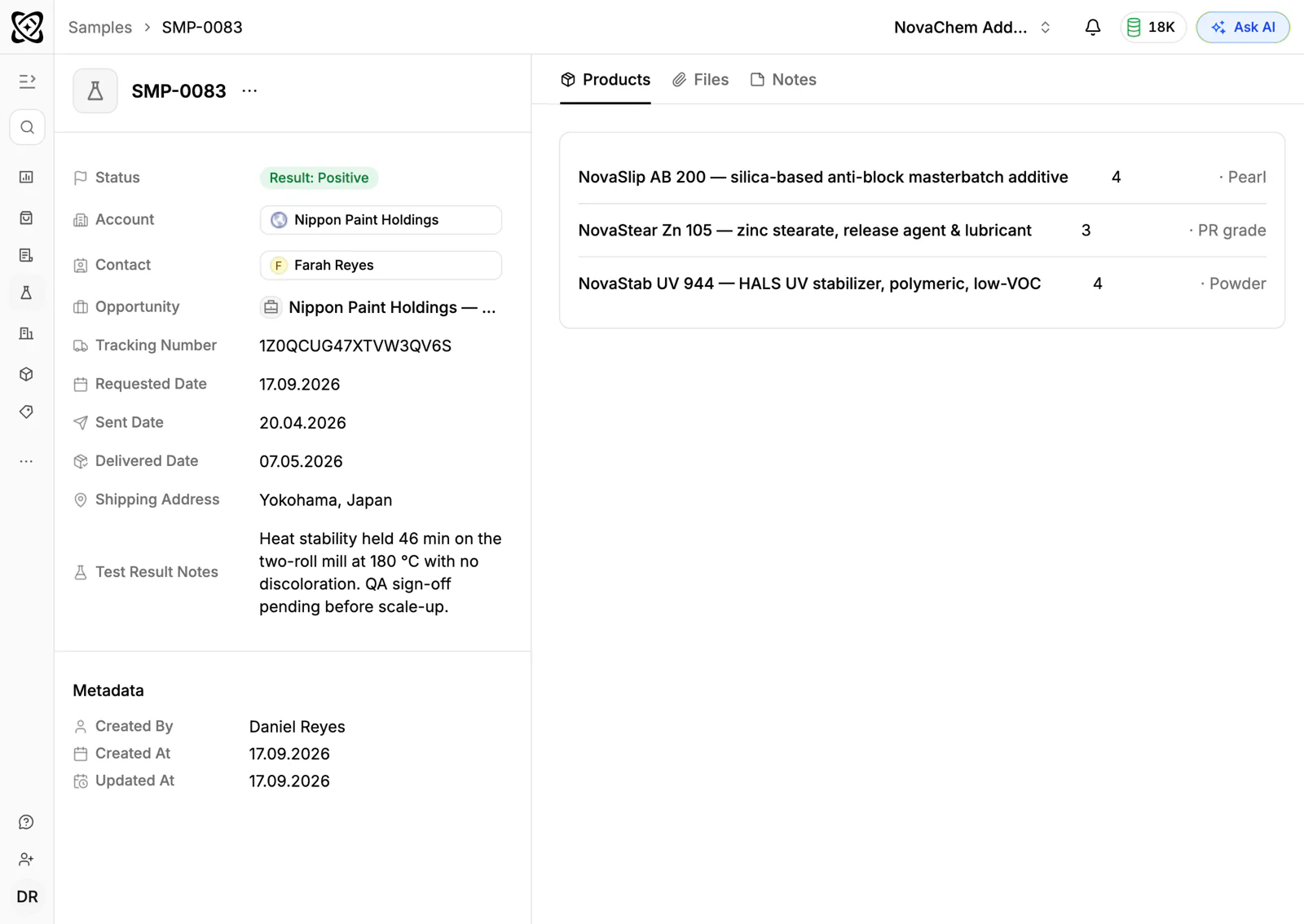
In PromptLab, every submission goes in as a sample record with feedback, each customer gets a price list, and the whole route from brief to repeat order runs in one pipeline whose stages you configure. The wider view for ingredient makers is on the chemicals page.
How does a flavours and fragrances sale actually work?
Most deals start with a brief. A beverage brand wants a citrus note that holds up in a low-sugar base. A home care brand wants a fresh scent that survives a bleach-free detergent. A perfumer or flavourist reads the brief, builds a few candidates and sends them out.
Then comes the loop that defines the trade. The customer tests the samples in their own product, gives feedback, and you adjust and send again. A single project can go through several rounds before one version is approved.
The buyers are rarely one person. A brand manager owns the idea, a formulation or product development lead tests the sample, and purchasing negotiates the price. Large accounts also have a quality contact who asks for documents. All of them need to be on the account.
What are briefs, submissions and approvals?
A brief is the customer's description of what they want: the product type, the profile, the dosage or use level, the cost target and the launch date. A submission is a sample you send against it. An approval is the customer's written yes, after which the project moves to a commercial quote.
Each round has a reference, a ship date and a verdict. A customer who says "closer, but too sweet" has told you exactly what to change, and that sentence belongs on the record. If it sits in a chat on a perfumer's phone, the next round starts from guesswork.
Approval is not the end. Many customers ask for a small pre-production batch before the first order, and some run the new scent or flavour through their own stability testing first. These are real waiting periods, and the CRM should show who owes the next move.
What pipeline stages fit flavours and fragrances?
One pipeline can carry the whole route if the stages are honest about what happened. Rename them to fit your own process.
| Stage | Entry condition |
|---|---|
| Brief received | The customer has described a product, a profile and a target |
| Submission sent | A sample is logged with a ship date |
| Feedback round | The customer has replied and a new round is in progress |
| Approved | The customer has approved a version in writing |
| Quote sent | A quote from the account's price list is out |
| First order | A sales order is created for the approved quote |
| Repeat supply | Reorders are expected on a rhythm |
A project that goes back into feedback simply moves back a stage. A project that stalls after approval shows up as a deal sitting in Quote sent, which is exactly the signal you want.
What must the CRM track for flavours and fragrances?
- Briefs, with the product type, the target profile, the use level and the launch date.
- Submissions, each with a reference, ship date, the contact who tested it and their verdict.
- Documents per account. Customers ask for safety data sheets, technical data sheets and supporting certificates. Keep the current versions on the account where any rep can find them. See what is a technical data sheet for what customers expect in one.
- Price lists per customer. A global brand, a regional blender and a small craft producer rarely pay the same price for the same compound, and sample sizes and pack sizes change the line.
- Minimum order quantities, which matter when a custom compound is made in batches. What is MOQ covers the idea.
- Reorder rhythm, so a quiet account is spotted before the customer's stock runs out.
How do you set this up in PromptLab?
- 1
Configure one pipeline
Set the stages above on your pipeline. Every brief becomes a deal on the customer's account, so the full history from first brief to latest reorder sits in one place.
- 2
Log every submission as a sample
Create a sample record for each submission, with the compound reference, the contact and a short note of what was changed since the last round. Record the customer's verdict as feedback. How to track product samples walks through the routine.
- 3
Build a price list per customer
Create customer price lists for your key accounts, by compound and pack size. A quote linked to the customer's list takes that list's prices, so the rep is not quoting from memory.
- 4
Keep documents on the account
Upload the data sheets and certificates the customer asked for to the account's files. When a quality contact asks for the latest version, the rep finds it in seconds.
- 5
Connect the chats customers use
Many flavourists and buyers answer on WhatsApp or Telegram. Connect your WhatsApp Business number and your company Telegram bot, and the feedback arrives in the shared Inbox beside email, on the right contact.
- 6
Automate the nudges
Use a workflow to create a task when a quote changes status or a deal changes stage. PromptLab also flags accounts with no recent engagement, so a customer who went quiet after a sample is not forgotten.
How does PromptLab compare for flavours and fragrances?
Swipe the table sideways to see every CRM →
| Checked on 30 September 2026 | PromptLab |  Pipedrive |  Zoho CRM |  HubSpot |
|---|---|---|---|---|
| Pricing | ||||
| Paid plans, a month | $11.99 – $99per seat | $14 – $79per seat | $14 – $52per seat | $7 – $150per seat |
| Number of plans | 3 | 4 | 4 | 4 |
| Free trial | ||||
| Billing | Billed monthly | Billed annually | Billed annually | Billed annually, plus a $1,500–$3,500 onboarding fee |
| Import from CSV and Excel | ||||
| Sales management | ||||
| Deal pipelines | ||||
| Quotes | From$59/month | From$23/month | Add-on | |
| Sales orders | From$23/month | |||
| Sample tracking | ||||
| Price lists | From$23/month | |||
| Meetings and calls | ||||
| Meeting recording and transcripts | Via marketplace | From$90/month | ||
| AI meeting summaries | ||||
| AI follow-up email drafts | From$59/month | From$23/month | From$90/month | |
| Meeting scheduler and call dialer | From$23.99/month | From$39/month | Via marketplace | |
| AI and automation | ||||
| CRM fields filled in from calls | From$40/month | From$90/month | ||
| Connect Claude or ChatGPT (MCP) | ||||
| Workflow automation | From$39/month | |||
| API and webhooks | From$23.99/month | |||
| Conversations | ||||
| Gmail and Outlook email sync | From$39/month | |||
| WhatsApp conversations | From$39/month | Add-on | ||
| Telegram conversations | ||||
| Save LinkedIn profiles | Via marketplace | From$23/month | From$150/month | |
| Privacy and security | ||||
| Single sign-on (SSO) | From$99/month | From$40/month | From$150/month |
Pipedrive has a pipeline a sales rep learns in an afternoon, and its Nova assistant records calls on every plan from $14 a seat a month, billed annually. It has no sample tracking and no price list per customer, though, and quotes wait for Premium at $59. Zoho CRM offers quotes, sales orders and price books from $23 a user a month, billed annually, but it doesn't model samples at any tier, so submission rounds would go untracked.
HubSpot is the most polished suite of the three, with a Starter plan from $7 a seat a month, billed annually. Quoting sits in a separate hub, sales orders and price lists aren't there, and Professional or Enterprise adds a $1,500 to $3,500 onboarding fee. See the detailed comparisons for Pipedrive and HubSpot.
Frequently asked questions
What should a CRM for a flavour or fragrance company track?
It should track briefs, each sample submission with its feedback, customer price lists, quotes, sales orders and the documents attached to each account. PromptLab includes all of these on every plan, from $11.99 per user per month.
Can I track sample rounds for a custom compound?
Yes. Log each submission as a sample with a reference, a ship date, the contact and the customer's verdict. Because each round is its own record, you can see how many rounds a project has taken and what changed.
How do I handle different prices for different customers?
Keep a price list for each key customer and quote from it. In PromptLab a quote linked to a customer's price list takes that list's prices. How to manage customer price lists covers the routine.
Where should safety data sheets and certificates live?
On the customer's account, where any rep can find them. PromptLab accounts have files and documents, so the current versions sit beside the deals and quotes they relate to.
Is there a free trial?
Basic and Professional come with a 14-day free trial, with no card needed. There is no free plan. Business is $99 per user a month, or $948 a year.
Sources
Prices and features of other CRMs come from each vendor's own pages, on the dates below.
- Pipedrive, checked on 30 September 2026: Pricing, MCP server, Nova, Exporting data
- Zoho CRM, checked on 30 September 2026: Pricing, Features, WhatsApp integration, MCP
- HubSpot, checked on 30 September 2026: Sales Hub pricing, Revenue Hub quote software, WhatsApp integration, MCP servers, Single sign-on (SSO)