











CRM for metals and steel service centres
How steel and metals sales works, from grades and cut-to-size quotes to mill lead times and spot versus contract pricing, and a CRM setup for it.
 By the PromptLab team6 October 20265 min read
A metals or steel service centre needs a CRM that can turn an enquiry for a grade and a cut size into a quote the same day, while remembering which customers buy on contract and which buy on the spot market. Prices move, lead times depend on the mill, and the customer who gets an answer first often gets the order.
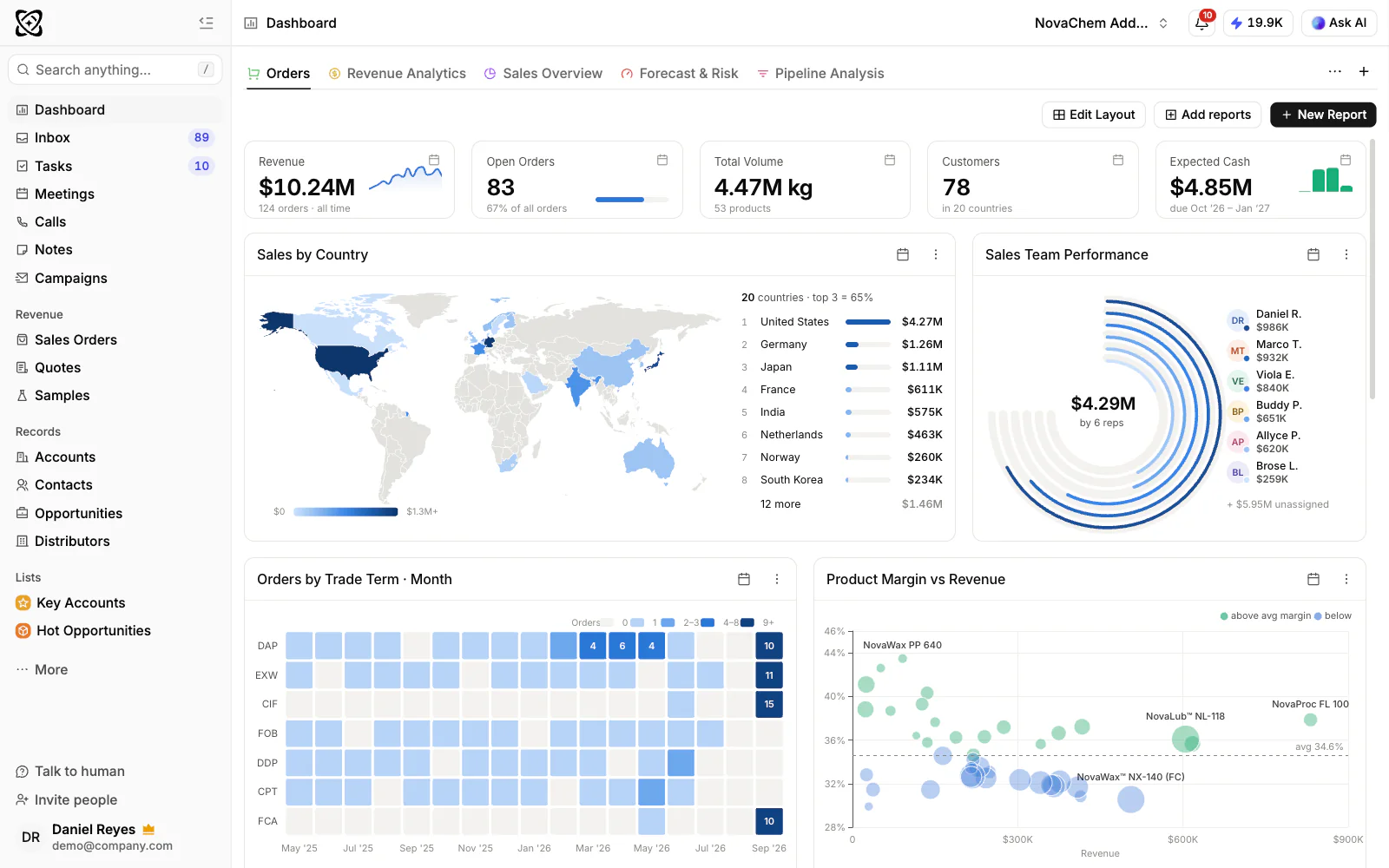
In PromptLab, contract customers quote from their own price lists, each spot quote gets a follow-up task as it goes out, and call-offs are logged as sales orders. The account side matches the distributors page.
How does a service centre actually sell?
A service centre buys coil, plate, bar or tube from mills and processes it: slitting, cutting to length, sawing, laser or plasma cutting. It then sells to fabricators, machine shops, construction firms and OEMs.
The enquiry is specific. "200 pieces of 10 mm plate in S355, cut to 600 by 400, delivered next week." The quote has to name the grade, the dimension, the quantity, the processing and the delivery date. A vague answer loses to a precise one.
Customers are of two kinds. Regular buyers order every week against a frame agreement and want the order to go through. Occasional buyers shop around and compare three quotes.
What are grades, certificates and lead times?
Metals are sold by grade and standard, such as S355 or 304 stainless, with a specific finish and tolerance. The grade decides the price, and many customers need a mill certificate with the delivery. Mixing up grades is an expensive error, so the grade belongs in a structured field.
Lead times depend on stock and on the mill. If the material is on the shelf, delivery is days. If it has to be ordered from a mill, the lead time is whatever the mill says, and it changes. A rep who quotes a delivery date should know which case applies, and the customer should hear when it changes.
How does spot versus contract pricing work?
Spot pricing follows the market on the day, so a quote is valid for a short time, perhaps one or two days. Contract pricing fixes a price or a formula for a volume and a period, so the customer has certainty.
A rep needs to see which kind of customer they are speaking to. A spot quote needs a quick follow-up, because it expires. A contract customer needs a review date, call-offs against the volume and a heads-up when the formula changes.
Say a fabricator asks for 200 plates in one grade every month. A rep who treats that as a string of spot quotes keeps competing on every order. A rep who spots the pattern can propose a frame agreement, fix a price basis and a review date, and turn a stream of enquiries into a contract account.
What pipeline stages fit a service centre?
Spot enquiries
| Stage | Entry condition |
|---|---|
| Enquiry | Grade, size and quantity are on the deal |
| Quoted | A priced quote with a validity date is sent |
| Chased | The follow-up task was done before expiry |
| Ordered | The quote became a sales order |
Contract and key accounts
| Stage | Entry condition |
|---|---|
| Target account | A fabricator or OEM with regular demand |
| Trial order | A first order has been shipped |
| Frame agreement | Annual volume and a price basis are agreed |
| Call-offs | Orders arrive against the volume |
| Review | The price and volume review is scheduled |
What must the CRM track?
- Grade, product form and size as structured fields.
- Quotes with a validity date, and a follow-up dated before it, so nobody chases an expired price.
- Customer price lists, one for each contract customer, with price basis and date.
- Sales orders against contract volumes.
- Account type: spot or contract, with the next review date.
- Documents, such as certificates and agreed terms.
- Conversations on email, WhatsApp and Telegram, where many buyers send drawings and quantities.
How do you set this up in PromptLab?
- 1
Create the spot and contract pipelines
Use the two pipelines above. Reps work the spot pipeline daily and the contract pipeline weekly.
- 2
Add grade and account-type fields
Add a pick-list field for grade and product form, and a field for spot or contract. Put the review date on contract accounts, with a task a month before it.
- 3
Build price lists for contract customers
Create a price list per contract customer. Update it when the price basis changes, so every quote uses the new price. Read how to manage customer-specific price lists.
- 4
Quote the same day
Create the quote from the list, add the processing line and send it. Track its status, and set a workflow that creates the follow-up task when the quote's status changes to sent. See how to write a sales quote.
- 5
Track call-offs as sales orders
Convert approved quotes to sales orders, and log each call-off as a sales order on the contract account, next to the agreed volume field.
- 6
Put buyers' chat apps in the Inbox
Connect WhatsApp and your Telegram bot, so a drawing or a quantity change sent by chat lands on the account. Record the review calls with contract customers too, when they run on Meet, Zoom or Teams.
How does PromptLab compare for metals and steel?
Swipe the table sideways to see every CRM →
| Checked on 30 September 2026 | PromptLab |  Salesforce Salesforce |  HubSpot HubSpot |  Pipedrive Pipedrive |
|---|---|---|---|---|
| Pricing | ||||
| Paid plans, a month | $11.99 – $99per seat | $25 – $550per seat | $7 – $150per seat | $14 – $79per seat |
| Number of plans | 3 | 5 | 4 | 4 |
| Free trial | ||||
| Billing | Billed monthly | Billed annually | Billed annually, plus a $1,500–$3,500 onboarding fee | Billed annually |
| Import from CSV and Excel | ||||
| Sales management | ||||
| Deal pipelines | ||||
| Quotes | From$100/month | Add-on | From$59/month | |
| Sales orders | From$100/month | |||
| Sample tracking | ||||
| Price lists | From$100/month | |||
| Meetings and calls | ||||
| Meeting recording and transcripts | Add-on | From$90/month | ||
| AI meeting summaries | Add-on | |||
| AI follow-up email drafts | Add-on | From$90/month | From$59/month | |
| Meeting scheduler and call dialer | From$23.99/month | Add-on | From$39/month | |
| AI and automation | ||||
| CRM fields filled in from calls | From$195/month | From$90/month | ||
| Connect Claude or ChatGPT (MCP) | From$195/month | |||
| Workflow automation | From$39/month | |||
| API and webhooks | From$23.99/month | From$195/month | ||
| Conversations | ||||
| Gmail and Outlook email sync | From$39/month | |||
| WhatsApp conversations | Add-on | Add-on | From$39/month | |
| Telegram conversations | ||||
| Save LinkedIn profiles | Via marketplace | From$150/month | Via marketplace | |
| Privacy and security | ||||
| Single sign-on (SSO) | From$99/month | From$150/month |
Pipedrive has a product catalogue and a pipeline an inside sales rep learns quickly, from $14 a seat a month, billed annually. It keeps no price list per customer and no sales orders, so contract prices and call-offs end up in a spreadsheet, and quotes wait for Premium at $59.
Salesforce can model frame agreements, call-offs and price formulas for a large metals group, given an admin or a partner to build them. Its quotes and price lists start on Pro Suite at $100 a user a month, billed annually. HubSpot's free CRM and $7 Starter plan, billed annually, are an easy start, and its marketing tools are strong, but quoting sits in the separate Revenue Hub and there are no sales orders or price lists. See the Pipedrive and Salesforce comparisons for detail.
Frequently asked questions
What is the best CRM for a steel service centre?
One with quotes, sales orders and customer price lists on the base plan, plus a shared inbox for email and messaging. PromptLab has all of these from $11.99 per user per month.
Can a CRM handle spot and contract pricing?
Yes. Use a price list per contract customer, and fresh quotes for spot enquiries with a validity date. PromptLab keeps both on the same account.
Can it show mill lead times?
PromptLab does not pull live mill or stock data. Record the lead time on the quote or the deal, and set a task to update the customer if it changes.
How do I stop quotes expiring unseen?
Have a workflow create a follow-up task when each quote is sent, and date it before the quote expires. The rep then chases while the price still stands.
Can a CRM store mill certificates?
Yes. Attach certificates and agreed terms as documents on the account or the deal, so a rep can resend one without asking the warehouse. PromptLab includes documents on every plan.
Sources
Prices and features of other CRMs come from each vendor's own pages, on the dates below.
- Salesforce, checked on 30 September 2026: Sales Cloud pricing, Sales Engagement pricing, Agentforce MCP support
- HubSpot, checked on 30 September 2026: Sales Hub pricing, Revenue Hub quote software, WhatsApp integration, MCP servers, Single sign-on (SSO)
- Pipedrive, checked on 30 September 2026: Pricing, MCP server, Nova, Exporting data