



















CRM for safety equipment (PPE) distributors
How PPE and safety equipment distribution sells, from wear trials and certificates to site contracts and reorders, and a CRM setup that tracks it.
 By the PromptLab team24 October 20267 min read
A safety equipment distributor needs a CRM that remembers which glove, boot or harness a site has trialled, who approved it and when it needs ordering again. The sale is rarely about the cheapest item. It is about whether workers will actually wear it and whether the safety manager can show it meets the standard.
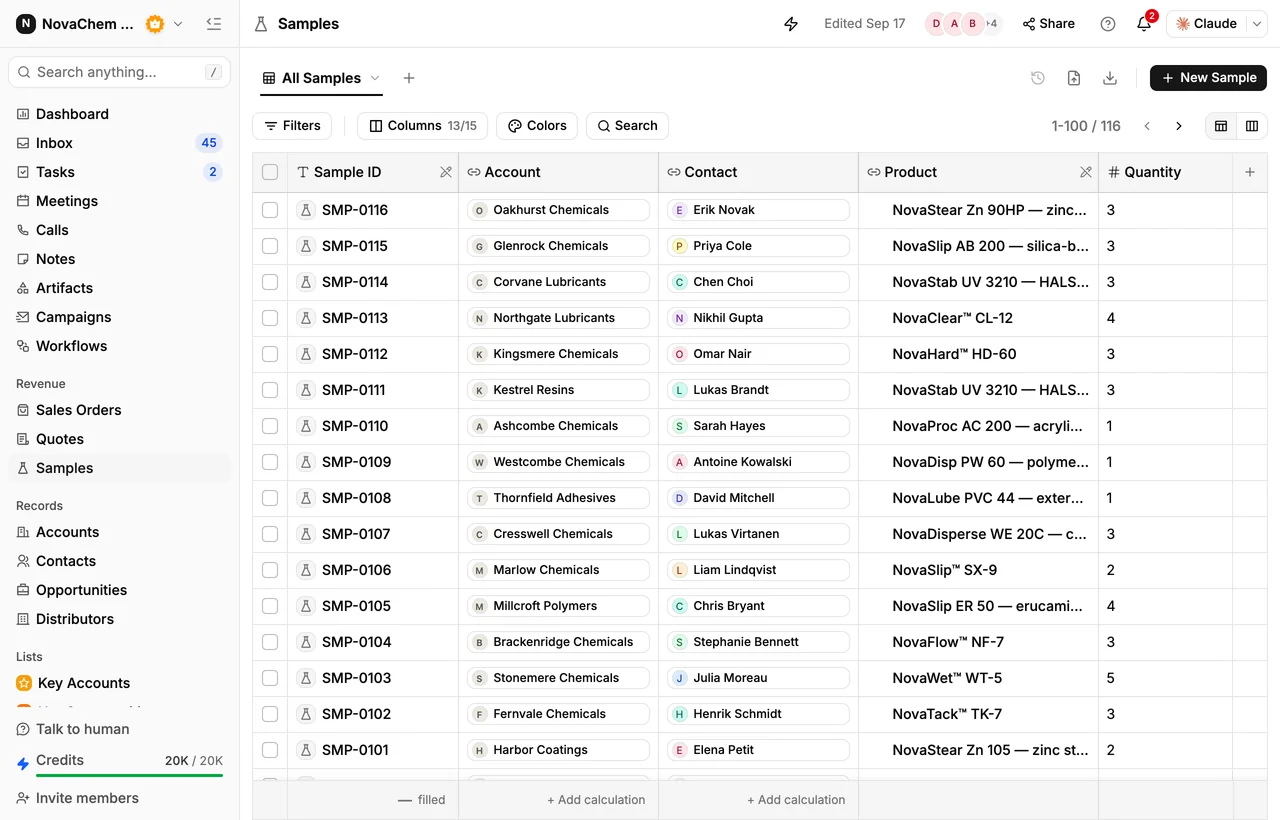
In PromptLab, a wear-trial pack is a sample request with a status and feedback, linked to the account and deal. Customer price lists, quotes and sales orders cover the commercial side. The wider distributor view is on the distributors page.
How does a safety equipment distributor actually sell?
Customers are construction firms, factories, warehouses, utilities, workshops, farms, food plants and any site where people work at risk. Some are small tradespeople buying boots and gloves. Others are large industrial sites with a safety manager, a procurement team and a list of approved products.
Three people usually matter. The safety officer decides what is needed to manage the risks on site. The buyer handles price, delivery and terms. The worker decides, in practice, whether the item stays on. A glove that fits badly gets taken off, whatever the specification says.
Distributors sell from a wide catalogue of brands and add services around it: site visits, sizing days, vending or stock cabinets, branded workwear and training. The relationship is as much about the rep who visits as about the catalogue.
What are standards, certificates and approvals?
PPE is sold against standards. Gloves, footwear, helmets, eye protection, hearing protection, respirators and harnesses each have their own, and the markings on the product and the paperwork that comes with it say which. In many markets, the manufacturer provides a declaration of conformity or a certificate, and a safety officer will ask to see it.
The distributor's job is to hold the right documents for every product and to know which ones were sent to which customer. A buyer who has approved a specific model for a site expects that model, or a documented equivalent, on the next order.
Why do wear trials decide the sale?
Before a site changes its gloves or boots, the safety officer wants some workers to try them. A wear trial means sending a few pairs in the right sizes, leaving them with a team for a week or two, and collecting feedback. Was it comfortable, did it grip, did it last, did anyone complain?
Treat each trial as a sample. Log the product, the sizes, the number of pairs, the team, the start date and the verdict. If the trial fails, note why. "Too stiff" and "wrong size run" are very different reasons. How to track product samples covers the routine.
How do contracts, framework agreements and site stock work?
Large buyers rarely order item by item. A site or a group agrees a supply contract for a period, with a list of approved products, agreed prices and a delivery arrangement. Some use a framework agreement, where individual sites order against agreed terms. Others run a stock cabinet or vending unit on site that you refill.
For the distributor, the contract is the start of the work. The agreed price list must be right on every order. The rep must keep the site ordering from the contract, not from the cheapest search result. And the renewal date has to be on someone's calendar months ahead. See how to sell to procurement teams for the buyer's side.
Blanket orders fit here too: a buyer commits to a period or volume and releases deliveries as needed.
Why do reorders and sizes matter so much?
PPE is a consumable. Gloves wear out in days. Disposable items go every shift. Helmets, harnesses and respirators have service lives, and inspection routines set by the maker and the site. A well-run account reorders on a predictable rhythm, and a missed reorder is a safety problem for the customer, not only a lost sale for you.
Sizes add a quirk. A site with two hundred staff does not need two hundred of one size, and a new starter needs a pair the same day. Knowing the size split of an account, even roughly, lets a rep suggest stock levels instead of waiting for an emergency order.
What pipeline stages fit safety equipment sales?
PromptLab has one deal pipeline with stages you set. Use a deal field for the type, such as new site, wear trial or contract renewal, and save a view for each. Counter-style reorders are sales orders on the account, not deals.
| Stage | Entry condition |
|---|---|
| Site enquiry | A safety officer or buyer has described a need |
| Risk review | The rep has visited and noted the hazards and current products |
| Documents sent | Certificates and data sheets are logged as sent |
| Wear trial | A sample is out with a team, with sizes and a start date |
| Trial approved | The verdict is positive and recorded |
| Contract quote | A quote with agreed pricing is with the buyer |
| Approved | The quote is accepted and the product is on the approved list |
| Supplying | Reorders arrive on a rhythm |
When a deal is lost, pick the loss reason. Product fit, Price and Competitor lead to different follow-ups, and a note on the deal can record what the workers said.
What must the CRM track?
- Wear trials, each with product, sizes, quantities, team, dates and the verdict.
- Approved products per site, so a rep knows which models are on the list and which are not.
- Documents sent, such as certificates and data sheets, with the date.
- Price lists per customer, because a contract customer, a small contractor and a counter customer pay different prices.
- Contract dates, as fields on the account, with a task for renewal.
- Order history by product, so a rep can see that a site's glove order has stopped.
How do you set this up in PromptLab?
- 1
Set up stages and a deal-type field
Add the stages above to your pipeline and a deal field for new site, trial or renewal. Save a view for each, and let simple reorders be sales orders on the account.
- 2
Log every wear trial as a sample
Record the product, sizes, quantity, team and contact. Put the workers' verdict in the sample's feedback. Link it to the account and the deal.
- 3
Create a task from the sample status
Build a workflow: when a sample's status changes to delivered, create a task for the rep to collect feedback in a week. That keeps trials from drifting.
- 4
Attach the documents
Store certificates and data sheets as documents on the account, with notes on which version went to the safety officer.
- 5
Build the contract price list
Create a customer price list for each contract customer, then quote from it. The margin shows on each line, so a rep sees the effect of a discount before sending.
- 6
Bring in the site's messages
Foremen and buyers use WhatsApp and Telegram a lot. Connect your WhatsApp Business number and your company Telegram bot, so urgent requests land on the account.
How does PromptLab compare for safety equipment sales?
Swipe the table sideways to see every CRM →
| Checked on 30 September 2026 | PromptLab |  HubSpot |  Attio |  Zoho CRM |
|---|---|---|---|---|
| Pricing | ||||
| Paid plans, a month | $11.99 – $99per seat | $7 – $150per seat | $35 – $79per seat | $14 – $52per seat |
| Number of plans | 3 | 4 | 4 | 4 |
| Free trial | ||||
| Billing | Billed monthly | Billed annually, plus a $1,500–$3,500 onboarding fee | Billed annually; free plan for 3 seats | Billed annually |
| Import from CSV and Excel | ||||
| Sales management | ||||
| Deal pipelines | ||||
| Quotes | Add-on | From$23/month | ||
| Sales orders | From$23/month | |||
| Sample tracking | ||||
| Price lists | From$23/month | |||
| Meetings and calls | ||||
| Meeting recording and transcripts | From$90/month | From$79/month | Via marketplace | |
| AI meeting summaries | From$79/month | |||
| AI follow-up email drafts | From$90/month | From$79/month | From$23/month | |
| Meeting scheduler and call dialer | From$23.99/month | Via marketplace | ||
| AI and automation | ||||
| CRM fields filled in from calls | From$90/month | From$79/month | From$40/month | |
| Connect Claude or ChatGPT (MCP) | ||||
| Workflow automation | ||||
| API and webhooks | From$23.99/month | |||
| Conversations | ||||
| Gmail and Outlook email sync | ||||
| WhatsApp conversations | Add-on | |||
| Telegram conversations | ||||
| Save LinkedIn profiles | From$150/month | Via marketplace | From$23/month | |
| Privacy and security | ||||
| Single sign-on (SSO) | From$99/month | From$150/month | Enterprise plan | From$40/month |
HubSpot is the most polished all-in-one suite, with a Starter plan from $7 a seat a month, billed annually. For a team selling products, quoting is an add-on, and samples, sales orders and price lists aren't there. Professional and Enterprise add a $1,500 to $3,500 onboarding fee. Attio is one of the best-designed of the new AI-native CRMs, free for up to three seats. Quotes, price lists and orders are left for you to build, and call recording waits for the Pro plan at $79 a seat a month, billed annually.
Zoho CRM is the value pick, with paid plans from $14 a user a month, billed annually, and quotes, orders and price books from $23. Samples aren't modelled. See the HubSpot and Zoho CRM comparisons.
Frequently asked questions
What should a CRM for a PPE distributor include?
It should track wear trials, certificates sent, customer price lists, quotes and sales orders, with each site's contacts. PromptLab includes sample tracking, quotes, price lists and sales orders on every plan, from $11.99 per user per month.
How do I track wear trials in a CRM?
Log each trial as a sample request with the product, sizes, quantity and contact, linked to the account and deal. Update its status as it moves, and record the workers' feedback on it.
Where should I keep PPE certificates?
Keep the master copies in your quality system. Attach the version you sent to the account as a document, so the CRM shows what each safety officer has seen without becoming a second quality system.
How do I handle contract pricing?
Create a customer price list for the contract and quote from it, so every quote uses the agreed price.
Is there a free trial?
Basic and Professional come with a 14-day free trial. There is no free plan.