



















CRM for veterinary products distributors
How veterinary products distribution sells to clinics, farms and pharmacies, from range reviews to reorders, and a CRM setup that tracks accounts and prices.
 By the PromptLab team31 October 20266 min read
A veterinary products distributor sells medicines, consumables, feed supplements and equipment to clinics, farms, pharmacies and retailers. A CRM for that trade has to hold each account's prices, what they buy and every conversation with the clinic manager or farm owner, so reorders keep coming without chasing.
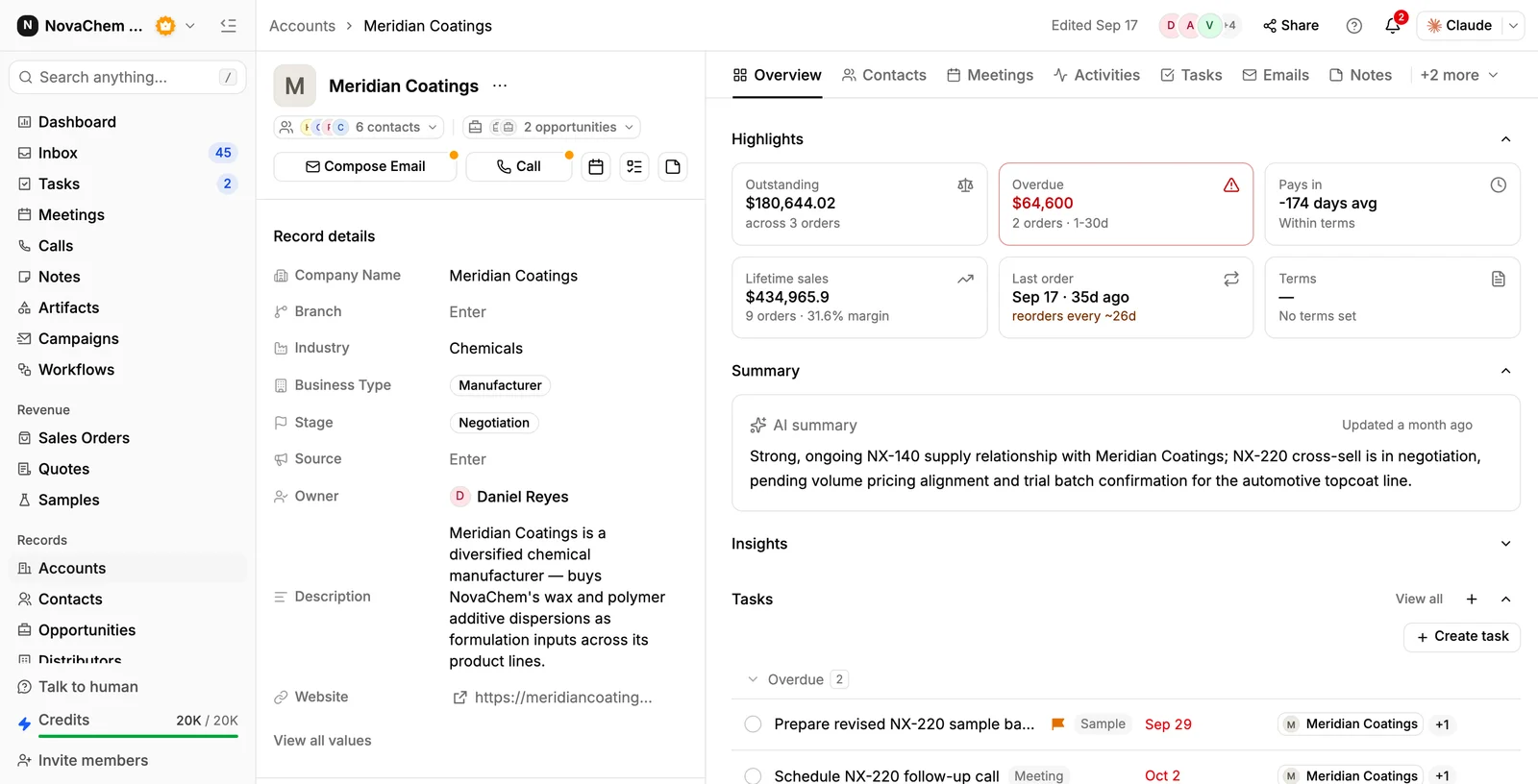
In PromptLab, each customer's agreed prices sit in a customer price list that you pick on each quote, quotes are built from your products with the margin on each line, and sales orders sit on the account. Clinic, farm and reseller deals share one pipeline, told apart by a field. The wider distribution view is on the distributors page.
How does veterinary distribution actually sell?
Buyers come in several kinds. Small-animal clinics buy a wide range in small quantities and want one delivery with everything on it. Large-animal and farm practices buy in bulk, often against a herd health plan. Pharmacies and pet retailers buy fast-moving products for resale. Farms buy direct for their own herd or flock.
The sale is about reliability. A clinic cannot run out of a core product, so the buyer sticks with the supplier who delivers when promised and answers the phone. Price matters, but a missed delivery costs more than a slightly higher unit price.
Reps visit clinics and farms on a route, and between visits the account orders on its own. The job is to know which accounts are due a visit, which are ordering less than usual, and which are ready for a new product.
What do buyers and regulators ask for?
Veterinary products are regulated, and the rules differ by country and by product. Some medicines can only be supplied to or on the order of qualified people, and many need a licence to hold and sell. Your compliance team knows which apply to you.
On the sales side, expect these requests:
- Range reviews. A clinic asks what you stock in a category and what the alternatives are. Quote from your products so the answer is one document, not a retyped email.
- Product information. Buyers ask for data sheets and safety data sheets. See what is a safety data sheet.
- Batch and expiry questions. Buyers ask about shelf life on delivery. Keep the answer in your order system, and use the CRM for the conversation around it.
- Delivery windows. Cold-chain or time-sensitive items need a promised slot. Put the slot in the quote's notes and on the sales order.
Why do reorders and account health matter?
Most clinics reorder the same core range on a rhythm. That makes the order history the best guide to account health. An account that ordered every two weeks and has not for six has either switched supplier or has a problem you do not know about.
A rep who can see order history by product also spots the cross-sell. If a clinic buys one category from you and another from someone else, that is a conversation worth having at the next visit. How to cross-sell to existing customers has the method.
What pipeline stages fit a veterinary distributor?
PromptLab has one deal pipeline per workspace, with stages you choose. Mark each deal as a clinic, a farm or a reseller with a field, and save a view for each. A workable set of stages:
| Stage | Entry condition |
|---|---|
| New account | A clinic, farm or retailer has agreed to a first meeting |
| Range review | Your range and a price list are with the buyer |
| Terms agreed | Account pricing and delivery slots are agreed |
| First order | A sales order exists on the account |
| Core range | The account reorders its main products without chasing |
| Expansion | The account is adding a second category |
What must the CRM track?
- A price list per account type, so a clinic, a farm and a pharmacy each see their own prices.
- Quotes with the margin on every line, and a clear status: Draft, Pending or Approved.
- The contact's role. The clinic manager orders, the lead vet chooses products, and the practice owner approves terms.
- Visit notes and tasks, so the next rep or the next visit starts where the last one stopped.
- Order history by product, so the rep sees what the account buys and what it stopped buying.
- Messages from every channel. Clinic managers email, farmers send WhatsApp messages from the yard. They should all land on the account.
How do you set this up in PromptLab?
- 1
Import accounts and products
Bring in accounts, contacts and products from CSV or Excel. Add an account field for the type: clinic, farm, pharmacy or retailer.
- 2
Build price lists
Create a customer price list for each key account and for each tier. Quotes use them. Editing a list reprices every quote linked to it, so put a price change in a new list. Managing customer price lists shows the routine.
- 3
Quote from the list
Pick the products and the price list on each quote. Line discounts show as you build, and so does the margin on each line. Send it as a PDF or a public link.
- 4
Record every visit
Log each visit as a note on the account, with the next step as a task. Calls held on Google Meet, Zoom or Microsoft Teams are recorded and summarised, and their action items become tasks.
- 5
Connect the channels
Connect email, your WhatsApp Business number and your company Telegram bot to the shared Inbox. The message about a short delivery lands on the account.
- 6
Spot the quiet accounts
Ask AI which accounts have not placed a sales order lately, and book a call to each one that has gone quiet.
How does PromptLab compare for veterinary distributors?
Swipe the table sideways to see every CRM →
| Checked on 30 September 2026 | PromptLab |  Pipedrive |  Zoho CRM |  HubSpot |
|---|---|---|---|---|
| Pricing | ||||
| Paid plans, a month | $11.99 – $99per seat | $14 – $79per seat | $14 – $52per seat | $7 – $150per seat |
| Number of plans | 3 | 4 | 4 | 4 |
| Free trial | ||||
| Billing | Billed monthly | Billed annually | Billed annually | Billed annually, plus a $1,500–$3,500 onboarding fee |
| Import from CSV and Excel | ||||
| Sales management | ||||
| Deal pipelines | ||||
| Quotes | From$59/month | From$23/month | Add-on | |
| Sales orders | From$23/month | |||
| Sample tracking | ||||
| Price lists | From$23/month | |||
| Meetings and calls | ||||
| Meeting recording and transcripts | Via marketplace | From$90/month | ||
| AI meeting summaries | ||||
| AI follow-up email drafts | From$59/month | From$23/month | From$90/month | |
| Meeting scheduler and call dialer | From$23.99/month | From$39/month | Via marketplace | |
| AI and automation | ||||
| CRM fields filled in from calls | From$40/month | From$90/month | ||
| Connect Claude or ChatGPT (MCP) | ||||
| Workflow automation | From$39/month | |||
| API and webhooks | From$23.99/month | |||
| Conversations | ||||
| Gmail and Outlook email sync | From$39/month | |||
| WhatsApp conversations | From$39/month | Add-on | ||
| Telegram conversations | ||||
| Save LinkedIn profiles | Via marketplace | From$23/month | From$150/month | |
| Privacy and security | ||||
| Single sign-on (SSO) | From$99/month | From$40/month | From$150/month |
Pipedrive is one of the easiest sales CRMs to learn. It has no price list per customer, so a clinic's and a farm's agreed prices for the same product live outside it, and quotes wait for Premium at $59 a seat a month, billed annually. Zoho CRM has quotes, sales orders and price books from $23 a user a month, billed annually, which covers the trade side.
HubSpot is a polished all-in-one suite with a Starter plan from $7 a seat a month, billed annually. For product sales, quoting sits in the separate Revenue Hub, and sales orders and price lists aren't there. Professional and Enterprise add a $1,500 to $3,500 onboarding fee. For a side-by-side look at one of them, see Pipedrive vs PromptLab.
Frequently asked questions
What should a CRM for a veterinary distributor include?
It should hold a price list per account type, quotes built from your products, sales orders, visit notes and a record of every message. PromptLab includes these on every plan, starting at $11.99 per user per month.
Can a CRM show which clinics have stopped reordering?
Yes, if orders are recorded as sales orders on the account. Ask AI can list the accounts with no recent order, and a task reminds the owner to call.
Can the CRM check licences or prescription rules?
No CRM replaces your regulatory process. Keep compliance checks in your own system and use the CRM for the commercial side: accounts, prices, quotes and conversations.
How do I manage different prices for clinics and farms?
Keep a price list for each tier and quote from it, so every account gets its agreed price. A price change goes in a new list, because editing a list reprices every quote linked to it.
Is there a free trial?
Basic and Professional come with a 14-day free trial, with no card needed. There is no free plan.
Sources
Prices and features of other CRMs come from each vendor's own pages, on the dates below.
- Pipedrive, checked on 30 September 2026: Pricing, MCP server, Nova, Exporting data
- Zoho CRM, checked on 30 September 2026: Pricing, Features, WhatsApp integration, MCP
- HubSpot, checked on 30 September 2026: Sales Hub pricing, Revenue Hub quote software, WhatsApp integration, MCP servers, Single sign-on (SSO)