



















CRM for water treatment chemicals suppliers
How water treatment chemicals sales works, from site surveys and dosing trials to service visits and reorders, and how to set up a CRM that tracks it.
 By the PromptLab team16 October 20265 min read
A water treatment chemicals supplier needs a CRM that keeps sites, programmes, service visits and reorders on the account record, not in a field engineer's notebook. The sale rarely turns on price per drum. It turns on whether your programme keeps the customer's boiler, cooling tower or process water within target, and whether you turn up when something drifts.
In PromptLab, trial programmes go in as sample records with feedback, each customer gets a price list, and the route from survey to recurring supply runs in one pipeline whose stages you configure. The wider view for chemical companies is on the chemicals page.
How does a water treatment chemicals sale actually work?
Customers run water systems that need continuous treatment: boilers, cooling towers, closed loops, process water and effluent. They range from a single building to a multi-site plant, and many buy through a service contract rather than one-off orders.
A technical rep or service engineer usually begins with a site survey. They look at the system, the water source, the past problems and what the customer currently uses. They then propose a programme: which products, at what dose, with what monitoring.
Supply is recurring by nature. Chemicals are consumed every week, so the real prize is a customer who reorders without being chased. That is also why losing track of a site is expensive: a lapsed visit is often followed by a lapsed order.
Some suppliers also sell through distributors who serve smaller sites. Those accounts care about margin, stock and whether your rep will support a hard problem at one of their customers.
What are surveys, trials and service visits?
A site survey is the first visit to understand the system. A trial is your programme running on part or all of it, with agreed checks. A service visit is the recurring visit to test the water, adjust the dose and restock. Each has a date, a result and a next step.
A trial with no follow-up date is a trial that quietly ends. A service visit that finds a problem but never creates a task is how the customer ends up calling a competitor. The CRM should show, for each site, when it was last visited, what was found and what is due.
Customers sometimes want documents too: safety data sheets, technical data sheets and dosing guidance for each product. These belong on the account.
What pipeline stages fit water treatment?
One pipeline can carry the route from lead to recurring supply. Rename the stages to match your own process.
| Stage | Entry condition |
|---|---|
| Enquiry | A site has described a system or a problem |
| Survey done | A site visit has taken place and notes are logged |
| Programme proposed | A quote for a treatment programme is out |
| Trial running | The programme is on the system with agreed checks |
| Approved | The customer has agreed to move to regular supply |
| First order | A sales order is created for the approved quote |
| Recurring supply | Reorders and service visits are on a rhythm |
A distributor account can use the same stages: introduced, range reviewed, terms agreed, first stocking order, active.
What must the CRM track for water treatment?
- Sites per customer. One customer often has several sites, each with its own system and contact.
- Trials and programmes, with the products, the start date and the checks agreed.
- Service visits and findings, with the date, what was found and any follow-up task.
- Documents per account, including data sheets and dosing guidance. What is a technical data sheet covers what customers expect.
- Price lists per customer. A large plant, a facilities contractor and a distributor pay different prices, and drum, tote and bulk sizes change the line.
- Reorder rhythm, so a quiet account is noticed before the tank runs low.
Seasonality can be real, for example in cooling water where demand follows warm weather. Check your own history for the pattern rather than assuming it.
How do you set this up in PromptLab?
- 1
Configure the pipeline
Set the stages above on your pipeline. Each opportunity becomes a deal on the customer's account, with one account per customer and its sites as contacts and notes.
- 2
Log trials as samples
Record each trial programme as a sample on the account, with the products, the start date, the contact and the agreed checks. Record the customer's verdict as feedback. How to track product samples covers the routine.
- 3
Build a price list per customer
Create customer price lists by product and pack size. A quote linked to the customer's list takes that list's prices, and the margin shows on each line.
- 4
Create a task from every visit
Record the visit as a meeting or note, and create a task for each finding. Tasks can be linked to an account or deal, so nothing found on site is lost.
- 5
Keep documents on the account
Upload data sheets and dosing guidance to the account's files, so anyone answering a customer finds the current version.
- 6
Let the Inbox hold the field chats
Plant operators and service contacts often use WhatsApp or Telegram. Connect your WhatsApp Business number and your company Telegram bot so those messages land on the right contact in the shared Inbox.
How does PromptLab compare for water treatment chemicals?
Swipe the table sideways to see every CRM →
| Checked on 30 September 2026 | PromptLab |  Pipedrive |  Zoho CRM |  HubSpot |
|---|---|---|---|---|
| Pricing | ||||
| Paid plans, a month | $11.99 – $99per seat | $14 – $79per seat | $14 – $52per seat | $7 – $150per seat |
| Number of plans | 3 | 4 | 4 | 4 |
| Free trial | ||||
| Billing | Billed monthly | Billed annually | Billed annually | Billed annually, plus a $1,500–$3,500 onboarding fee |
| Import from CSV and Excel | ||||
| Sales management | ||||
| Deal pipelines | ||||
| Quotes | From$59/month | From$23/month | Add-on | |
| Sales orders | From$23/month | |||
| Sample tracking | ||||
| Price lists | From$23/month | |||
| Meetings and calls | ||||
| Meeting recording and transcripts | Via marketplace | From$90/month | ||
| AI meeting summaries | ||||
| AI follow-up email drafts | From$59/month | From$23/month | From$90/month | |
| Meeting scheduler and call dialer | From$23.99/month | From$39/month | Via marketplace | |
| AI and automation | ||||
| CRM fields filled in from calls | From$40/month | From$90/month | ||
| Connect Claude or ChatGPT (MCP) | ||||
| Workflow automation | From$39/month | |||
| API and webhooks | From$23.99/month | |||
| Conversations | ||||
| Gmail and Outlook email sync | From$39/month | |||
| WhatsApp conversations | From$39/month | Add-on | ||
| Telegram conversations | ||||
| Save LinkedIn profiles | Via marketplace | From$23/month | From$150/month | |
| Privacy and security | ||||
| Single sign-on (SSO) | From$99/month | From$40/month | From$150/month |
Pipedrive has a pipeline an engineer can pick up quickly, and Nova records calls on every plan from $14 a seat a month, billed annually. It has no samples or price lists, and quotes wait for Premium at $59. Zoho CRM has quotes, sales orders and price books from $23 a user a month, billed annually, but samples aren't modelled at any tier.
HubSpot has a free CRM and a Starter plan from $7 a seat a month, billed annually. Quoting sits in a separate hub, and sales orders and price lists aren't there. Professional or Enterprise adds a $1,500 to $3,500 onboarding fee. See how Zoho CRM and HubSpot compare in detail.
Frequently asked questions
What should a CRM for a water treatment supplier include?
It should hold accounts with their contacts, trials, quotes, customer price lists, sales orders, documents and tasks for follow-up. PromptLab includes these on every plan, from $11.99 per user per month.
Can a CRM track service visits?
Yes. Record each visit as a meeting or note on the account and create a task for any finding. PromptLab can also create a task from a meeting, so follow-up has an owner.
How do I spot customers who are drifting away?
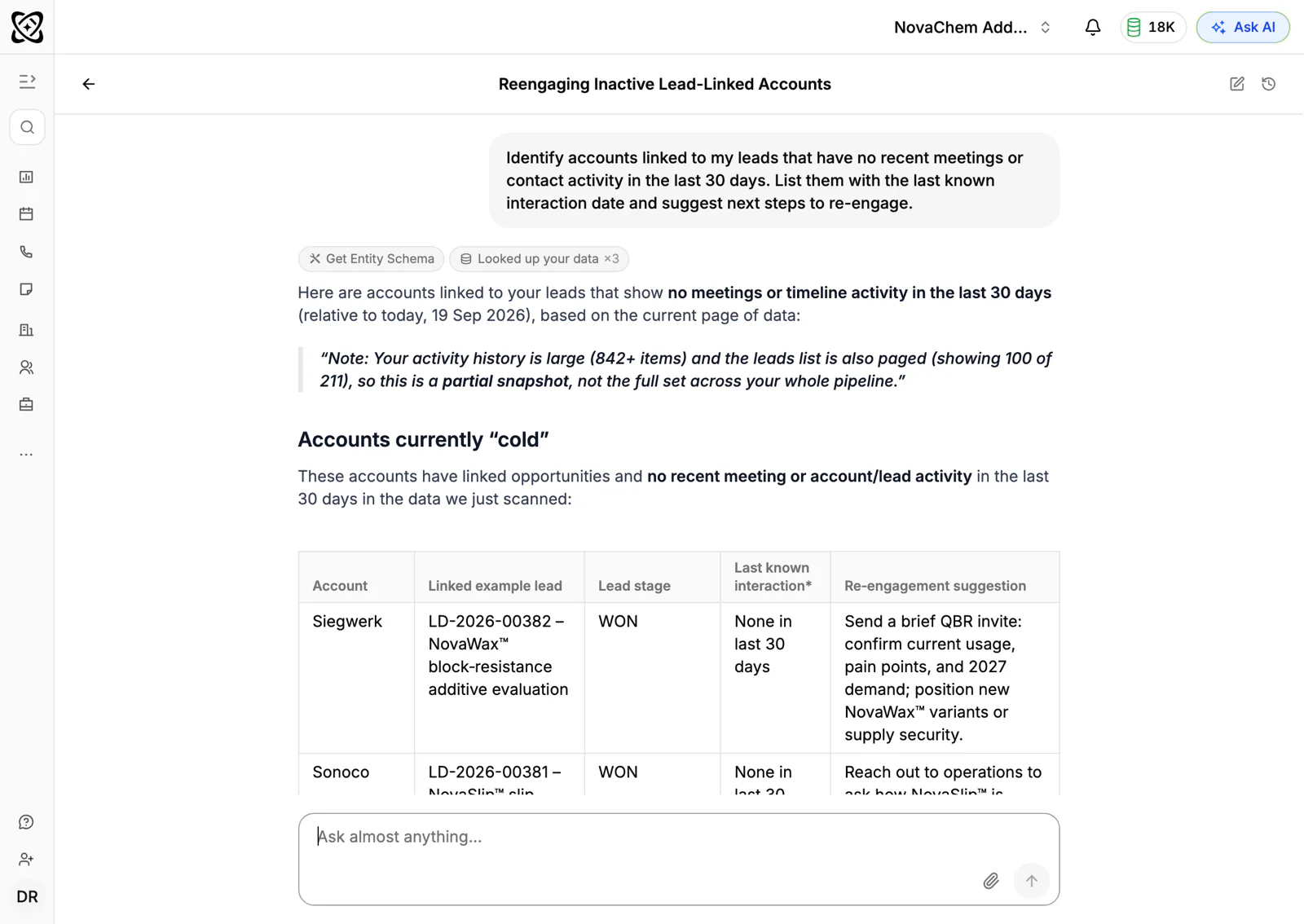
Watch for accounts that stop engaging. PromptLab flags accounts with no recent engagement, and how to increase repeat orders covers the follow-up routine.
Can I keep different prices for different customers?
Yes. Keep a price list per customer and quote from it. In PromptLab a quote linked to a customer's price list takes that list's prices.
Is there a free trial?
Basic and Professional come with a 14-day free trial, with no card needed. There is no free plan. Business is $99 per user a month, or $948 a year.
Sources
Prices and features of other CRMs come from each vendor's own pages, on the dates below.
- Pipedrive, checked on 30 September 2026: Pricing, MCP server, Nova, Exporting data
- Zoho CRM, checked on 30 September 2026: Pricing, Features, WhatsApp integration, MCP
- HubSpot, checked on 30 September 2026: Sales Hub pricing, Revenue Hub quote software, WhatsApp integration, MCP servers, Single sign-on (SSO)