



















Customer complaint response email templates
Nine complaint response emails for product sellers: acknowledge, ask for details, explain the cause, offer a fix and follow up once it is resolved.
 By the PromptLab team29 October 20265 min read
A complaint is the moment a buyer finds out what working with you is really like. They have a damaged pallet, a wrong grade or a late delivery, and they are waiting to see how fast and how honestly you answer. A clear reply often keeps the account. A slow or defensive one loses it.
These templates cover the whole exchange, from the first acknowledgement to the check-in after the fix. Keep each email short, name the problem in the buyer's words and say what happens next. For the process behind them, read how to handle customer complaints.
Acknowledge the complaint
Subject: Re: [Issue] on order [Order number]
Hi [First name],

Thank you for telling us. I'm sorry about [Short description of the problem]. I've taken ownership of this and I'm looking into it now.

I'll write again by [Time and date] with what I've found and what we'll do about it. If it is urgent for your line, call me on [Phone].

[Your name]
Send it as soon as the complaint arrives, even if you have no answers yet. Silence reads as indifference.
Subject: Summary of our conversation about order [Order number]
Hi [First name],

Thanks for calling earlier. To make sure I have it right: [Problem in one or two lines], affecting [Quantity or batch]. You need it resolved by [Date].

I'm checking with [Warehouse, quality or production] and will come back to you by [Time and date]. Tell me if I've missed anything.

[Your name]
Use it after any call or chat, so the complaint exists in writing.
Ask for the details
Subject: What we need to investigate order [Order number]
Hi [First name],

To find the cause quickly, could you send:

1. Photos of the [Packaging, label or product]
2. The batch or lot number on the pack
3. The quantity affected and how it was stored
4. Your delivery note, if you have it

A partial answer today is better than a complete one next week.

[Your name]
Use it when you need evidence before you can decide. Ask for only what you will use.
Explain and fix
Subject: Order [Order number]: what happened and what we'll do
Hi [First name],

We've found the cause. [Plain explanation, for example the wrong grade was picked from the warehouse]. That was our mistake, and I'm sorry for the disruption.

Here is what we'll do:
- Ship a replacement of [Product and quantity] on [Date], at our cost
- Arrange collection of the original goods on [Date]

Does that work for your schedule?

[Your name]
Use it when the fault is yours. Take responsibility in the first lines and give dates.
Subject: Order [Order number]: credit offered
Hi [First name],

Having reviewed the issue with [Product], I'd like to offer a credit of [Amount] against this order. The credit will appear on your account by [Date].

If you'd rather have a replacement, tell me and I'll arrange it. Whichever you choose, I'll confirm in writing.

[Your name]
Use it when the buyer no longer needs the goods or the replacement would arrive too late.
Subject: Our findings on order [Order number]
Hi [First name],

Thank you for the photos and batch details. Our check of batch [Batch number] shows [Finding, for example the product was within specification when it left us].

I know that is not what you hoped to hear, and I don't want to leave it there. Could we look at [Storage, handling or process] together? I can join a call on [Date] with our technical team.

[Your name]
Use it when the evidence doesn't support the complaint. Stay factual and offer a next step.
Delays and follow-up
Subject: Update on order [Order number]
Hi [First name],

A short update. The replacement is now due on [New date] because [Reason]. I know this adds to the delay, and I'm sorry.

I'll confirm the courier details as soon as it ships.

[Your name]
Send it the moment a promised date slips, before the buyer has to ask.
Subject: Is everything resolved on order [Order number]?
Hi [First name],

The replacement should have reached you on [Date]. Could you confirm it arrived and that everything is as it should be?

If anything is still not right, tell me and I'll deal with it today.

[Your name]
Use it two working days after delivery. It closes the loop and shows you kept the thread.
Subject: Closing out order [Order number]
Hi [First name],

I'm glad this is resolved. To stop it happening again, we've [Change, for example added a second check at picking].

Thank you for giving us the chance to put it right. If there is anything else I can do, I'm at [Phone].

[Your name]
Use it once the buyer confirms. Name one real change, not a vague promise.
How to personalise them
- Use the buyer's words. If they wrote "the drums were leaking", say that, not "a packaging issue".
- Give a time, not "soon". "By 3 pm tomorrow" is a promise you can keep.
- Keep one owner. The buyer should hear from the same rep from first email to the last.
- Don't blame the courier or the warehouse in the email. Fix it first, discuss it internally later.
Send them from your CRM
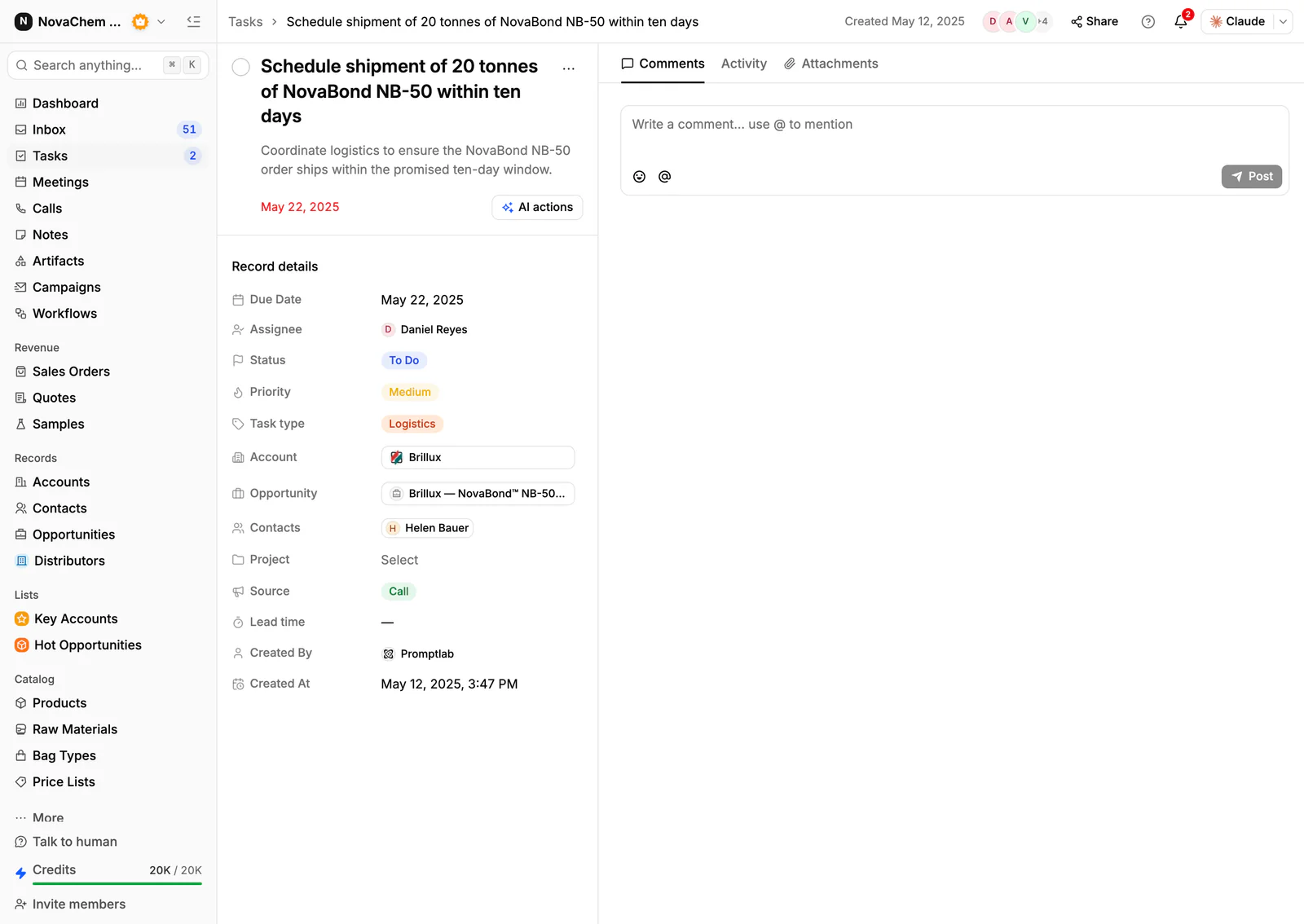
A complaint goes wrong when the reply sits in one person's mailbox. In PromptLab, email, WhatsApp and Telegram messages arrive in a shared Inbox, so a colleague can see the whole thread when the owner is away. Create a task with a due date for each promised update, and keep the complaint as a note on the account. See the Inbox reference and the tasks reference.
Frequently asked questions
What should the first reply to a complaint say?
Three things: that you have it, who owns it and when the buyer will hear from you next. Send it within the hour if you can. You don't need the answer yet, so don't explain the cause or argue in it.
Should I apologise even if I don't know who is at fault?
Yes, for the disruption, not for a cause you haven't confirmed. "I'm sorry about the delay to your line" is true whoever is at fault.
How do I word a reply when the complaint isn't justified?
Share what you checked, using the batch number and facts, and offer a joint review. Avoid telling the buyer they are wrong. Keep the next step open.
Should complaints be handled by email or by phone?
Use both. Call for anything urgent, then confirm in writing so there is a record of what was agreed.
How should I close a complaint in writing?
Once the buyer confirms the fix, send a short note that names one real change you made, such as a second check at picking, and thanks them for raising it. Keep a note of the cause on the account so the next rep sees the history.