



















How to manage key accounts
How to manage key accounts when you sell physical products: pick the accounts, name an owner, write an account plan, set a rhythm and track orders and risk.
 By the PromptLab team16 October 20267 min read
To manage key accounts, choose the few customers that matter most, give each one a named owner and a written plan, and review them on a fixed rhythm. The plan covers what they buy, what they could buy, who decides and what could make them leave. The rhythm keeps you ahead of the problems instead of reacting to them.
For a business that sells chemicals, packaging, ingredients or industrial supplies, a handful of accounts often carry most of the revenue. Losing one is a bad quarter. This guide shows how to run those accounts step by step, with examples from product sales. If you want the definition first, read what key account management is.
Step 1: Decide which accounts are key
A key account is not simply the biggest customer. It is a customer where losing the relationship would hurt, or where growth would change your year. Pick them on a few plain criteria:
- Revenue today: the customers that make up a large share of your orders.
- Growth room: customers who buy from you in one product line and from a rival in another.
- Strategic value: a name that opens doors, or a plant where your product is specified in.
- Dependence: customers where your product is built into their process, so a switch is painful for both sides.
Say your coatings company has 300 customers. You might pick 12 as key accounts: eight for revenue, three for growth room and one because its approval carries weight in the industry. Write the list down and review it twice a year. Accounts move in and out.
Keep the list short. A rep can run a real account plan for perhaps five to ten accounts. Beyond that, the plans turn into forms nobody reads.
Step 2: Name one owner and a small team
Every key account has one owner, a single person who answers for the relationship. Around the owner sit the people who touch the account: a customer service contact, a technical specialist, someone in logistics and a manager who knows the buyer's boss.
Write the team on the account record. When the buyer rings with a delivery problem, anyone should know who to hand it to. When the owner is on leave, a named deputy picks up.
Step 3: Map the people on the buyer's side
Key accounts fail when you know one person. That person moves jobs, and the account moves with them. Map the buyer's side the way you would map your own:
- The buyer who places orders and negotiates price
- The technical contact who tests samples and approves a grade
- The decision maker who signs off on a supplier change
- The user on the production line who notices when quality slips
Aim to have a real relationship with at least three of them. Record each contact on the account with their role, and note what each one cares about. The buyer watches price and lead time. The technical contact watches batch consistency.
Step 4: Write a one-page account plan
An account plan does not need to be long. One page is enough if it answers these questions:
- 1
What do they buy today?
List products, typical order size, how often they order and the price list that applies. This is the baseline.
- 2
What could they buy?
Name the products they buy elsewhere and the sites or divisions you do not yet supply. This is your growth list.
- 3
What does success look like this year?
Set a target you can check, such as moving a second product line onto your supply or landing a three-year contract. Use your own numbers, not a generic target.
- 4
What are the risks?
A rival sampling in their lab, a price increase you are about to announce, a quality complaint still open, a buyer who is leaving. Be blunt.
- 5
What are the next three actions?
Each with an owner and a date. If the plan has no dated actions, it is a description, not a plan.
Step 5: Set a rhythm of contact
Key accounts need contact that is regular and not only reactive. A simple rhythm works for most product businesses:
| What | How often | Who |
|---|---|---|
| Quick check-in call or message | Every two to four weeks | Account owner |
| Order and delivery review | Monthly | Owner with customer service |
| Business review meeting | Quarterly | Owner and a manager, with the buyer |
| Account plan refresh | Twice a year | Owner |
The quarterly meeting is the one that counts. Bring a short summary of what they bought, how deliveries performed, what is open and what you propose next. Our key account review checklist lists what to cover.
Between those meetings, add value without asking for anything. Send a note when a raw material price moves, share a technical bulletin on their grade or warn them early about a lead-time change. Buyers remember the supplier who told them first.
Step 6: Watch the orders, not only the relationship
A friendly buyer can still be quietly moving volume to someone else. Check the numbers every month:
- Are orders arriving at the usual rhythm, or has the gap grown?
- Is the order size falling for one product?
- Is a quote open that nobody has chased?
- Is a sample from a rival mentioned in a recent call?
Say a packaging customer normally reorders every five weeks. When the gap reaches eight weeks, the owner calls. Often the answer is dull, such as a plant shutdown. Sometimes it is the first sign of a supplier switch, and a call in week eight is far better than a surprise in month six. For more on this, see how to increase repeat orders.
Step 7: Handle problems fast and visibly
A key account judges you most when something goes wrong: a late delivery, an off-spec batch, a pricing mistake on an invoice. Three habits help:
- Tell the customer before they find out.
- Name one person who owns the fix and give a date.
- Follow up after it is resolved, and log what happened.
An account with a clean record of problems fixed quickly is harder for a rival to take than one that never had a problem and never saw how you behave under pressure.
Key account basics, per account
Common mistakes
- Too many key accounts. If everyone is key, no one gets real attention.
- One contact. The relationship dies when that person leaves.
- Notes in a private notebook. If the owner is away, the account is blind.
- Only calling when there is a problem or a quote. Add contact that is useful on its own.
- Never updating the price list. Stale prices cause friction at renewal time. See how to manage customer price lists.
How PromptLab helps
We built PromptLab for teams that sell physical products, so the account record carries what a key account manager needs. Contacts, deals, emails, meetings, quotes, sales orders, samples and the customer's price list all hang off the same account.
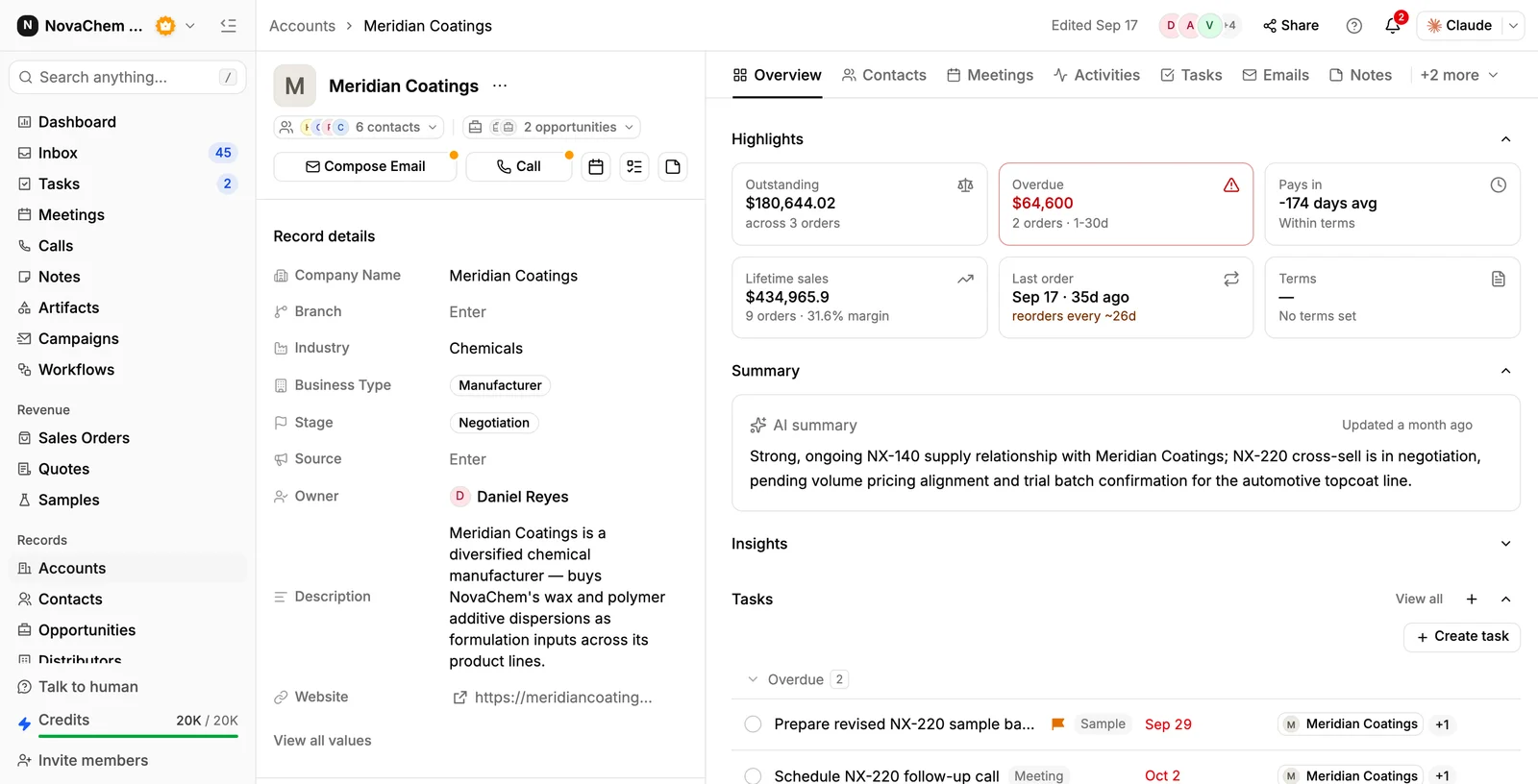
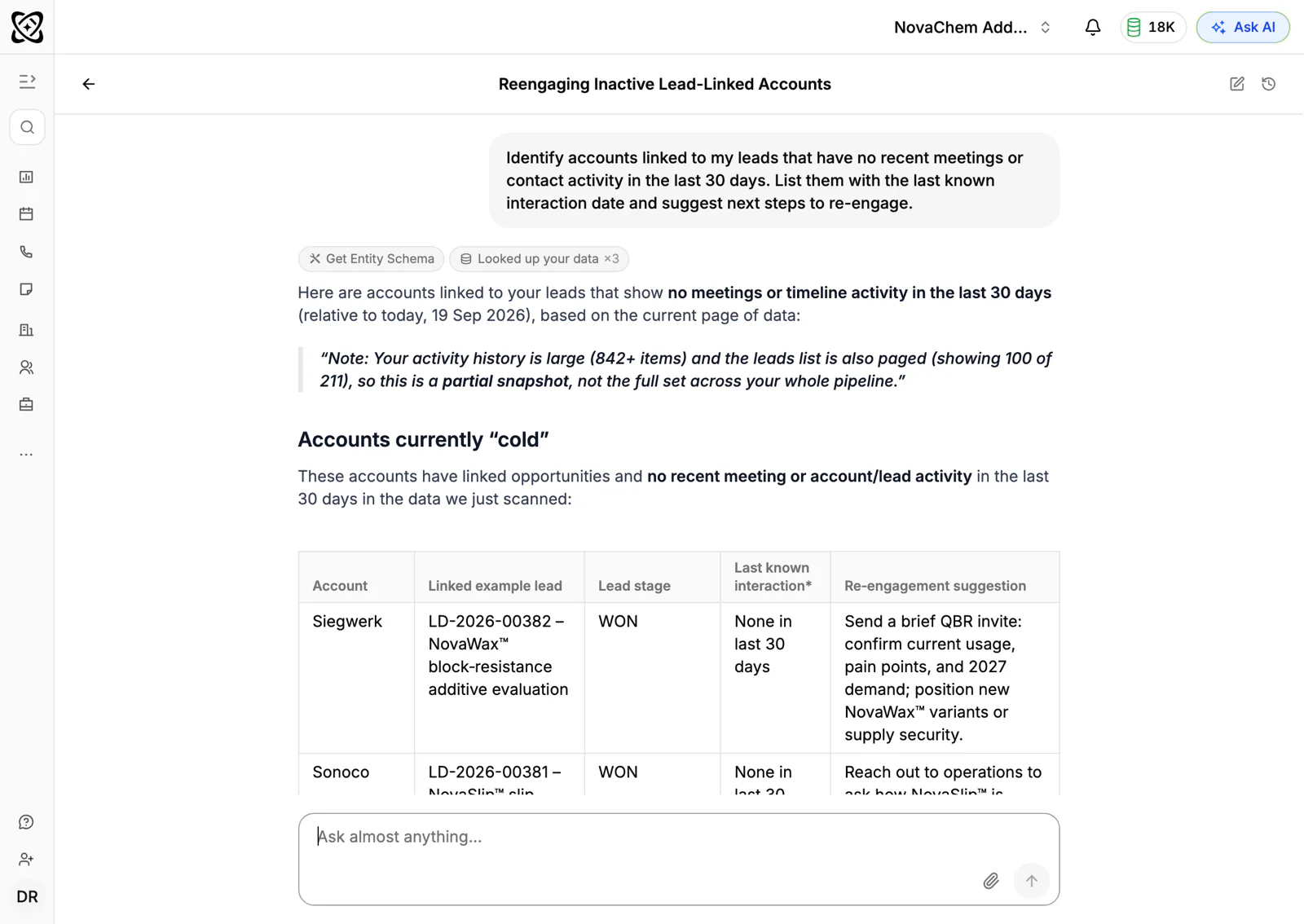
Email capture from Gmail, Outlook or your own mail server logs the conversation without typing. Meetings on Google Meet, Zoom or Microsoft Teams are recorded and summarised, so the owner has the buyer's own words to hand. A workflow can create a task when a quote changes status or a deal changes stage, so a follow-up does not depend on memory. And you can use Ask AI to ask, in plain words, what an account has bought and which quotes are open.
Frequently asked questions
How many key accounts should one person manage?
Most reps can run a proper plan for roughly five to ten. If you give someone more, split the list into those that get a full plan and those that get a lighter rhythm. A plan nobody reads is worse than none.
What is the difference between a key account and a big customer?
A big customer buys a lot today. A key account is one where the relationship is critical to you, because of revenue, growth room or strategic value. A mid-sized customer with room to double can be more important than a large one that is already buying everything from you.
What should be in a key account plan?
What they buy now, what they could buy, the target for the year, the risks and the next three dated actions. Add the contacts on the buyer's side and the price list that applies. One page is enough.
How often should you review a key account?
Check in every two to four weeks, review orders and deliveries monthly, hold a business review with the customer each quarter and refresh the plan twice a year. Adjust to how often the account actually orders.
How do you know a key account is at risk?
Look for longer gaps between orders, smaller order sizes, unanswered quotes, a contact who leaves and mentions of a rival's sample. A CRM that shows recent engagement per account makes these easier to catch.