



















How to negotiate volume discounts
How to negotiate volume discounts on physical products: know your floor, trade price for terms, set tiers, and record every agreed price in your CRM.
 By the PromptLab team24 October 20266 min read
To negotiate a volume discount, know your margin floor before the call, ask for something in return for every price step, and anchor the discount to a commitment you can measure: a bigger order, a yearly volume or a longer contract. Never give a lower price for nothing. A discount should buy you volume, payment terms, forecast visibility or a longer agreement.
This guide is for sales teams selling physical products, where the buyer asks "what is your price for 20 tonnes?" and the rep has to answer without losing the margin. It covers how to prepare, how to structure tiers, what to trade and how to keep the agreed price on record.
Know your numbers before the call
Negotiation is easiest when you know where you can go. Before you reply to a volume request, work out three prices for the product:
- List price: what a standard buyer pays.
- Target price: what you would like to win at this volume.
- Floor price: the lowest price you will accept, set by margin, not by feeling.
Say a product costs $1,000 a tonne to produce and deliver, and the list price is $1,400. A floor of $1,150 keeps a margin of about 13%. If the buyer asks for $1,050, you know the answer is no before the call starts. For the margin maths, see what gross margin is.
Also know the cost of the volume. A big order may need extra freight, a longer production run or tied-up stock. A discount that ignores these costs can turn a good order into a loss.
Step by step: negotiate the discount
- 1
Find out what the buyer really needs
Ask about yearly volume, order frequency and delivery pattern. A buyer who orders 20 tonnes once is different from a buyer who orders 2 tonnes every month. The second is worth more, even at a lower unit volume.
- 2
Offer tiers, not a single cut
Present a price ladder tied to quantity. For example, list price up to 5 tonnes, a lower price from 5 to 20, and a lower one again above 20. Tiers show the buyer where the next saving sits, and push the order towards the next level.
- 3
Ask for something before you give something
When the buyer asks for a lower price, answer with a question: "If we can reach that price, can you commit to the yearly volume?" Trade price against volume, payment terms, a longer contract or a shorter forecast window.
- 4
Move in smaller steps each time
Give a smaller concession on each round: 3%, then 1.5%, then nothing. Shrinking steps signal that you are near your limit. Large first concessions teach the buyer that more is available.
- 5
Offer non-price value
If the price will not move, change the terms: free delivery above a quantity, a slower payment date, a held stock for call-off orders, or a faster sample turnaround. These often cost less than a cut in price.
- 6
Put the deal in writing and record it
Send a quote that states the price, the quantity or volume it applies to, the delivery terms and the payment terms. Use the Notes field for the period the price applies to. Then put the price in a new price list for that customer, so the next quote uses it.
What to ask for in return
A discount is a purchase. Decide what you are buying.
- A commitment on volume: a stated yearly quantity, or a minimum per order.
- A blanket order: one agreement with scheduled releases. The glossary entry on a blanket purchase order explains how it works.
- Better payment terms: payment in advance or a shorter period, instead of 60 days.
- A longer contract: twelve months at a fixed price against three months.
- Forecast sharing: a rolling forecast helps you plan production and stock.
- Exclusivity or a main-supplier role: a share of their purchases of the product.
If the buyer will give none of these, the discount is a gift. You can still give a small one to win the first order, but record that it is a one-off.
Volume rebates as an alternative
Sometimes a better answer than a lower unit price is a rebate: a payment or credit back after the buyer reaches a yearly volume. The buyer pays the normal price, and earns the discount only when the volume arrives. It protects you if the forecast was optimistic. The explainer on volume rebates covers the types and how to account for them.
Handle the usual tactics
- "A competitor is cheaper." Ask for the quote, the grade and the delivery terms. Compare like for like. If the product is different, the price is not comparable.
- "We'll order more next time." Offer the price for the next order only after it arrives, or give a tier that the larger order must reach.
- "I need to ask my boss." Ask what the decision maker cares about, and offer to join the conversation.
- Last-minute demands. If the discount request comes after the quote is agreed, treat it as a new negotiation with a new trade.
Keep a record of every agreed price
A negotiated price is useless if the next order goes out at list price, or if a colleague quotes a different number. After every deal:
- Put the agreed price in a new price list for the customer, note the volume it applies to, and switch the old list to inactive. Editing the prices on a list reprices every quote linked to it, so a new list leaves past quotes as they were.
- Note the reason, such as "tier 20 t+, 12-month agreement".
- Put the period in the quote's Notes field, since there is no separate validity date.
- Set a task to review the price when the period ends.
The guide on how to manage customer price lists shows a clean way to organise this.
How PromptLab helps
PromptLab builds quotes from your products and the customer's price list. You can set a discount on each line, and the margin on every line is visible while you edit, so you see the floor before you send the quote.
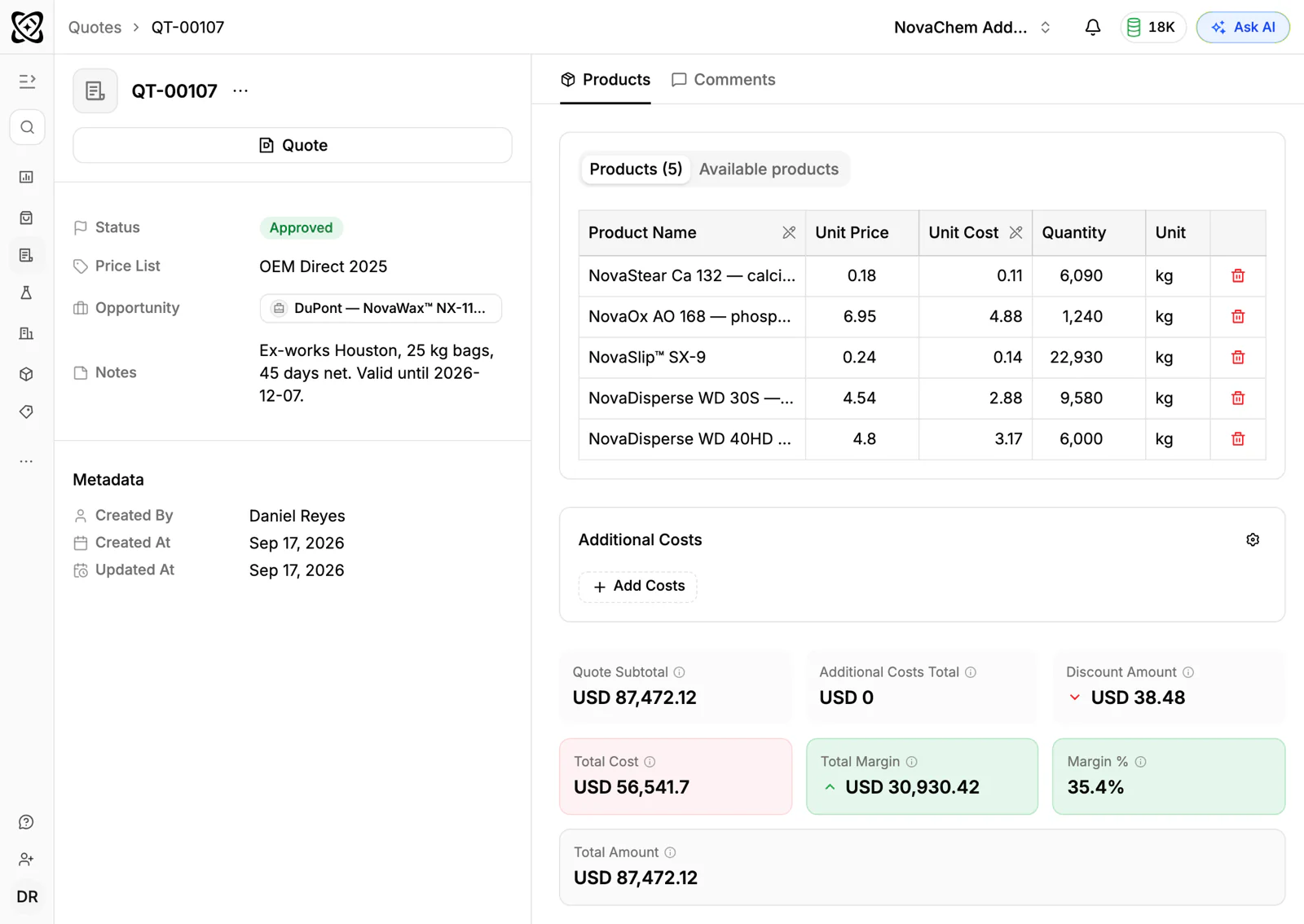
A quote has the statuses Draft, Pending and Approved, so a quote with a discount below your usual margin can stay at Pending until a manager marks it Approved. The customer receives a PDF or a public link. Once the buyer agrees, you create the sales order as its own record, and an invoice can be created from that order.
The negotiation itself often happens on email, WhatsApp or Telegram. Those messages arrive in the shared Inbox on the account, next to the deal, so the history of what was offered is in one place. The quotes and samples page shows the full flow.
Frequently asked questions
How much volume discount should I give?
There is no standard figure. Work backwards from your floor price: the cost of the product, the extra costs of the volume and the margin you need. Give discounts in tiers linked to quantity, and never go below the floor.
What should I ask for in return for a discount?
Ask for a commitment you can measure: a yearly volume, a blanket order, faster payment, a longer contract or shared forecasts. If the buyer gives nothing back, keep the discount small and mark it as a one-off.
Is a rebate better than a lower price?
Often, yes. A rebate is paid only when the buyer reaches the agreed volume, so you give the discount after you have the sale. A lower unit price is given up front, whether or not the volume arrives.
How do I respond when a buyer says a competitor is cheaper?
Ask for the competing quote and compare grade, quantity, delivery terms and payment terms. If it is the same product, show what your price includes, such as lead time and support, before you move on price.
How do I stop reps giving away margin?
Show the margin on every quote line, set a floor per product and require approval below it. Keeping agreed prices on the customer's price list also stops different reps quoting different numbers.