



















Quotation email templates
Six quotation email templates for product sellers: standard, with options, revised price, with sample results, urgent and an annual renewal quote.
 By the PromptLab team16 October 20264 min read
The quotation email is the message that carries your price. The attached quote has the numbers, but the email decides whether the buyer opens it, reads it and knows what to do next. A good one is short, states the key terms in the body and ends with a clear next step.
These templates cover the quotes a supplier of chemicals, packaging or industrial products sends most often. Each one assumes the formal quote is attached as a PDF. Once it is sent, move to our quote follow-up email templates. Before you send, run through the quote checklist.
The standard quotation email
Subject: Quote [Quote number] for [Product]
Hi [First name],

Thank you for your enquiry. Please find quote [Quote number] attached for [Quantity] of [Product] in [Pack size].

The main terms:
- Price: [Price] per [Unit]
- Delivery: [Incoterm and location], about [Number] days from order
- Payment: [Payment terms]
- Valid until: [Date]

If you'd like to go ahead, reply to this email with your purchase order number and I'll confirm the dispatch date the same day.

[Your name]
Use it for a clear request with a known quantity. Putting the terms in the body means the buyer sees them without opening the attachment.
Quotes with choices
Subject: Options for your [Product] order: quote [Quote number]
Hi [First name],

Attached is quote [Quote number]. I've priced two options so you can compare them:

Option A: [Grade or pack], [Price] per [Unit]
Option B: [Grade or pack], [Price] per [Unit]

Option B costs more per [Unit] but [Reason, for example fewer deliveries or a longer shelf life]. If you tell me how you plan to use it, I can say which I'd choose.

[Your name]
Use it when the request leaves room, for example a drum against an IBC, or two grades. Keep it to two options. Three makes the buyer postpone the decision.
Subject: Price breaks for [Product]: quote [Quote number]
Hi [First name],

Quote [Quote number] is attached. As you mentioned your volumes may grow, I've included price breaks:

[Quantity 1]: [Price 1] per [Unit]
[Quantity 2]: [Price 2] per [Unit]
[Quantity 3]: [Price 3] per [Unit]

The lower prices apply to a single order or to a call-off agreement over [Period]. Tell me which suits you and I'll update the quote.

[Your name]
Use it when the buyer has hinted at a larger or repeat volume.
Revised and time-sensitive quotes
Subject: Revised quote [Quote number] for [Product]
Hi [First name],

I've updated quote [Quote number], and the new version is attached. What changed: [Change, for example the quantity, the delivery location or the price].

The new price is [Price] per [Unit], valid until [Date]. Everything else stays as before. Please discard the earlier version.

[Your name]
Use it whenever any term changes. Say what changed in the first line so nobody has to compare two PDFs.
Subject: Quote [Quote number] for [Product], stock held until [Date]
Hi [First name],

You asked for a fast answer, so here is the quote: [Quantity] of [Product] at [Price] per [Unit], available from stock and shipping within [Number] days of your order.

I can hold this stock until [Time and date]. After that it goes back on sale. If you can confirm before then, I'll reserve it.

[Your name]
Use it only when the deadline is real. A false deadline costs you trust the next time.
Quotes that build on earlier work
Subject: Quote for [Product] after your trial
Hi [First name],

Thank you for the trial results. As [Property] met your target of [Target], here is quote [Quote number] for the same grade you tested, batch [Batch number].

The product you receive on a production order comes from the same specification. I've attached the [TDS or certificate of analysis] for reference.

[Your name]
Use it right after a successful sample. Naming the tested batch connects the price to the proof. See our sample follow-up email templates for the steps before it.
Subject: Your [Year] prices for [Product]
Hi [First name],

Your current prices for [Product] run until [Date]. Attached is the quote for the next [Period] on the same volumes you buy today: [Price] per [Unit], against [Old price] now.

[Reason for the change, or "The price is unchanged."] If your plans for the year are different, tell me and I'll re-quote.

[Your name]
Use it a month or two before a price agreement ends. If the price is rising, pair it with our price increase letter templates.
How to personalise them
- Put the terms in the body. Price, delivery, payment and validity belong in the email, not only in the attachment.
- Use their words. If the buyer called it "the 25 kg bag", so do you.
- End on one action. Reply with a PO, choose an option, confirm by a date.
- Name the file clearly. "Quote [Number] [Company].pdf" is easy to find later.
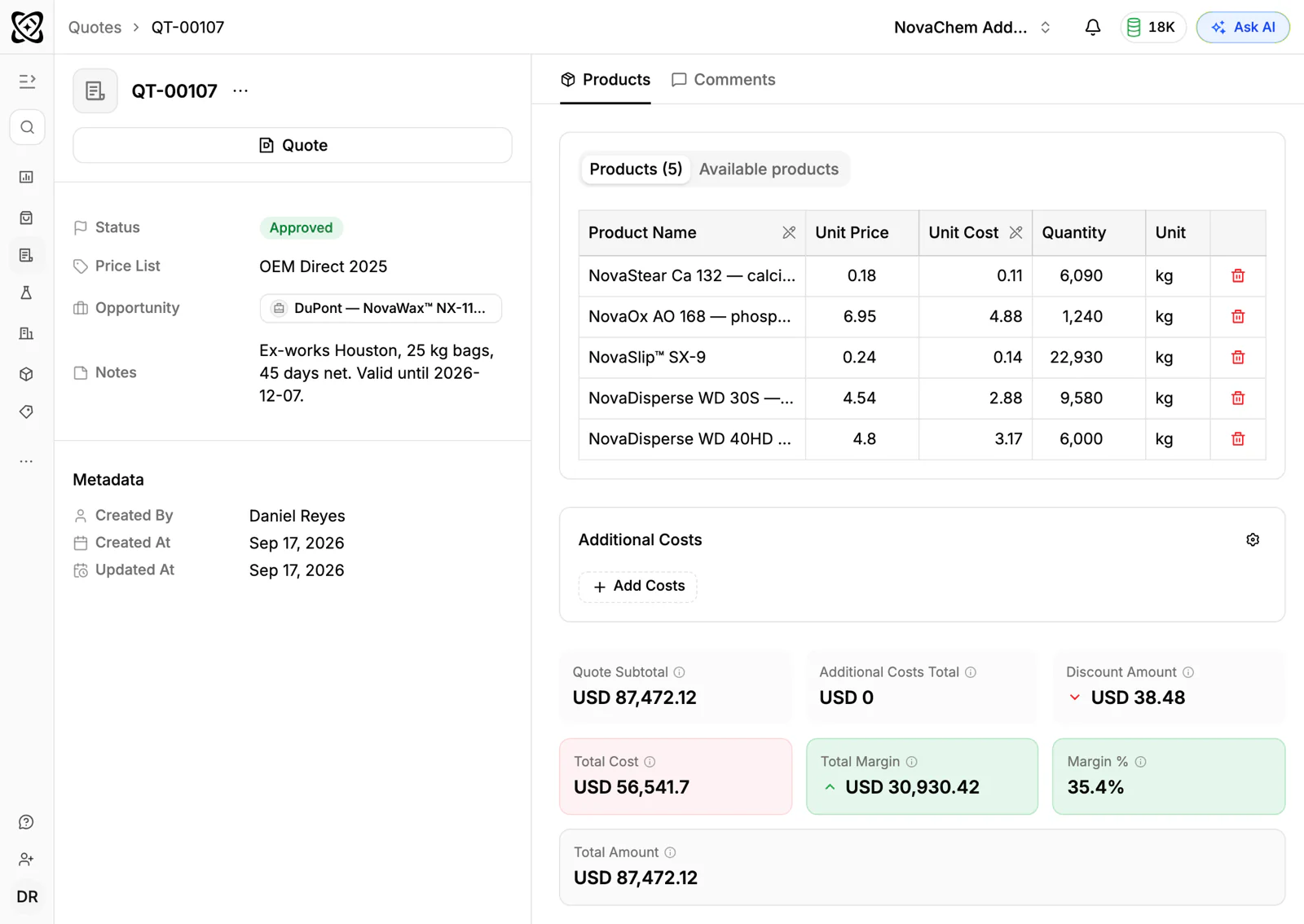
Send them from your CRM
Frequently asked questions
What should a quotation email include?
The product, quantity, price per unit, delivery terms, payment terms and the date the quote is valid until. Attach the formal quote and repeat those terms in the email so the buyer can decide from one screen.
How long should a quotation email be?
Under 120 words, plus the list of terms. The attachment carries the detail. The email only needs to say what is attached, what it covers and what you want the buyer to do.
Should I send the quote as a PDF or in the email body?
Send both. The PDF is the formal record the buyer's purchasing team files. The body gives the key terms so the reply can come quickly.
When should I follow up after sending a quotation?
Two to four working days later, with one specific question. Our quote follow-up email templates give wording for each stage.
How do I write a quote that is easy to approve?
Make every line clear, show the validity date and offer one obvious next step. Our guide to writing a sales quote walks through the layout.