








Quote follow-up email templates
Nine quote follow-up emails for product sellers: the day-after check, a price objection, a lead-time worry, an expiry notice and a final nudge.
 By the PromptLab team6 October 20265 min read
Sending the quote is half the job. Quotes in product sales often sit unanswered because the buyer is comparing three suppliers, waiting for a budget, or has simply lost the email. A short, specific follow-up gets them moving again.
These templates match the moments that come up after a quote leaves your hands. Each one gives the buyer something to react to. If you want help with the quote itself first, read how to write a sales quote that wins the order.
Checking the quote arrived
Subject: Quote [Quote number] for [Product]
Hi [First name],

I sent quote [Quote number] yesterday for [Quantity] of [Product] at [Price] per [Unit], delivered to [Location]. Could you confirm it reached you and that the specification is right?

If anything needs changing, such as the pack size or delivery date, I can reissue it quickly.

[Your name]
Use it the day after sending, especially to a new buyer. It also catches quotes lost in a spam folder.
Subject: Questions on quote [Quote number]?
Hi [First name],

There's a lot in quote [Quote number], so if it helps, I can walk you through it in 10 minutes: the price breaks, the payment terms and the delivery schedule.

Does [Day] at [Time] work?

[Your name]
Use it for larger or multi-line quotes.
Handling objections
Subject: Re: Quote [Quote number], price
Hi [First name],

Thanks for being open about the price. Before I change anything, can I ask what you're comparing it with? It matters whether it's the same grade, pack size and delivery terms.

If the gap is real, there are a few things I can look at: a larger order for a better price break, a different pack, or a delivery schedule that lets us combine shipments.

[Your name]
Use it when the buyer says the quote is too expensive. Ask first, discount second.
Subject: Comparing [Product] quotes
Hi [First name],

Understood that you have another quote. When you compare them, it's worth checking three things: whether the product meets [Spec], what the minimum order is, and what lead time they promise on repeat orders.

If those match and their price is still lower, tell me by how much and I'll see what I can do.

[Your name]
Use it when the buyer mentions a rival price. Don't criticise the competitor.
Subject: Delivery on quote [Quote number]
Hi [First name],

I understand the [Number]-day lead time is a concern. Two options: we can ship a first batch of [Quantity] from stock by [Date], with the rest to follow, or set up a call-off agreement for [Period].

Which would suit your production plan better?

[Your name]
Use it when delivery, not price, is the blocker.
Moving it forward
Subject: Quote [Quote number] valid until [Date]
Hi [First name],

A quick reminder that quote [Quote number] is valid until [Date]. After that, [Reason, for example we review the price against raw material costs].

If you'd like to go ahead, reply with your purchase order number, or tell me what needs to change and I'll update it today.

[Your name]
Use it a few days before expiry, and only if the date is real.
Subject: Revised quote [Quote number], version 2
Hi [First name],

Thanks for the feedback. I've revised the quote with [Change: new quantity, new pack or new delivery date]. The new price is [Price] per [Unit].

The revised version is attached, and everything else is unchanged. If it works for you, I can confirm the order today.

[Your name]
Use it right after you change a quote, so the buyer sees what moved.
Subject: Still relevant: [Product] quote
Hi [First name],

I haven't heard back on quote [Quote number], so let me ask directly: is this still a live project? If the timing has moved, say so and I'll check back in [Month].

If you've chosen another supplier, I'd value a line on why. It helps us improve.

[Your name]
Use it a week after the first follow-up.
Subject: Closing quote [Quote number]
Hi [First name],

I'm going to close quote [Quote number] on my side so it doesn't sit open. If your plans change, I can reopen it, though prices may have moved by then.

Thanks for your time, and I hope we get to work together on a later project.

[Your name]
Use it as the last message. Then mark the deal as lost, with the reason.
How to personalise them
The best quote follow-up refers to something only you and the buyer know.
- Quote the reason they gave. If they said "we only reorder in 25 kg bags", use that wording.
- Offer a number, not a feeling. "A price break at 5 pallets" is more useful than "a better price".
- Follow the status. A quote that was revised needs a different email from one that has not moved.
Once the quote is accepted, the next step is the sales order. See what is quote-to-order and how to speed up quote-to-order.
Send them from your CRM
Frequently asked questions
How long should I wait before following up on a quote?
One working day to confirm it arrived, then three to five working days to ask about progress. After that, a weekly rhythm is enough. Match it to the buyer's buying cycle: a weekly follow-up is too fast for a project that decides quarterly.
How do I follow up on a quote without sounding pushy?
Give the buyer something new each time: a clarified spec, a delivery option, a document. A message that only says "any update?" adds nothing and is easy to ignore.
What do I say when a buyer says my quote is too expensive?
Ask what they are comparing against, then check that grade, pack size and delivery terms match. If the gap is real, offer options such as a larger order or a different pack rather than a straight discount.
Should I put an expiry date on a quote?
Yes, if it is real. Raw material prices move, and a date gives the buyer a reason to decide. Don't invent a deadline you won't keep.
Can I track where a quote stands?
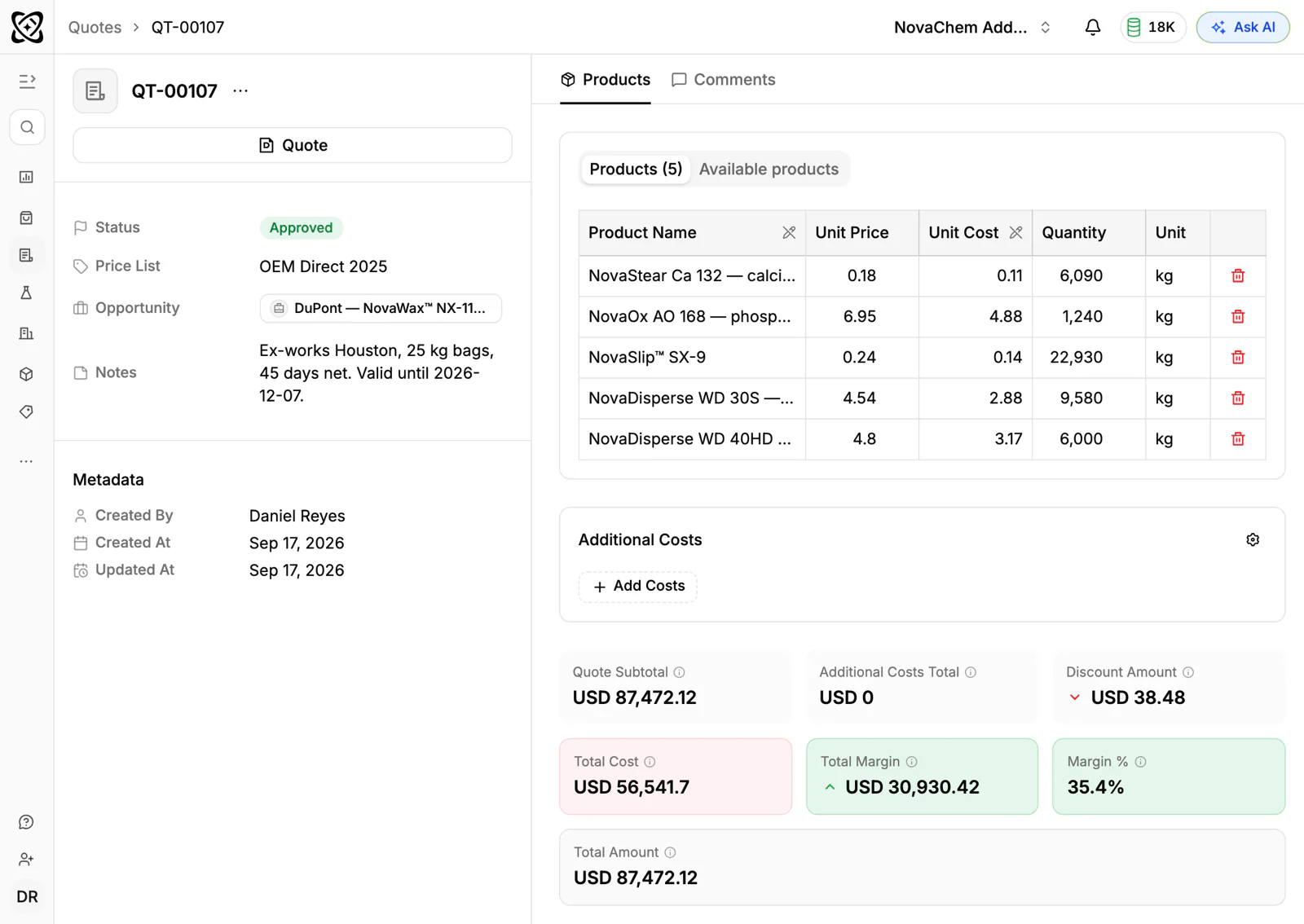
Yes. In PromptLab each quote has a status (Draft, Pending or Approved) and sits on its deal, so you can pick the right follow-up. The status tracks your own process. It doesn't tell you whether the buyer has opened the email.