



















What is a sales funnel?
A sales funnel shows how many prospects reach each step to a closed deal. Learn how it works, how it differs from a pipeline, and a B2B worked example.
 By the PromptLab team29 October 20263 min read
Definition
Sales funnel
A sales funnel is a model of the buying journey that shows how many prospects reach each step, from first contact to a closed deal. It is wide at the top and narrow at the bottom because some prospects drop out at every step.
Ask three sales leaders what their funnel is and you will get three drawings. The idea is always the same: count the people or companies at each step, and see where they fall away.
Why a sales funnel matters
A funnel turns a vague feeling ("we need more leads") into a specific question: at which step do we lose the most? If many prospects reply but few ask for a quote, the problem is the offer or the follow-up, not the lead source.
It also sets expectations. If you know roughly how many enquiries it takes to produce one order, you can work backwards from a revenue target to the number of enquiries you need.
How a sales funnel works
A B2B product funnel often has steps like these:
- Enquiry or lead: someone replies, fills in a form or is introduced.
- Qualified: you have confirmed a real need, a buyer and a rough volume.
- Sample or quote: the buyer tests a sample or receives a price.
- Negotiation: price, terms and delivery are being agreed.
- Order: the buyer commits.
At each step you count what enters, what moves on and what drops out. The share that moves on is the conversion rate for that step. Multiply the rates together and you get the rate for the whole funnel.
Sales funnel vs sales pipeline
People use the two words as if they were the same, but they look from different sides. The funnel is a view of volume and conversion: how many, and what share. The sales pipeline is a view of individual deals: which ones are open, what each is worth and who owns it.
Put simply, the pipeline is the list of deals and the funnel is the shape they make when you count them by stage. The stages themselves are the deal stages you already use.
An example from product sales
Say a distributor of cleaning chemicals gets 200 enquiries in a quarter, with these made-up numbers:
| Step | Prospects | Share that moved on |
|---|---|---|
| Enquiry | 200 | 50% |
| Qualified | 100 | 40% |
| Sample or quote | 40 | 50% |
| Negotiation | 20 | 50% |
| Order | 10 | n/a |
The whole funnel converts 10 of 200, which is 5%. The biggest loss in absolute terms is at the first step, but the step that looks weakest is qualification, where only 40% move on. The team might tighten its first-contact questions before spending more on lead sources.
Related terms
- Sales pipeline: the deal-by-deal view of the same journey.
- Deal stage: the step a deal is currently at.
- Win rate: the share of closed deals that were won.
- Pipeline coverage: how much open pipeline you hold against a target.
How PromptLab handles it
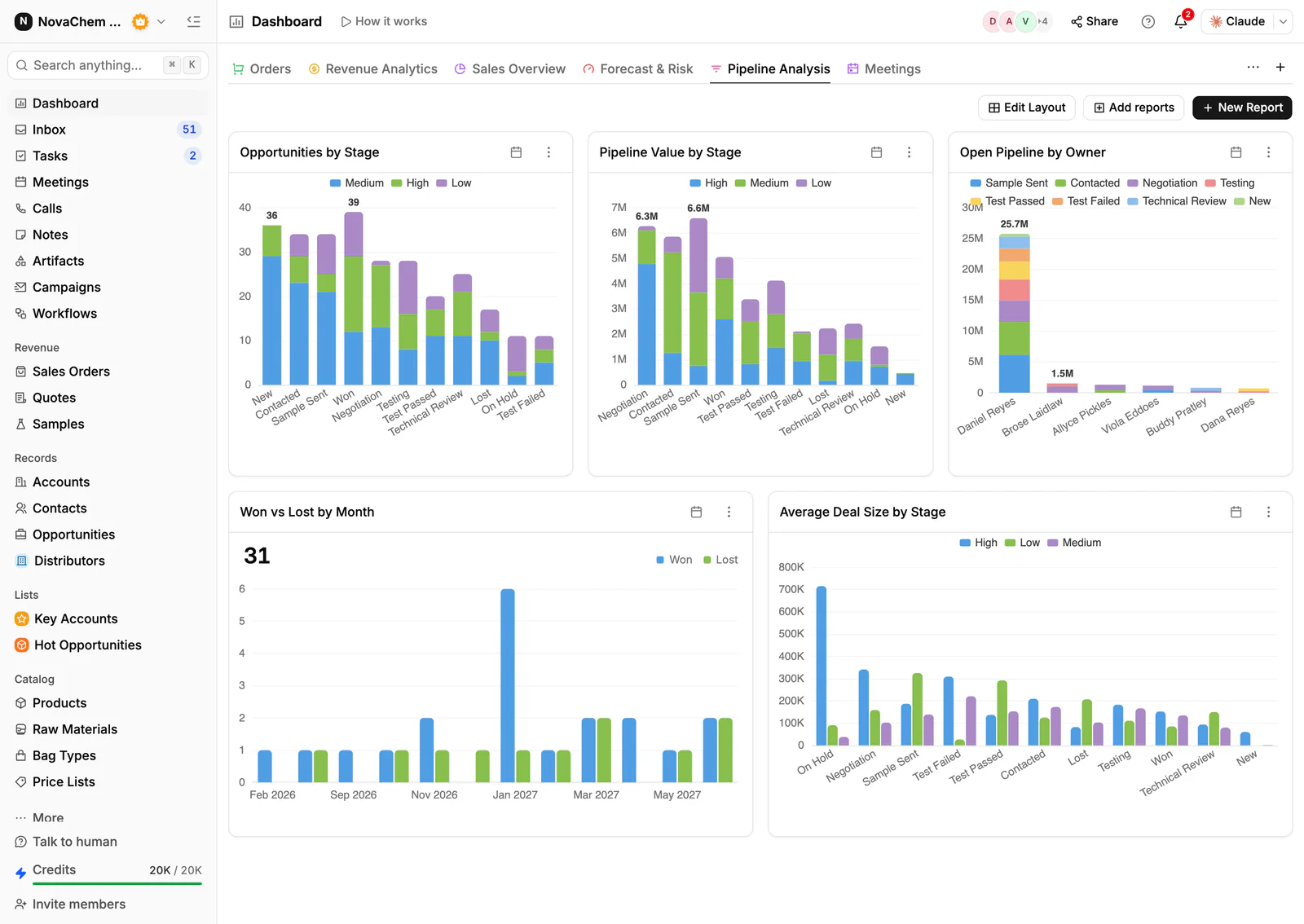
PromptLab gives each workspace one deal pipeline with stages you define, plus owners, lists and custom fields to split deals by product or region. Reports and dashboards on pipeline and revenue show where deals sit. Lost deals need a loss reason from a fixed list (Price, Competitor, Timing, No budget, Product fit, Other), so you can see why deals drop out and not only that they did.
Frequently asked questions
What are the stages of a sales funnel?
There is no single standard. A classic marketing version, AIDA, runs attention, interest, desire and action, while B2B product teams usually use steps such as enquiry, qualified, sample or quote, negotiation and order. Use the steps that match how your buyers actually buy.
What is the difference between a sales funnel and a sales pipeline?
The funnel counts how many prospects reach each step and what share convert. The pipeline lists the individual open deals with their value and owner. They describe the same journey from two angles.
What is a good funnel conversion rate?
It depends on your product, price and sales cycle, so compare against your own past quarters rather than a general figure. A rate that improves quarter on quarter is a better sign than one that matches someone else's.
How do I find the weak step in my funnel?
Work out the share that moves on at each step and look for the lowest one, then ask why buyers stop there. Loss reasons on lost deals and notes from calls usually explain it.