













What is pipeline coverage?
Pipeline coverage is the value of your open pipeline divided by your sales target. Learn the formula, a worked example and how to read the ratio.
 By the PromptLab team6 October 20264 min read
Definition
Pipeline coverage
Pipeline coverage is the total value of your open deals divided by the sales target for the same period. A ratio of 3 means you have three dollars of pipeline for every dollar you need to close.
Pipeline coverage answers one question: do we have enough deals in play to hit the number? You work it out for a month, a quarter or a year, and you can do it for a whole team or for one rep.
Why pipeline coverage matters
Not every deal closes. If your target is $100,000 and you have exactly $100,000 in open deals, you would need to win every single one. That almost never happens.
Coverage shows the gap early. If the ratio is low in week two of the quarter, you still have time to find more deals. If you only look at it in the last week, all you can do is hope.
How to calculate pipeline coverage
The formula is simple:
Pipeline coverage = open pipeline value ÷ sales target
Use only deals that are still open and that you expect to close inside the period you are measuring. Leave out deals already won and deals with a close date next year.
You can work it the other way round too. Divide 1 by your win rate to get the coverage you need. This works best with a win rate measured by value, or when your deals are of similar size. If you win one deal in four, you need four times your target in pipeline. If you win one in three, you need three times. Our guide to win rate shows how to find yours.
Want to try your own numbers? Use the calculator below.
Pipeline coverage calculator
Coverage ratio
2.6x
Open pipeline ÷ remaining target
Remaining target
$350,000
Pipeline you need
$1,400,000
Remaining target ÷ 25% win rate
Gap
$500,000
More pipeline to build
An example from chemical distribution
These figures are made up.
A distributor of industrial solvents has a quarterly target of $400,000. Its reps hold open deals worth $1,000,000 that are due to close this quarter. Coverage is $1,000,000 ÷ $400,000, which is 2.5.
Over the last year the team has won about one deal in three. That means it needs coverage of around 3. At 2.5 it is short. To reach 3 it needs $200,000 more in pipeline, which is the value of about 20 deals if the average deal is $10,000.
So the sales manager now has a clear job: get about 20 more qualified deals into the pipeline this month, not next quarter.
What is a good pipeline coverage ratio?
There is no universal answer. The right ratio depends on your win rate and on how clean your pipeline is.
- A team that wins one deal in two can get by with coverage near 2.
- A team that wins one in five needs coverage near 5.
- If old deals sit in the pipeline for months with no activity, the ratio looks better than it is.
Check the ratio against your own history instead of copying a number from a blog.
Common mistakes
- Counting stalled deals. A deal with no activity for 90 days is not coverage.
- Mixing periods. Compare this quarter's target with this quarter's deals only.
- Ignoring stage. $50,000 at the proposal stage is worth more than $50,000 at first contact. Many teams track coverage for late stages separately.
Related terms
- Win rate tells you how much coverage you need.
- Sales velocity shows how fast that pipeline turns into revenue.
- A sales pipeline is the list of deals the ratio is built from.
- A deal stage lets you split coverage by how far along each deal is.
- Sales forecasting uses coverage as one of its inputs.
How PromptLab handles it
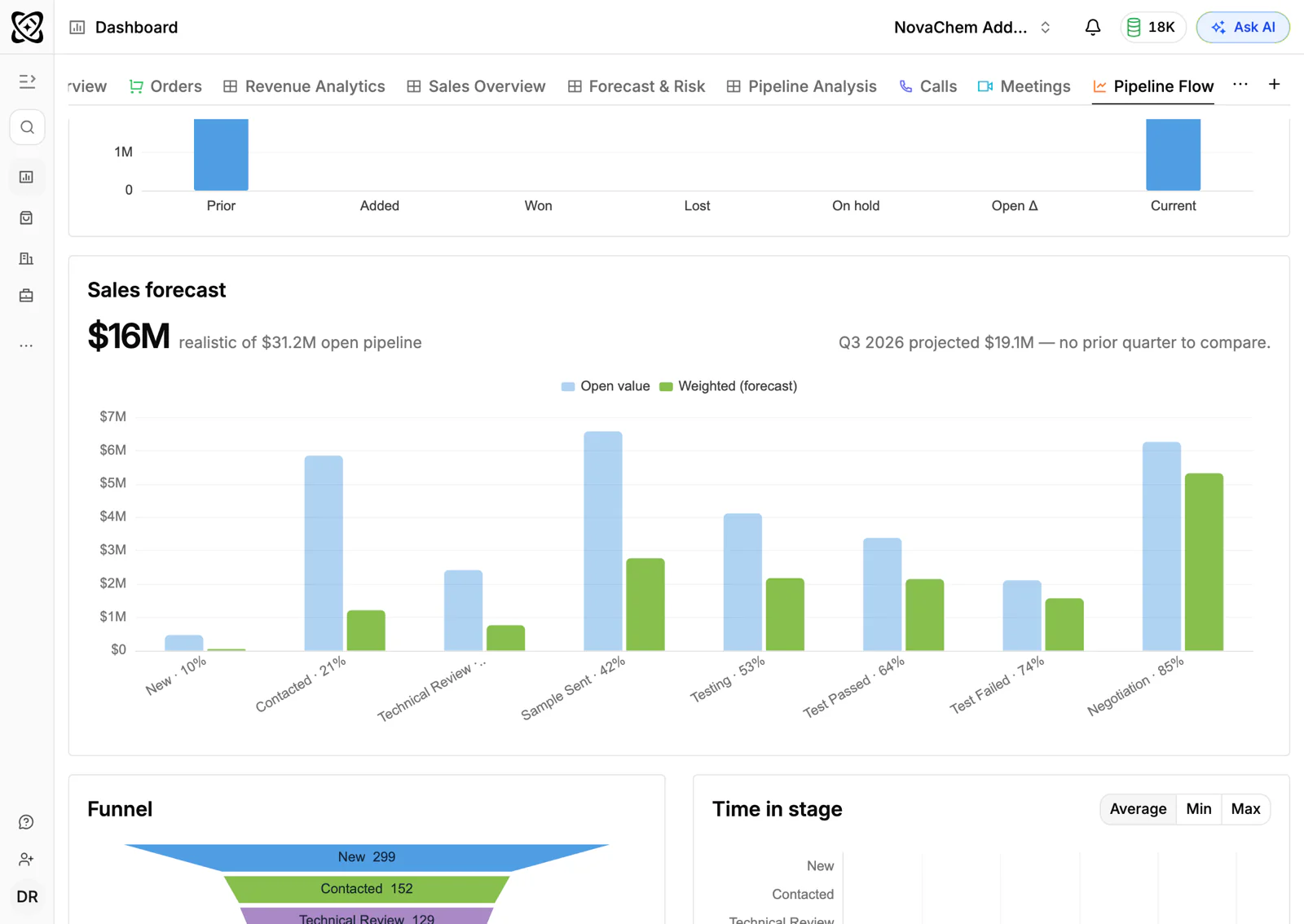
In PromptLab every deal sits in a pipeline with a stage, a value and a close date, so the numbers behind coverage are already in the CRM. You build reports and dashboards on pipeline and revenue, and you can see pipeline analysis by stage without copying anything into a spreadsheet.
Frequently asked questions
What is a good pipeline coverage ratio?
It depends on your win rate. Divide 1 by your win rate: if you win one deal in four, you need coverage of about 4. Many teams start from 3 and adjust once they see their own history.
Should I count deals from every stage?
You can, but it flatters the number. Many teams also track coverage for the later stages only, because early deals are less likely to close in time.
How often should I check pipeline coverage?
Weekly is a good habit. A short check in your pipeline review catches a gap while there is still time to fill it.
Is pipeline coverage the same as a forecast?
No. Coverage tells you if there is enough pipeline. A forecast is your estimate of what will actually close. Coverage is one input to it.