



















Discount request reply templates
Nine replies to a buyer's request for a discount: ask first, trade for volume, hold the price, offer terms instead and say no politely. Ready to copy.
 By the PromptLab team6 November 20265 min read
"Can you do better on the price?" lands in every sales inbox. The weak reply is a quick yes, which teaches the buyer to ask every time and takes margin you did not have to give. The strong reply asks what the buyer is comparing, then trades the discount for something: volume, a longer commitment, faster payment.
These replies are written for manufacturers and distributors who quote from a price list. Pick the one that matches the buyer's request, fill in the brackets and send it. For the thinking behind them, read how to handle price objections and how to negotiate volume discounts.
First reply: ask before you give
Subject: Re: Price on [Product]
Hi [First name],

Thanks for the feedback on the price. So I understand the gap, can you tell me what you're comparing it with? It helps to know whether it is the same grade, pack size, minimum order and delivery terms.

If you can share the other figure, I'll see where we can meet you.

[Your name]
Use it first, every time. A discount offered before you know the gap is usually larger than needed.
Subject: Re: Price on [Product]
Hi [First name],

I understand price matters. Our [Price] per [Unit] for [Product] reflects [Reason: the grade, the batch testing, delivery in [Number] days, technical support]. For the same spec, the cheaper options we see tend to differ on [Difference].

Do those points matter for your application? If not, there may be a different grade that suits you better.

[Your name]
Use it when value is the real point. Keep to facts the buyer can check.
Trading a discount for something
Subject: Price for [Quantity] of [Product]
Hi [First name],

I can't move the price on [Quantity]. At [Higher quantity] per order, I can offer [Price] per [Unit], because it fills a [Pallet or truck] and saves us handling.

Would [Higher quantity] work, either in one order or over [Period]?

[Your name]
Use it when the request is for a lower price at the same quantity.
Subject: A [Period] price for [Product]
Hi [First name],

If you can commit to [Total quantity] over [Period], with call-offs as you need them, I can hold [Price] per [Unit] for the whole period. That gives you price certainty, and lets us plan production.

Would a commitment like that suit you? I can draft the terms today.

[Your name]
Use it for a repeat buyer. Only offer a fixed price if you have checked your own raw material costs.
Subject: Terms on quote [Quote number]
Hi [First name],

The price on [Product] is as low as I can take it. What I can do is help on terms: [Payment terms, for example 45 days from invoice] instead of [Standard terms], or free delivery on orders over [Amount].

Would that help on your side?

[Your name]
Use it when the buyer's problem is cash flow, not the unit price. Check with finance first.
Holding the line
Subject: Re: Price on [Product]
Hi [First name],

Thank you for asking. I've checked, and I can't go below [Price] per [Unit] on this order without moving our spec or service level. I'd rather be straight with you than offer a discount we can't sustain.

If the budget is fixed, tell me the figure and I'll look at a smaller pack or an alternative grade that fits.

[Your name]
Use it when the price is at your floor.
Subject: Your [Competitor] comparison
Hi [First name],

Thank you for sharing the other quote. Before I react to the price, I see that theirs is based on [Difference: ex-works delivery, a 12-month contract, a different grade]. On a like-for-like basis the gap is closer to [Amount].

If you want to proceed with us, I can offer [Price] for [Quantity]. Does that close the gap?

[Your name]
Use it when the buyer shows you a rival price. Compare terms, not just numbers.
Saying yes the right way
Subject: Revised price on [Product]
Hi [First name],

I've managed to get approval for [Price] per [Unit] on [Quantity], on the basis that the order is confirmed by [Date] and the delivery is [Schedule].

The revised quote is attached. If everything is as agreed, send me your purchase order and I'll confirm it today.

[Your name]
Use it when you agree. Attach a condition and a date, or the discount becomes the new normal.
Subject: Re: First order pricing
Hi [First name],

Thank you for the first order enquiry. For first orders our list price applies, so I can't offer a discount at this stage. Once we have worked together for a few orders, I'm happy to look at a volume or annual agreement.

If you'd like to go ahead, the quote is valid until [Date].

[Your name]
Use it for a first order when you do not have history to trade against.
Tips for using these replies
- Never give a discount for free. Ask for volume, a date, payment terms or a longer commitment in return.
- Change the quote, not the habit. Update the price in writing and note why, so the next rep sees the reason.
- Know your floor before you reply. Check the margin on the quote, not just the price.
- Mind the price list. If many customers get the same break, put it in the price list for them, instead of letting it live in emails. See how to manage customer price lists.
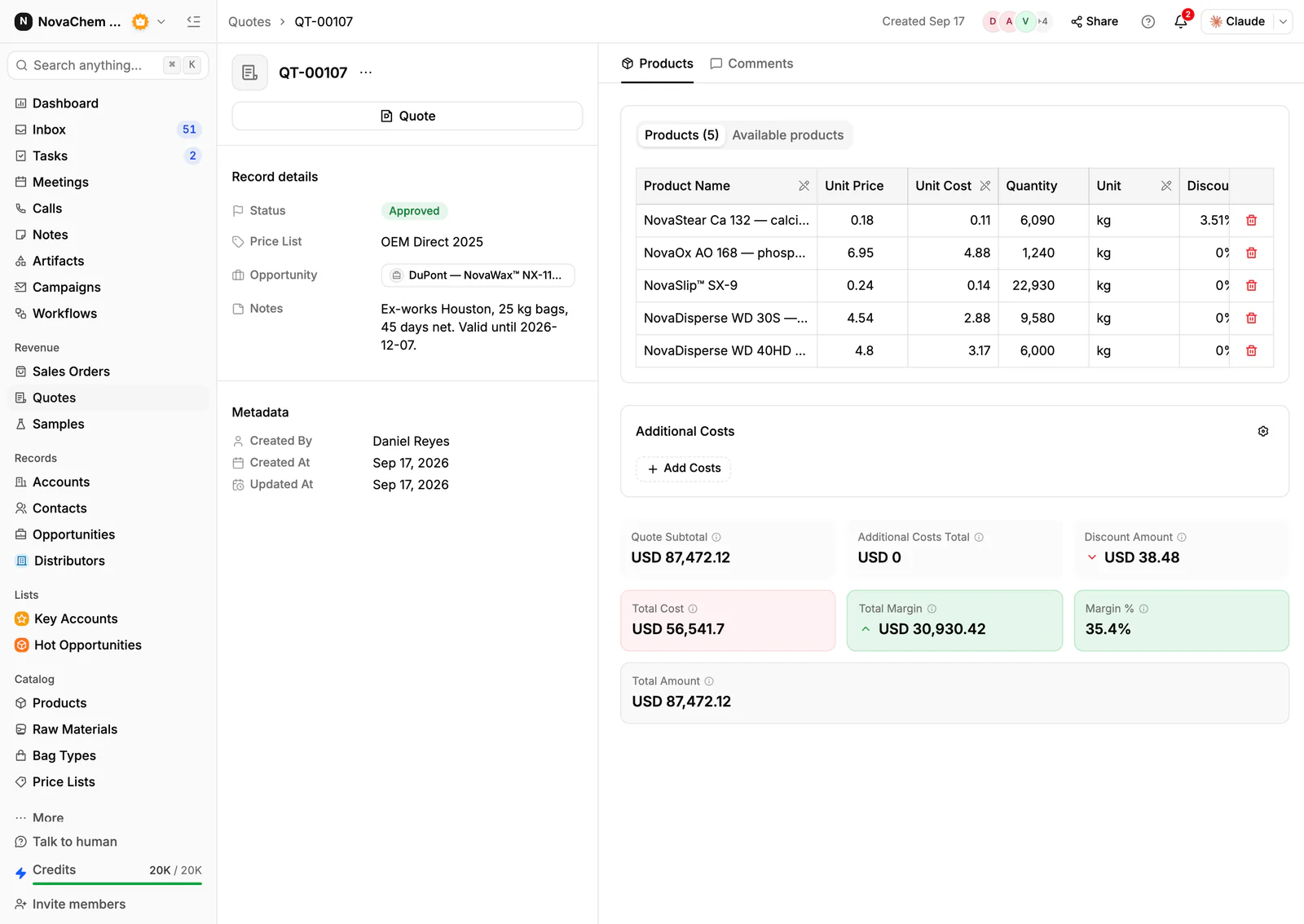
Send them from your CRM
Frequently asked questions
Should I give a discount the first time a buyer asks?
Rarely. Ask what they are comparing against, then offer something in exchange for the discount, such as a larger order or a committed period. A first-time yes teaches the buyer to ask again.
How do I decline a discount without losing the deal?
Be clear about the price, explain what it covers, and offer a route that fits their budget: a different pack, a different grade or a bigger order. A buyer who feels heard will often accept a no.
What can I offer instead of a lower price?
Payment terms, delivery terms, a fixed price for a period, free delivery over a threshold or a sample of a second product. Check each with finance and operations before you offer it.
How much discount is acceptable?
It depends on your margin and your costs, so set the limits by product group before the negotiation. Make sure each rep knows what they can approve and what goes to the manager.
Where should I record a negotiated price?
On the quote, with a note of the condition. If the price will apply to many orders, put it into a customer price list, so everyone quotes the same figure.