



















How to handle price objections in B2B sales
Handle price objections by finding out what "too expensive" means, showing total cost and value, and trading concessions instead of discounting. With examples.
 By the PromptLab team16 October 20266 min read
To handle a price objection, first find out what the buyer means by "too expensive". Then show the value or total cost behind your number, and if you do concede, trade something for it instead of simply cutting the price. Most objections are a question, not a refusal, and a calm question back is the best first move.
In B2B product sales the buyer often compares your quote with a competitor's, a previous supplier's price or a budget set by someone else. This guide gives a process you can follow on a call or in an email, with examples from chemicals, packaging and industrial supply.
What a price objection usually means
"Your price is too high" can mean at least five different things. The buyer has a lower quote in hand. The buyer has a budget and your number does not fit it. The buyer wants a discount and says this to everyone. The buyer cannot see why your product costs more. Or the buyer is not sure they need it yet.
Each needs a different answer. A discount only helps with the third. If you cut the price on a reflex, you teach the buyer to object, and you lose margin on the deals that would have closed anyway.
Step by step: respond to a price objection
- 1
Stay calm and do not defend
Do not justify the price in the first sentence. A defensive answer tells the buyer the price is soft. Say "Thanks for being straight with me" and move to a question.
- 2
Ask what they are comparing it with
"Which part of the price is the issue?" and "What number did you have in mind?" are fair questions. Ask for the competing quote if you can. You need to know whether the other offer covers the same grade, pack size, incoterm and payment terms.
- 3
Compare like with like
Many price gaps close when you line up the details. One quote may be ex-works and yours delivered. One may be a lower grade, a longer lead time or a smaller pack. Go through the lines together and write down the differences.
- 4
Show total cost, not unit price
A buyer who counts only the price per kilo misses freight, waste, rework, downtime and the cost of a failed batch. Build a simple picture of what the buyer pays per finished unit, not per delivered unit.
- 5
Tie the price to what they care about
Reliability, technical support, consistent batches, faster delivery and shorter payment terms all have a cost on the buyer's side. Use their own words from earlier calls. If you have not recorded them, that is the lesson for next time.
- 6
Trade, do not give
If you move on price, ask for something. A larger order, a longer contract, a faster payment or a commitment on volume are all fair trades. A discount with nothing attached is a cost.
- 7
Confirm and send the revised quote the same day
Once you agree, put it in writing at once. Update the quote, keep the old version in the history and set a task to follow up. The quote follow-up email templates help here.
Worked example: a packaging price gap
Say a corrugated packaging supplier quotes a food producer 10,000 boxes at $0.92 each. The buyer replies that a competitor quoted $0.84.
The rep asks to compare the two. The cheaper quote is for a lighter board, ex-works, with a four-week lead time. The rep's quote is delivered, uses the board the buyer's line was running before, and ships in ten days. The buyer admits their line had jams last time with lighter board.
The rep does not drop the price. They offer to match the lighter board on a trial of 2,000 boxes and to keep the first quote for the rest. The buyer gets a fair test, and the rep keeps the margin on the main order.
Common objections and how to answer them
"A competitor is cheaper"
Ask for the details of the other quote. Compare grade, pack, incoterm, lead time and payment terms. If the products really are the same, you are in a price negotiation, so decide your floor and trade.
"It's over our budget"
Ask what the budget is and who set it. Then offer a way to fit: a smaller first order, a different pack size or a staggered delivery. Do not cut the unit price until you have tried to change the shape of the order.
"We need a better price for volume"
Ask for the volume in writing, per month or per year. Quote a tier, for example a lower price above a stated quantity, and put the commitment in the terms. Volume that never arrives costs you.
"We're happy with our current supplier"
This is rarely about price. Ask what would have to be true for them to try a second source. A sample or a small trial order is often the answer. See how to track product samples.
"Can you do better?"
Say yes, if you can, and ask what they can do in return. "If you can commit to the full 20 tonnes this quarter, I can look at it" is a clean, honest reply.
Know your floor before the call
Every good price conversation starts before it begins. Know your cost, your target price and the lowest price you can accept. Say your cost is $1.52 a kg and you quote $1.85. A cut to $1.75 takes $0.10 a kg from your margin of $0.33, which is about a third of it. Seeing that number in advance makes a "small" discount feel like what it is.
Keep a record of what you conceded and what you got back. After a quarter you will see which customers always get a discount, and whether it was ever bought with volume. Tracking win and loss reasons also helps your pipeline review.
When you do need to raise prices
Price objections get harder when you raise prices for existing customers. Give notice, explain the input costs in plain words and offer a date to lock the old price on an agreed order. The price increase letter templates give you wording.
How PromptLab helps
Price conversations go better with the facts in front of you. In PromptLab, a quote links to the deal and to the customer's price list, and each line shows unit price and unit cost side by side. The summary shows total cost, margin and margin percentage as you edit, so you can see what a concession costs before you offer it.
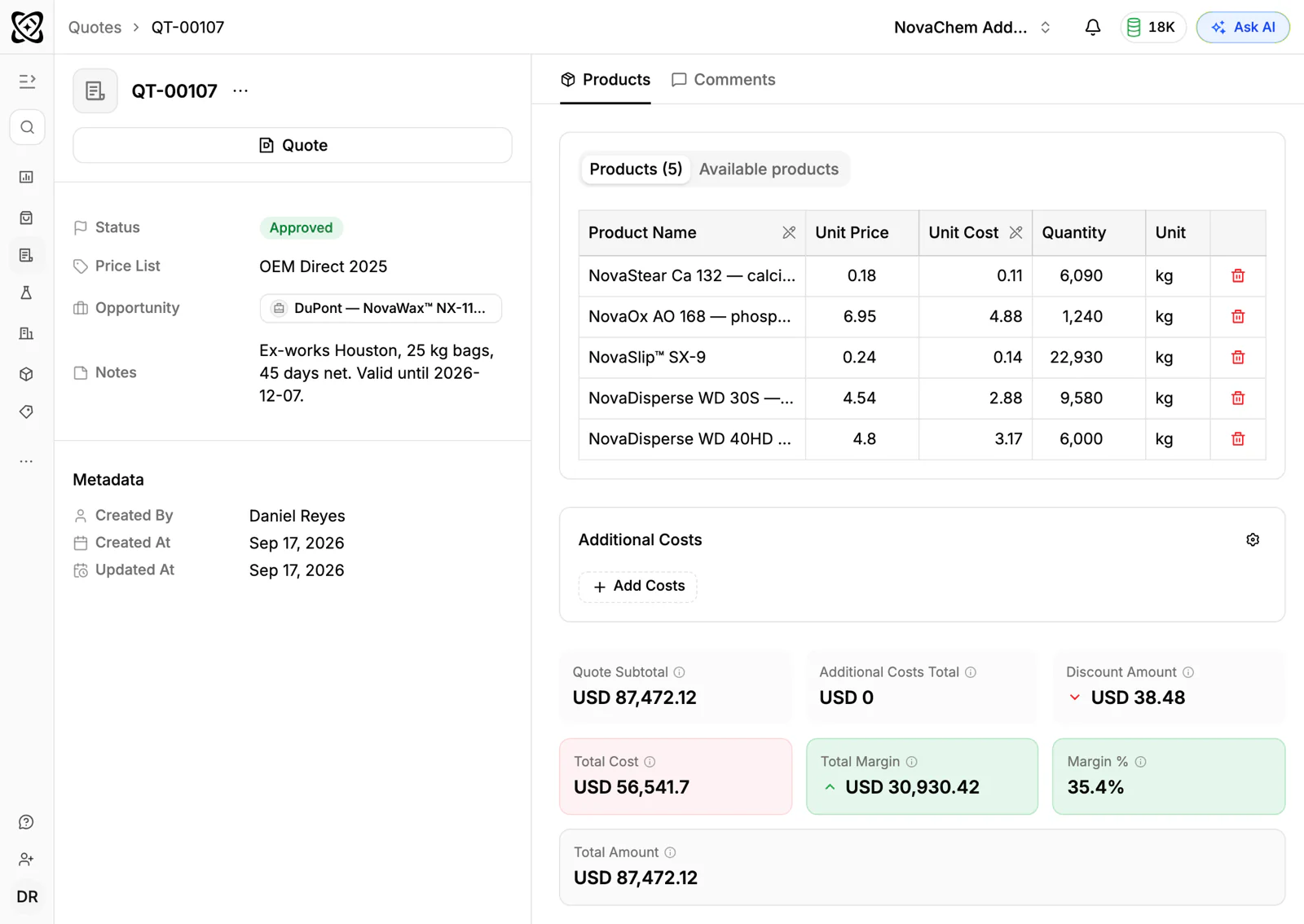
Everything the buyer has said sits on the account: emails, meetings with recordings and transcripts, and WhatsApp and Telegram messages in the shared Inbox. Before a negotiation you can open the account, or ask in plain words with Ask AI, and see what the buyer said about price last time. Keep a customer's agreed prices on their price list so a quote starts from the right number.
Frequently asked questions
How do you handle a price objection in B2B sales?
Ask what the buyer is comparing against, line up the details such as grade, pack and terms, and show the total cost or value behind your price. If you concede, trade it for volume, a longer commitment or faster payment instead of cutting the price alone.
Should I lower my price when a customer pushes back?
Not straight away. First find out what the objection really is. Many are about missing information or a mismatched comparison, and a discount does not fix those. If you do lower the price, ask for something in return.
How do I respond when a competitor is cheaper?
Ask for the details of their quote and compare like with like: grade, pack, incoterm, lead time and payment terms. If the offers are truly the same, decide your floor and negotiate. If they differ, show what the difference is worth to the buyer.
What is value-based selling in B2B?
It means pricing and presenting your product around what it is worth to the buyer, such as fewer failed batches or reliable delivery, rather than around your cost. It needs you to know what the buyer cares about, which means recording it from every call.
How can I avoid price objections in the first place?
Qualify the buyer's needs and budget early, quote complete and clear terms, and show value before you show a price. A quote that is specific and delivered quickly raises fewer objections than a vague one.