



















How to expand into a new sales region
Expand into a new sales region by testing demand, choosing direct sales or a distributor, setting prices and tracking the region in your CRM from day one.
 By the PromptLab team29 October 20265 min read
To expand into a new sales region, first test whether buyers there want what you make, then choose how you'll sell (your own reps, a distributor, or both), set prices and samples for that market, and track the region separately from day one so you can see if it's working. Move in small steps. A region that's tracked from the start tells you quickly whether to push on or stop.
This guide is for founders and sales leaders at manufacturers and distributors who want to sell beyond their home market, whether that's the next state, the next country or a new part of the world. It covers the questions to answer before you start, the first ninety days and how to measure the result. It doesn't give legal, tax or customs advice: for those, talk to a qualified adviser in the target market.
Start with demand, not with a plan
A new region fails for a plain reason more often than a complicated one: nobody there needed the product at your price. Before you hire or ship anything, collect evidence.
- Existing signals. Are customers there already contacting you? Look at enquiries, website visits and orders you've received from the region.
- Who buys. Name the type of buyer: a formulator, a contractor, a distributor, a manufacturer. Make a list of twenty real companies of that type.
- What they buy today. Find out who supplies them now and what they pay, by talking to them.
- What gets in the way. Think about lead time, language, certifications, payment terms and the cost of getting goods there.
If you can't name twenty buyers and say why they'd switch, you're not ready to expand.
Choose how you will sell there
You have three realistic routes, and each asks for different things from your team.
| Route | Good when | Watch out for |
|---|---|---|
| Your own reps | Deals are large, technical and few | Slow to start, costly before the first order |
| A distributor | The region needs local stock, language and relationships | You depend on their effort and see less of the end customer |
| Both | You want local help but keep the big accounts | Clashes over who owns which account |
Many product companies start with a distributor or an agent and keep the largest accounts themselves. Whatever you choose, settle account ownership in writing before the first deal. For the distributor route, read how to sell through distributors, and when you're choosing one, the distributor evaluation checklist helps.
Step by step: the first ninety days
- 1
Define the region and the target buyer
Put clear edges around it: the countries or states, and the type and size of buyer. A vague region gives you vague numbers.
- 2
Build the first list
Make a list of twenty to fifty target accounts in the region, with the right contact at each. Keep it in the CRM, not a spreadsheet, so activity attaches to it.
- 3
Prepare the offer for that market
Check that you can quote in the right currency and units, state lead times honestly, and send samples. Make a customer price list for the region so every quote starts from the same prices.
- 4
Start with samples
In product sales, a sample is how a new buyer tests you. Offer a sample to every qualified account and track what happens next.
- 5
Set a small target
Choose a target you can check at the end of ninety days, such as the number of qualified accounts, samples out and quotes sent. Don't set a revenue target for a market you haven't tested.
- 6
Review at day thirty, sixty and ninety
Look at what the numbers say. Keep going, change the approach or stop. Write down why.
Set prices and terms for the new market
Prices in a new region often differ from home: freight, duties, local competitors and payment terms all push them around. Decide these before the first quote.
- Currency and units. Quote in the currency and units the buyer works in.
- Incoterms. Say who pays for freight and insurance and where risk passes. See what Incoterms are.
- Payment terms. Decide what you'll accept with a new buyer you haven't met, such as part payment up front or a letter of credit.
- Minimum order. Set a minimum order quantity that makes the shipment worth sending.
Keep the rules in one place so every rep quotes the same way.
Common mistakes
- Entering many regions at once. You can't learn from five tests you can't watch.
- Hiring before you have a buyer list. A rep with no target accounts spends months finding out what you could have asked.
- Giving a distributor the region with no targets. Agree on what they will do, not just what they will get.
- Mixing the new region into home numbers. You can't tell if it works.
- Skipping the handover. When a rep leaves the region, the accounts need a clean transfer. See the sales territory handover checklist.
How PromptLab helps
PromptLab keeps one deal pipeline per workspace, so you track the new region with stages, owners, lists and custom fields rather than a second pipeline. Use the Region field on each account, put the target accounts in a list for that region, and use customer price lists, quotes and sample tracking for the offer.
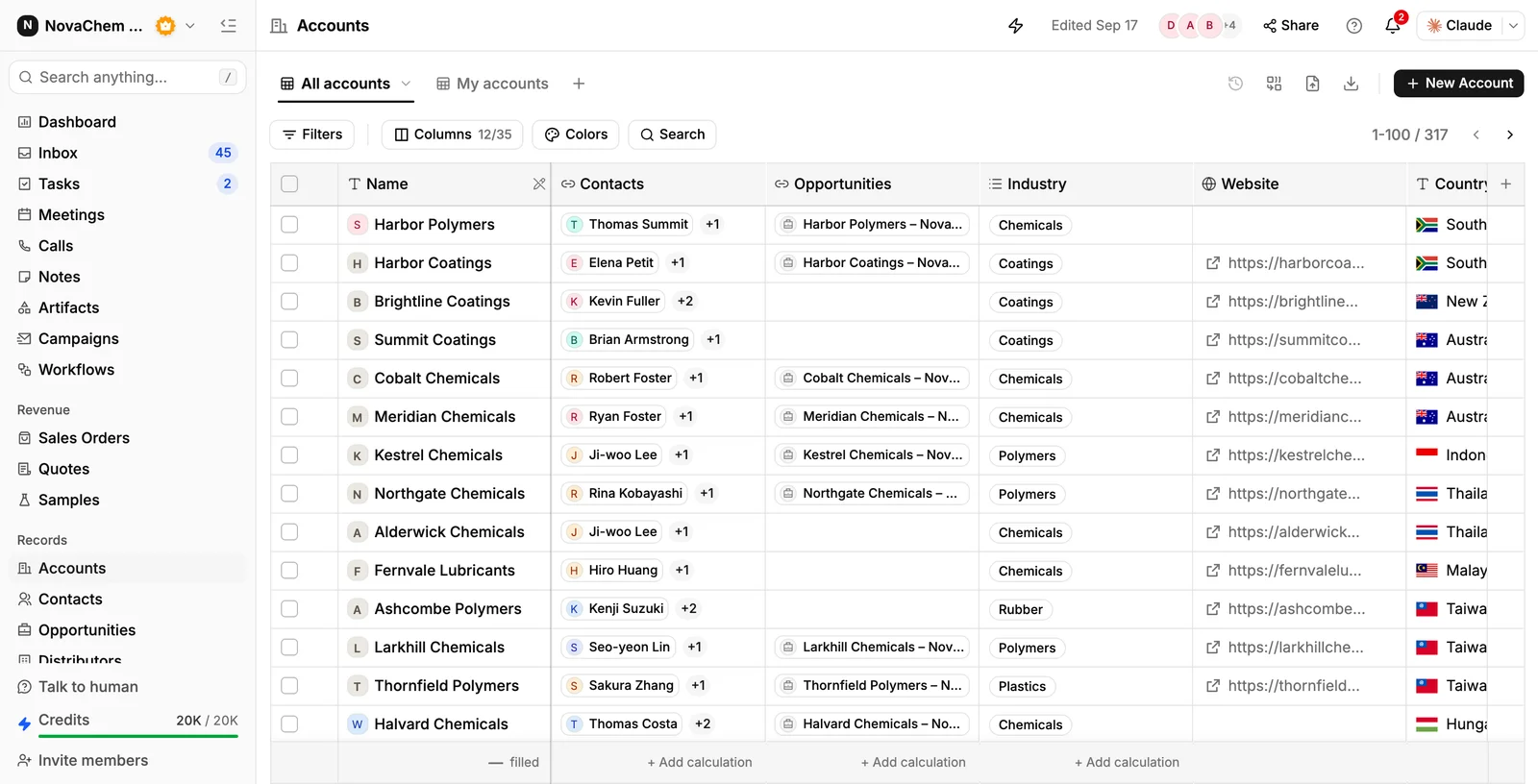
Reports and dashboards on pipeline and revenue let you check the region at day thirty, sixty and ninety. To keep who owns what clear, see how to manage sales territories.
Frequently asked questions
How do I know if a new region is worth entering?
Look for evidence before you spend: enquiries and orders already coming from there, a list of twenty named buyers and a clear reason they'd switch to you. If you can't produce those, test with samples first.
Should I use a distributor or my own reps?
A distributor suits regions that need local stock, language and relationships. Your own reps suit few, large, technical deals. Many companies start with a distributor and keep the largest accounts themselves, with account ownership agreed in writing.
How long should a regional test run?
Ninety days is a sensible first test, with reviews at thirty, sixty and ninety days. Judge it on early signs such as qualified accounts, samples sent and quotes issued, since orders may take longer.
How do I track a new region in the CRM?
Use the Region field on accounts, a list of the region's target accounts, and owners for each. In PromptLab there's one pipeline per workspace, so the region is tracked with those rather than a separate pipeline.
Do I need to change my prices for a new market?
Often yes. Freight, duties, local competition and payment terms all affect the price. Make a customer price list for the region and quote from it so every rep starts from the same numbers. Check tax and customs questions with a local adviser.