












How to run a weekly pipeline review
A 45-minute weekly pipeline review for B2B product teams: the agenda, the questions to ask on each deal, and the hygiene rules that keep the numbers honest.
 By the PromptLab team6 October 20266 min read
A good weekly pipeline review takes 45 minutes, covers the deals that matter and ends with a named next step on every one of them. Start with the numbers, spend most of the time on the five to eight deals that decide the month, and finish with hygiene: close dates, stages and stale deals. Nobody reads out a list. Everybody leaves knowing what happens by Friday.
This guide gives you the agenda, the questions that expose a weak deal, and the rules that stop the CRM drifting away from reality. It is written for teams that sell physical products, where a deal is a sample, a quote, a price negotiation and then a stream of repeat orders.
What a pipeline review is for
A pipeline review has one job: decide what each open deal needs this week. It is not a status update, and it is not a place to defend your numbers.
Reviews go wrong in two ways. Either the manager reads the whole board aloud and half the room checks email, or reps present only the deals they feel good about. Fix both by fixing the input. The review runs from the CRM, on a screen everyone can see, and the manager picks the deals, not the rep.
If you want the wider picture first, read what a sales pipeline is and how to build a B2B sales pipeline.
The 45-minute agenda
- 1
Numbers first (5 minutes)
Open the dashboard. Look at open pipeline value, deals created this week, deals won and lost, and pipeline against target. Do not discuss individual deals yet. Note anything odd, such as a stage that has doubled in size, and come back to it.
- 2
Movement since last week (5 minutes)
List what moved forward, what moved back and what was added. A deal that jumped two stages needs a one-line reason. A deal that was lost needs a one-line cause: price, lead time, spec, competitor or no answer.
- 3
Deep dive on the deals that matter (25 minutes)
Pick the biggest deals, the ones closing this month and the ones that have stalled. Spend about four minutes each. Use the questions in the next section.
- 4
Hygiene sweep (5 minutes)
Filter for deals with a close date in the past, no next step, or no activity for a set number of days. Fix them on the spot or close them out.
- 5
Commitments (5 minutes)
Each rep reads out their next actions for the top deals. The manager writes them down as tasks, not as notes.
Questions to ask on every deal
Four minutes per deal means you need sharp questions. These work for product sales because they follow how an order actually forms.
Is the need real?
- What is the customer making or selling with our product, and what happens if they do not buy this quarter?
- Is this a one-off order, a trial run or a recurring supply arrangement?
Where is the product in their process?
- Has a sample shipped? Has it been tested? What did they say about it?
- Does it need approval from quality, R&D or a plant manager before they can order?
Who decides, and have we met them?
- Who signs the purchase order, and have we spoken to them?
- Is the person we talk to the buyer or only the person who researches?
Is the commercial side agreed?
- Which quote is out, when was it sent and what is its status?
- Did the customer ask for a price or lead time we cannot hit?
What happens next?
- What is the next step, who owns it and what date is it on?
- If the answer is "waiting to hear back", what is our plan if they stay silent?
If a rep cannot answer the third and fifth questions, the deal is probably earlier in the pipeline than its stage says. Move it back. That is not a punishment, it is a more accurate forecast. See how to forecast sales for what to do with the corrected numbers.
A worked example
Say a coatings supplier has a deal at "Quote sent", worth $48,000 a year, with a close date this month. The review goes like this. The rep says the buyer liked the sample. The manager asks who approves the switch. The rep does not know. The manager asks when the quote was sent: 19 days ago, no reply.
The outcome is not a lecture. It is two tasks: ask the contact who signs off, and propose a call with the plant manager by Thursday. The close date moves to next month.
Hygiene rules that keep the review honest
Reviews fail when the data is stale. Agree these rules once and enforce them in the sweep.
Pipeline hygiene rules
Write the exit criteria for each stage down in one sentence. "Sample sent" means a sample is tracked as shipped, not that someone promised to send one. "Quote sent" means a quote exists with a status. A shared definition is what makes a stage mean something.
Mistakes that kill a review
- Reviewing everything. Forty deals in 45 minutes is a recital. Pick the deals that decide the month and sweep the rest with filters.
- Asking for updates, not decisions. End each deal with an action, an owner and a date.
- Letting reps update the CRM during the meeting. Do it before. The meeting is for judgement.
- Only talking about late-stage deals. Early-stage coverage decides next quarter. Use the pipeline coverage calculator to check you have enough.
Pipeline coverage calculator
Coverage ratio
2.6x
Open pipeline ÷ remaining target
Remaining target
$350,000
Pipeline you need
$1,400,000
Remaining target ÷ 25% win rate
Gap
$500,000
More pipeline to build
How PromptLab helps
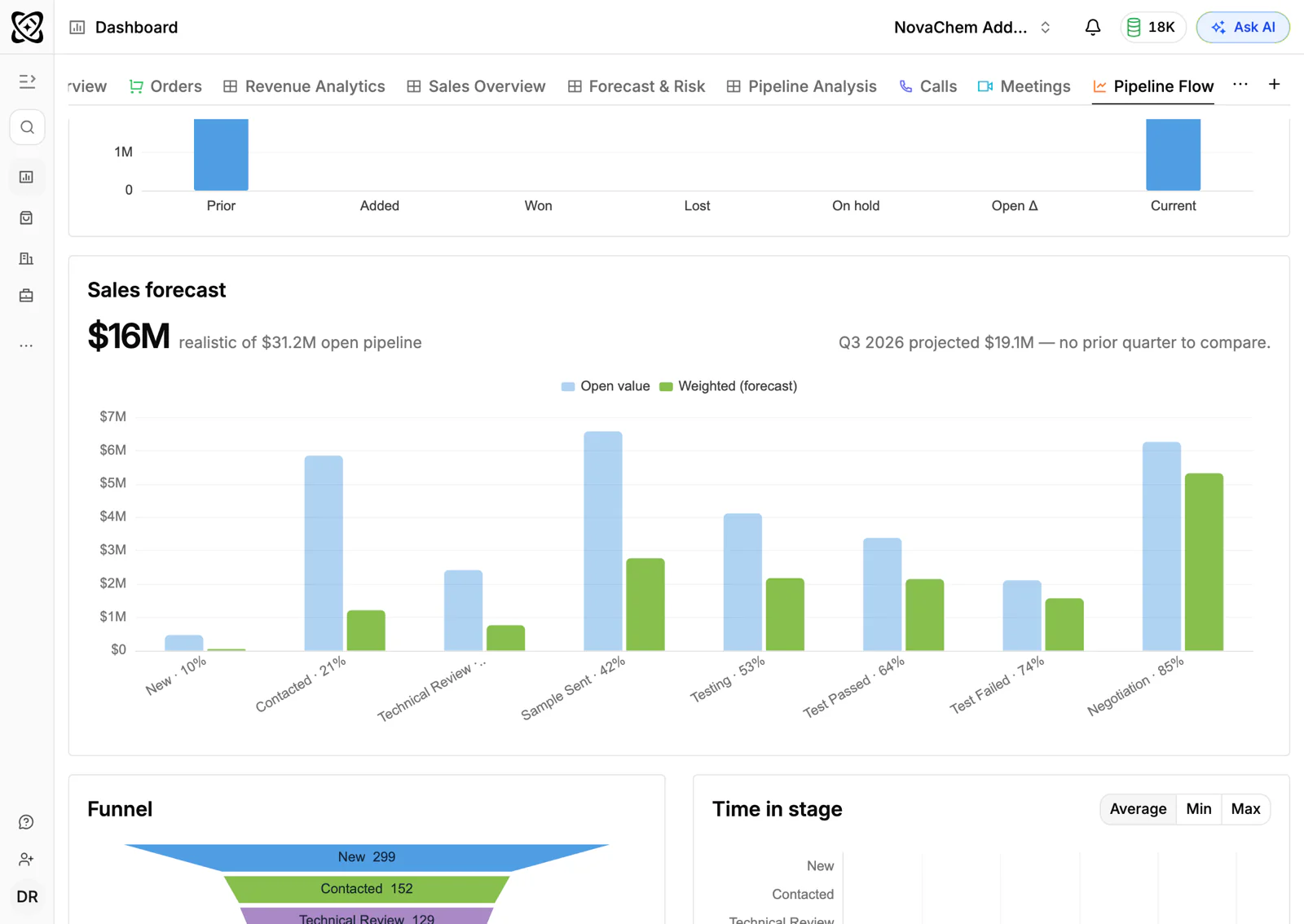
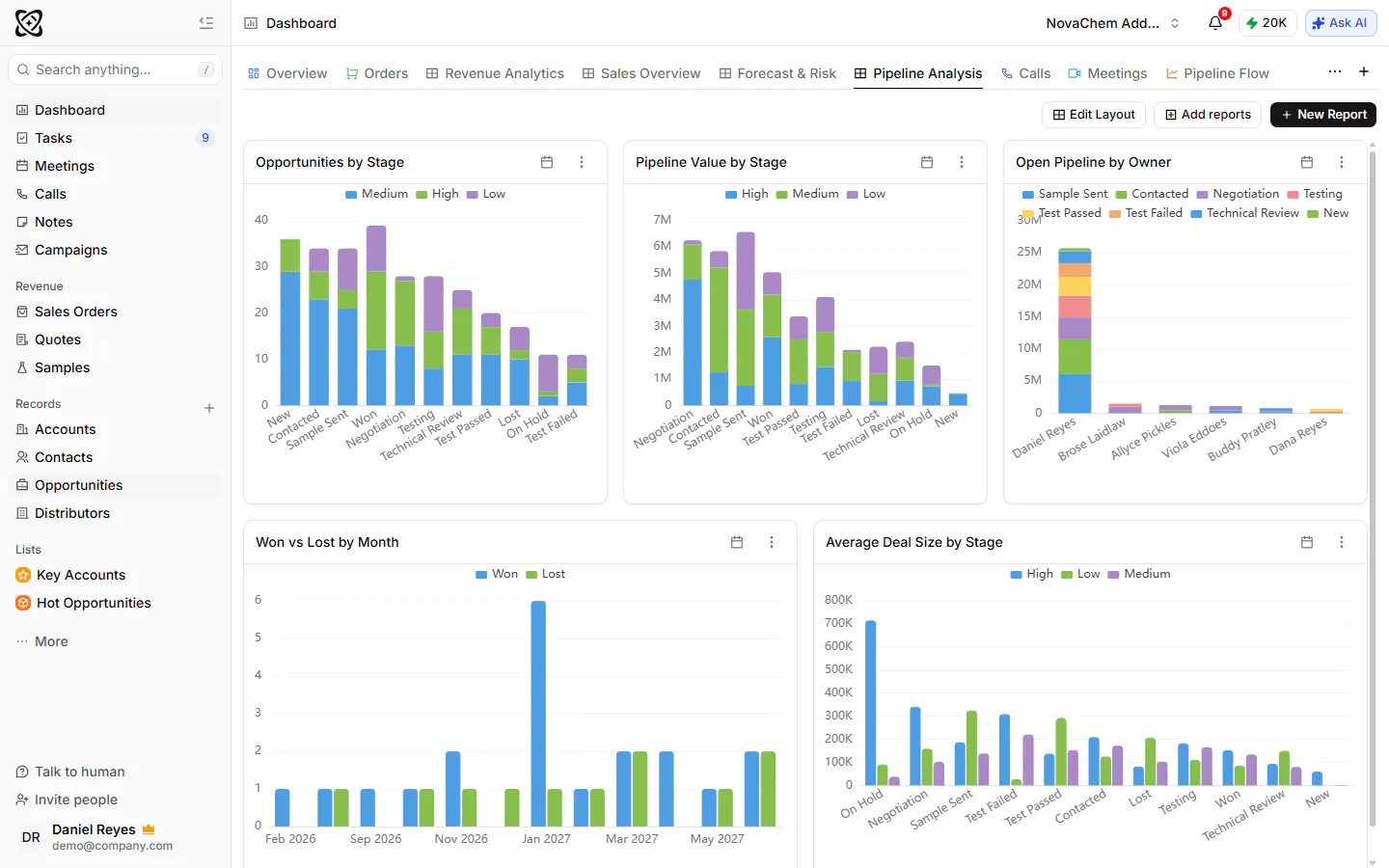
We built PromptLab so the review can run from one screen. Deal pipelines, accounts, contacts, tasks, quotes and sample tracking are on every plan, and reports and dashboards on pipeline and revenue let you see stage-by-stage drop-off and pipeline movement without exporting anything to a spreadsheet.
Quotes are auto-attached to the deal, so "which quote is out and what is its status?" is a glance, not a question. Meeting recordings, AI summaries and CRM autofill mean the deal record reflects what the buyer actually said, which cuts the "I forgot to update it" problem. And a workflow can create a task whenever a deal changes stage, so a deal moved in the review gets its next step without anyone typing it.
For a printable version of this agenda, see the pipeline review checklist.
Frequently asked questions
How often should you run a pipeline review?
Weekly for the team and, for managers with larger teams, a shorter one-to-one with each rep. Monthly reviews are too slow to catch a stalled deal. Keep the weekly session to 45 minutes so it does not get cancelled.
Who should attend a pipeline review?
The sales manager and the reps who own the deals being discussed. Invite someone from operations or customer service when a deal depends on stock, lead time or a sample. Keep the room small.
What should you look at in a pipeline review?
Open pipeline value against target, movement since last week, the biggest and soonest-closing deals, stalled deals and data quality. Spend most of the time on a handful of deals, not the whole board.
How do you stop reps sandbagging or inflating deals?
Define stage exit criteria in plain words and ask for evidence: a shipped sample, a sent quote, a named decision maker. When the CRM records meetings, captures email and attaches quotes to the deal, most of the evidence is already there.
What is the difference between a pipeline review and a forecast call?
A pipeline review is about actions on deals. A forecast call is about the number you commit to. Run the review first, then forecast from the corrected pipeline. How to forecast sales covers the second step.