



















How to launch a new product to existing customers
Launch a new product to existing customers by picking the right accounts, offering samples, personalising the first message and following up in a set order.
 By the PromptLab team31 October 20265 min read
To launch a new product to existing customers, choose the accounts most likely to need it, tell them one by one with a reason that fits their business, offer a sample, and follow up on a fixed schedule. Your current customers already trust you and already buy from you, so they are the fastest route to your first orders.
This guide is for manufacturers and distributors who add products to the range. It covers who to approach first, what to say, how to use samples, and how to track the response. For the internal side of a launch, use the new product launch checklist, and for wording, the new product announcement email templates.
Start with who should hear about it first
Do not announce to everyone at once. Build a short list in tiers.
- Tier 1: accounts that buy something close. A customer who buys your solvent-based coating is the obvious first call for the water-based version.
- Tier 2: accounts you have talked to about this need. Look at old notes, lost deals and sample requests where the buyer said "we would need something that…".
- Tier 3: the rest of the base. A broader announcement comes after you have a few early users to mention.
Aim for a first group you can actually call, say 15 to 25 accounts, rather than the whole list. A good launch is a set of conversations, not a broadcast.
Step by step: run the launch
- 1
Write the one-paragraph case for each tier
For each tier, write what the product does for that buyer in plain terms: the problem it solves, the spec that matters, the price position against what they buy now. Skip the product-brochure language.
- 2
Prepare what a buyer will ask for
Data sheet, safety data sheet where it applies, a price in the customer's price list, a minimum order and a lead time. If a buyer has to wait for these, the interest cools.
- 3
Contact Tier 1 personally
Call or send a short personal email or message. Say why you are writing to them in particular, and offer a sample. A rep who knows the account should send it.
- 4
Send samples and log them
Ship the sample with a date and a named contact for feedback. Note it on the deal the day it ships, and set a task to ask how it went.
- 5
Follow up in a set order
Follow up after the sample arrives, again when you have feedback, and then with a quote. A pattern like day 3, day 10 and day 21 works for many teams.
- 6
Announce to Tier 2 and 3 with early results
Once a few customers are testing or ordering, widen the message. Describe the use case, not the customer's name, unless they have agreed to be named.
- 7
Review at 30 and 90 days
Count samples sent, samples that led to a quote, quotes that led to orders, and the reasons given for a no. Adjust the pitch, the price or the target accounts.
What to say in the first message
Keep it short and specific. A good launch message has four parts:
- Why you are writing to this account.
- What is new, in one sentence.
- What it means for them, using something you know about their business.
- One clear next step, such as a sample.
For example: "Hi Maria, you buy our 5-litre primer for the trade customers you supply. We have a new low-odour version that dries faster. Could I send you a litre to try on your next job?" That is a better opener than an announcement to the whole list.
Use the account's history. A buyer who asked for a lower-odour product last spring should hear that you remembered. Look at the notes, the old quotes and the sample feedback before you write.
Use samples to move interest into orders
For product sales, a sample is the proof. Treat it as a step in the deal, not a favour.
- Log every sample against the account and the deal, with the product and quantity.
- Ask for feedback against a few criteria the buyer cares about, such as colour, viscosity or fit with their process.
- Follow up on the feedback date, not whenever you remember.
- When the feedback is good, send a quote the same week.
The sample follow-up email templates give you wording.
Common mistakes
- Announcing to everyone, following up with no one. A launch needs calls, not just a send.
- No price or lead time ready. A buyer who likes the sample will ask for both.
- Cannibalising a product you still want to sell. Decide whether the new product adds or replaces, and brief the reps.
- Not logging the response. Without notes, you cannot tell which pitch worked.
- Giving up after one message. Many replies come after the second or third touch.
How PromptLab helps
PromptLab keeps the launch in one place. Build your Tier 1 list in a list of accounts, so every rep sees the same group. Track each sample request with its status and feedback on the deal, and send a quote from your products and the customer's price list when the feedback is good.
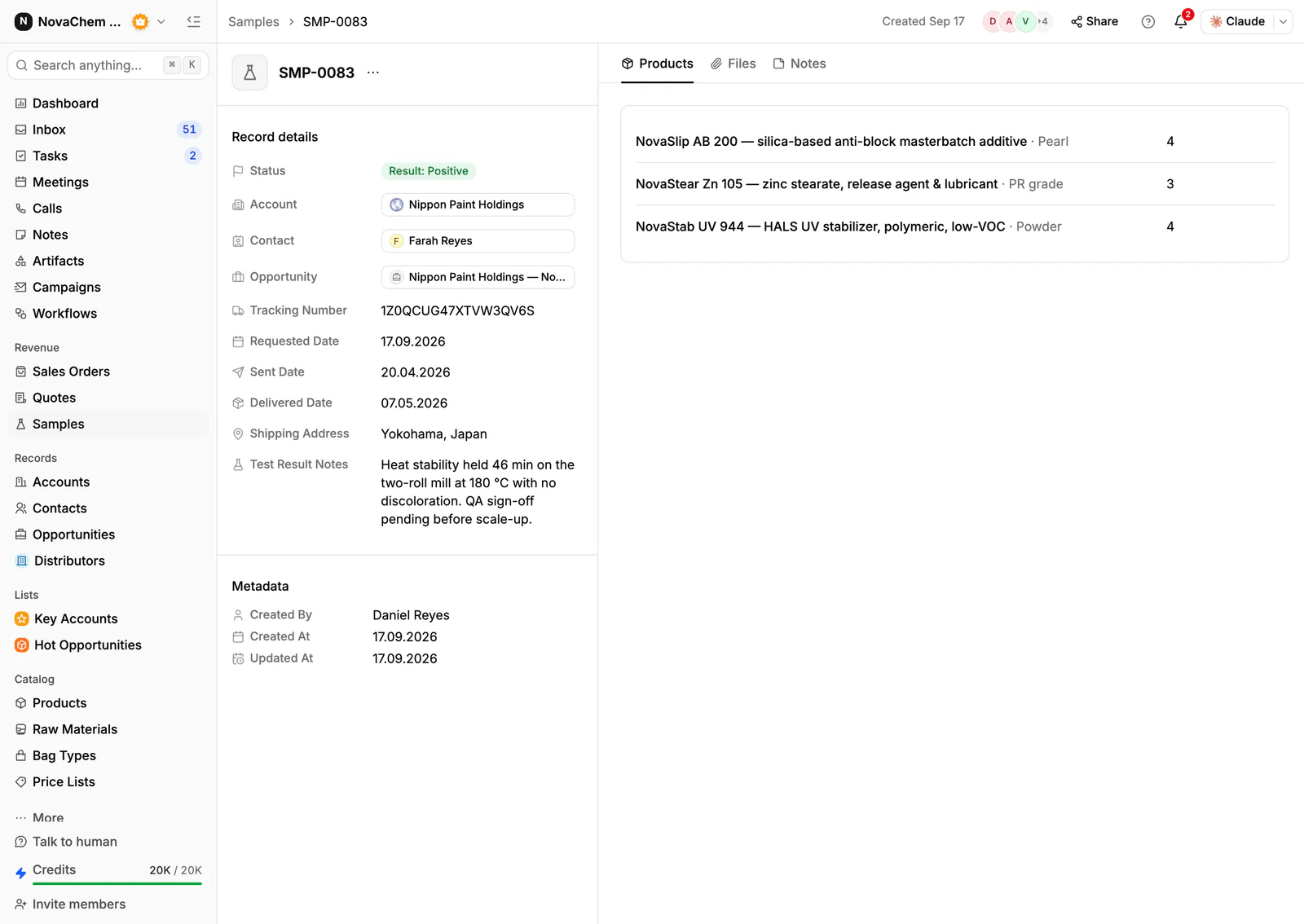
Create a task for each follow-up, and let a workflow create one when a sample changes status. Replies from email, WhatsApp and Telegram land in the shared Inbox beside the account. For a wider announcement, an email campaign can send a multi-step sequence from your own mailboxes and stop when a contact replies. Use Ask AI to ask which accounts bought a related product, then check the answer against the account. See the lists reference, or read about quotes and samples.
Frequently asked questions
How do I announce a new product to existing customers?
Start with the accounts most likely to need it and contact them personally, with a reason that fits their business and an offer of a sample. Widen the announcement once you have early users.
Should I offer samples when launching a product?
Yes, for most physical products a sample is the strongest proof. Log it on the account, agree what feedback you want, and follow up on a set date.
Who should I tell first about a new product?
Customers who already buy something close, and accounts that told you they had a need it meets. They are the most likely to order and the most useful to learn from.
How many times should I follow up after announcing a product?
Plan for at least three touches: after the first message, after the sample arrives and after feedback. Many replies come after the second or third.
How do I measure whether a product launch worked?
Count samples sent, quotes sent, orders won and reasons given for a no, at 30 and 90 days. Compare accounts by tier to see which pitch worked.