



















How to manage customer credit limits
Set, record, review and enforce customer credit limits: a simple sales and finance process with worked numbers, review triggers and a rule for the limit.
 By the PromptLab team7 November 20266 min read
To manage customer credit limits, set a limit for each customer from a credit check and their expected order size, record it where sales can see it, compare it with what the customer owes before accepting each new order, review it on a fixed schedule or when something changes, and agree in advance what happens when an order would cross it. The limit protects your cash. It only works if sales can see it at the moment of the order.
This guide is the ongoing process. For the definition, read what is a credit limit. For the first assessment of a new buyer, use the new customer credit check checklist. It is written for suppliers of chemicals, packaging, ingredients and similar goods who sell on terms such as net 30.
Why credit limits go wrong
Credit limits usually fail in one of three ways. The limit is set once and never reviewed, so a customer who has doubled its orders still sits on the old figure. The limit lives in the finance system, so a rep accepts a large order without knowing the customer is already near it. Or the limit exists but nobody agreed what happens at the limit, so every case becomes an argument.
A good process fixes each: a review schedule, a visible limit and a written rule.
Step by step: manage the limits
- 1
Set the limit from evidence
Use a credit check, trading history, financial statements if available, and trade references. Then look at the expected order. Say a customer buys $8,000 a month on 30-day terms: at any time you might have one or two invoices open, so a limit of $16,000 to $20,000 covers normal trading with room for a larger order. Those figures are an example. Pick numbers from your own margin and risk appetite, and a limit you could afford to lose.
- 2
Record the limit where sales can see it
Put the limit, the payment terms and the date it was set on the customer's record. A rep taking an order should not need to phone finance for it. If the limit is hidden, it will be ignored.
- 3
Check each new order against it
Before accepting an order, add it to the unpaid balance and compare it with the limit. Include open sales orders not yet invoiced, not just invoices. An order that fits is accepted. One that would cross the limit follows the rule you set.
- 4
Decide what happens at the limit
Write down the options: hold the order until a payment arrives, ask for part payment up front, ship in stages, raise the limit after a review, or require a guarantee or a letter of credit (see what is a letter of credit). Name who can approve an exception and up to what amount. Rule beats judgement when the customer is on the phone.
- 5
Review on a schedule and on triggers
Review every customer once a year, large ones twice. Also review when something changes: a late payment, a sudden jump in order size, a change of owner, a bad credit report, news about their industry. A review takes ten minutes if the numbers are in front of you.
- 6
Chase overdue invoices early
A customer who pays late is telling you something. Contact them the day after the due date, not a month later. Hold new orders if the overdue amount passes a threshold you set in advance. Tell the sales owner at once, because they know the customer and may know the reason.
Who decides what
Credit is a shared job and it fails when both sides assume the other has it.
- Sales knows the customer, the relationship and the size of the opportunity. They propose the limit and tell finance about changes they hear about.
- Finance owns the checks, the risk level and the final number. They can say no.
- A named approver decides exceptions above a set amount, usually a sales director or the owner.
Agree the split in writing and keep it to one page.
Signals to raise or cut a limit
| Raise it when | Cut or review it when |
|---|---|
| They pay on or before the due date, consistently | Payments slip past the due date |
| Order volume has grown steadily | Orders suddenly jump well above normal |
| A clean updated credit report | A poor report or a legal notice |
| A parent company or bank guarantee | News of trouble in their industry |
| The relationship is strategic | Contacts leave or cannot be reached |
Mistakes to avoid
- One limit for everyone. A long-standing customer and a first-time buyer carry different risk.
- Ignoring open orders. The limit should count what you have agreed to ship, not only what has been invoiced.
- Waiving the rule for a friend. A good customer asked for an exception is still an exception, and you need a record.
- Chasing late. The earlier you ask, the more likely it is a simple mix-up.
- Cutting credit without warning. Tell the customer why before you hold an order, and offer a route back.
How PromptLab helps
PromptLab does not run credit checks or block orders at a limit, so the rule stays with your team. What it does well is put the facts in front of sales. Add a custom field on the account for the credit limit, one for the review date and one for the approver, since accounts take custom fields. For a customer, the account's Overview shows the outstanding balance across its sales orders, the overdue amount and how many days it takes to pay on average, so a rep can compare what is owed with the limit before taking the next order. Payment terms and Trade terms are on each sales order, and sales orders sit on the account, with invoices created from a sales order or on their own. The daily digest lists overdue invoices in Slack, Telegram or WhatsApp, so sales sees them without opening a report.
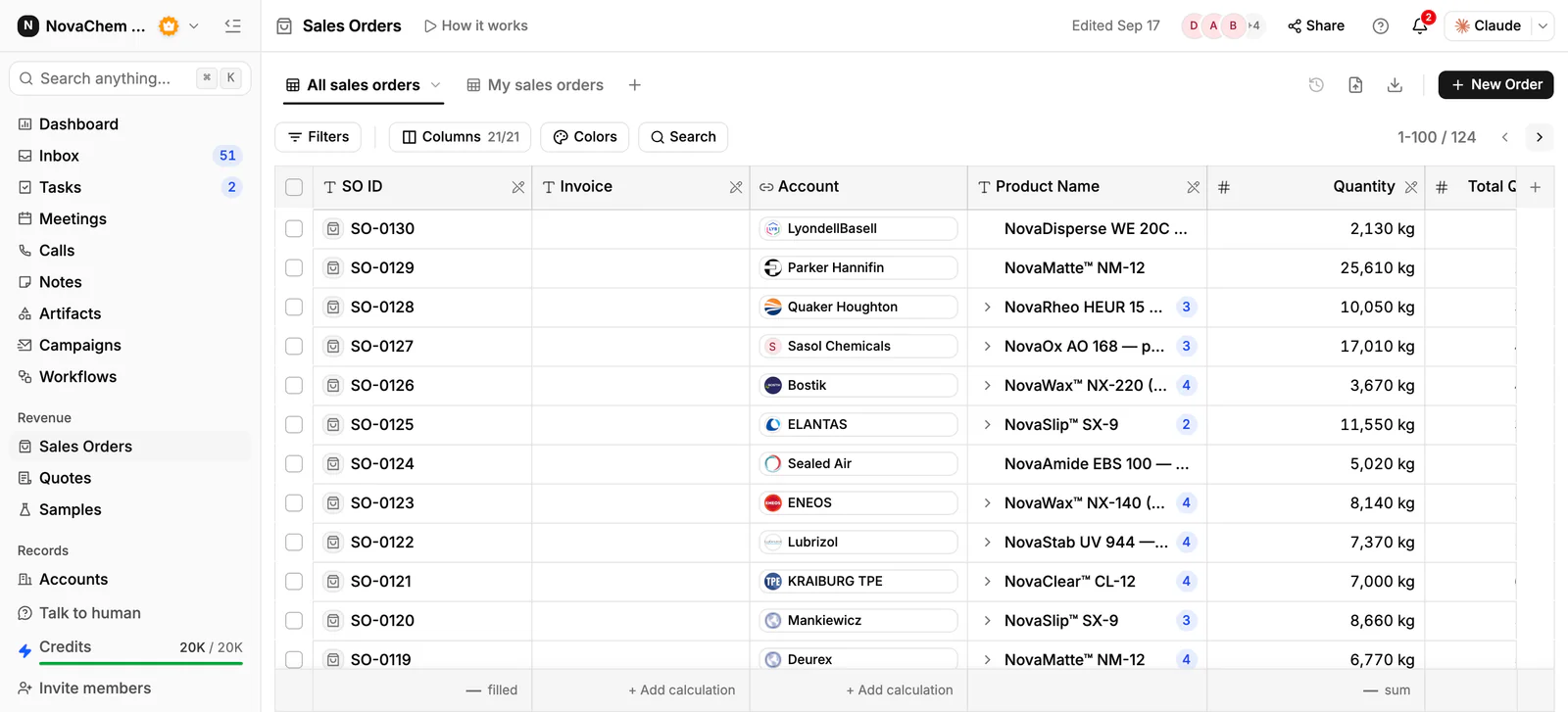
Put a task on the account for its owner, due on the review date, so the review does not slip. A workflow on a schedule can also create a review task for finance every month. Ask AI can answer a plain question such as "which accounts have overdue invoices?" from your own records. For the rest of the order process, see how to speed up quote to order.
Frequently asked questions
How do I set a customer credit limit?
Use a credit check, their trading history and the size of their expected orders. A rough guide is enough open balance to cover normal trading with room for a larger order, set at an amount you could afford to lose. Record it with the date.
How often should I review credit limits?
At least once a year for every customer, more often for large ones, and whenever something changes: a late payment, a big jump in orders, a poor credit report or news about their business.
What should I do when an order exceeds the credit limit?
Follow the rule you wrote beforehand: hold it until payment, take part payment up front, ship in stages, review and raise the limit, or ask for a guarantee. Name who can approve an exception.
Who should own credit limits, sales or finance?
Both, with different jobs. Sales proposes and reports changes, finance owns the checks and the final number, and a named approver decides exceptions.
Should the limit count open orders?
Yes. Add orders you have agreed to ship but not yet invoiced to the unpaid invoices. Otherwise a customer can order several times before the first invoice appears.