



















How to run a weekly sales meeting
A 45-minute weekly sales meeting for B2B product teams: the agenda, what to prepare, how to keep it short and how to turn every decision into a task.
 By the PromptLab team24 October 20265 min read
A good weekly sales meeting runs 45 minutes, follows the same agenda every time and ends with every decision turned into a task with an owner and a date. Spend the first minutes on last week's commitments, the middle on the few deals and customer problems that need the team, and the last on next week. Anything that is only an update goes in writing before the meeting.
This guide is for sales leaders at companies that sell physical products. Your team has samples out, quotes waiting, price talks and delivery questions. A meeting that fits that work looks different from a software sales stand-up.
What the weekly sales meeting is for
The meeting has three jobs: get everyone looking at the same numbers, decide what to do about the deals and problems that need more than one person, and agree commitments. It is not a place for each rep to read a diary aloud.
If your meeting has no decisions in it, it is a newsletter. Send it by email and give the time back. For the deeper deal-by-deal discussion, see how to run a pipeline review. This meeting is wider: it covers the pipeline, but also customers, samples, quotes, stock and the week ahead.
The 45-minute agenda
- 1
Last week's commitments (5 minutes)
Go through the tasks agreed last week. Done, not done, and why. Do not debate. If the same task is late for the second time, ask what is blocking it.
- 2
The numbers (5 minutes)
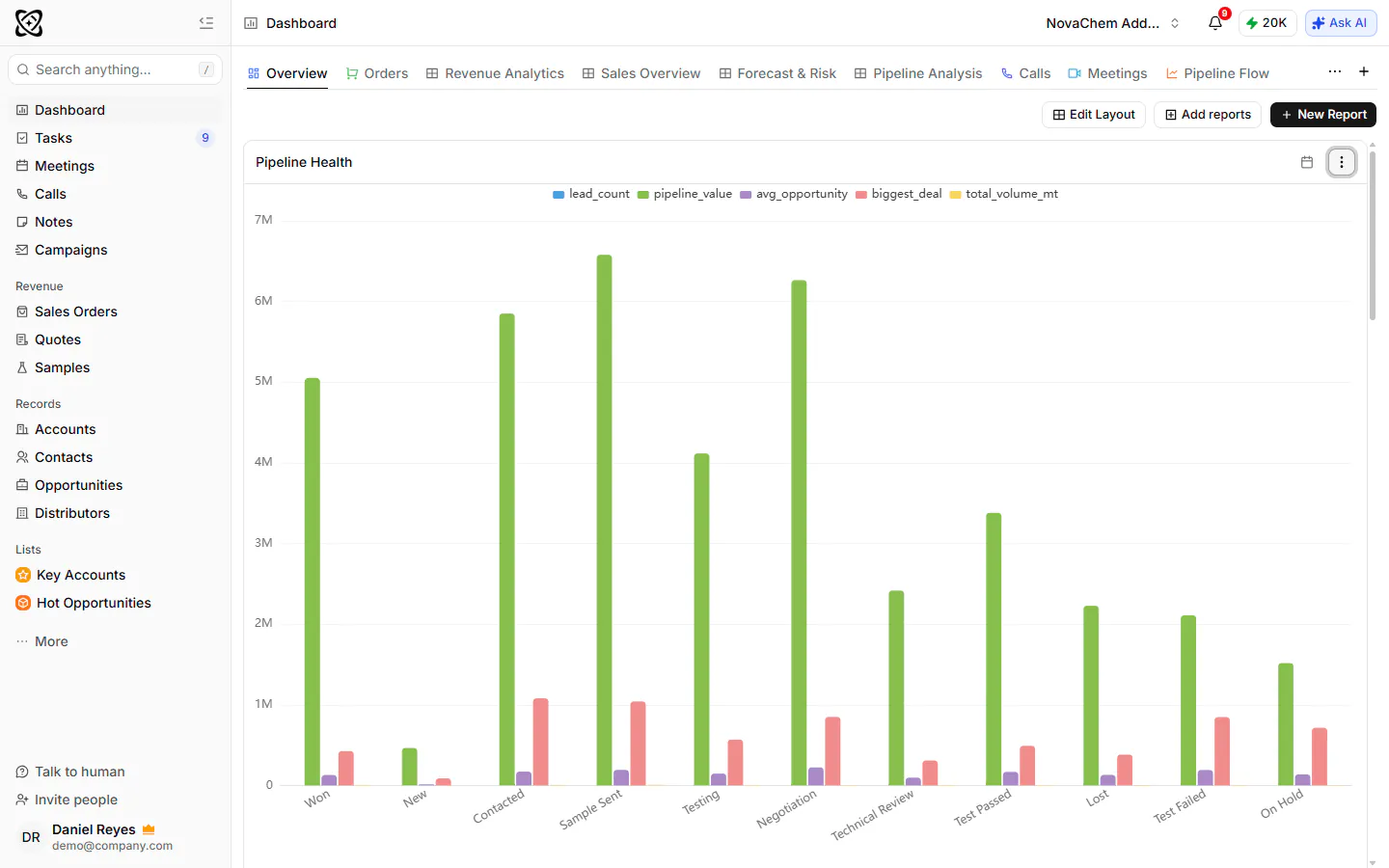
Open the dashboard. Look at new deals created, quotes sent, samples shipped, orders received and the open pipeline. One person talks, the rest look for anything that looks odd.
- 3
Quotes and samples that are waiting (10 minutes)
In product sales, deals stall at quotes and samples. List quotes sent with no reply and samples delivered with no result. For each, decide who chases, when, and with what offer.
- 4
Three deals that need the team (15 minutes)
Pick the three deals where a decision is needed: a price below the usual margin, a large order that needs stock, or a technical issue. The manager picks them in advance. Each gets five minutes, with a decision at the end.
- 5
Customer and market news (5 minutes)
One or two items only. A competitor's price move, a customer problem with a delivery, a new application a buyer mentioned. Anything that others need to know.
- 6
Next week's commitments (5 minutes)
Each rep names their top three actions. The manager records them as tasks, in the CRM, before anyone leaves the room.
Prepare in 20 minutes
The manager's preparation decides whether the meeting is 45 minutes or 90.
- Open the pipeline and filter for deals that moved, stalled or are due to close this month.
- Check quotes with status Pending that are more than a few days old.
- List samples delivered but without a recorded result.
- Pick the three deals for the discussion and tell the reps which they are.
- Ask each rep to update their deals and tasks before the meeting, so the screen is right.
Reps prepare in five minutes: update stages, log the week's calls and decide what they need from the team. If a rep needs a price decision, they send the quote draft in advance.
Questions that keep the meeting useful
Ask these instead of "any updates?":
- What is the one deal this week you could lose, and why?
- Which customer is waiting on us, for a quote, a sample result or a delivery date?
- What did a buyer say this week that we have not heard before?
- Where do you need help from me, from the lab or from the warehouse?
- Which deal should be closed as lost, so the pipeline is honest?
When a deal is lost, record the reason in the CRM so the team can see patterns across weeks.
Run it so people want to attend
- Start and finish on time. A meeting that always overruns teaches people to arrive late.
- Hold it on a fixed day. Monday morning suits planning. Friday afternoon suits review and next-week prep.
- Share the screen, not a deck. The CRM is the source. Slides go stale the same day.
- Park side topics. Write them down and settle them after, with the people involved.
- Rotate a topic. Once a month, one rep presents a customer story or a product lesson for ten minutes.
- Include remote reps. If part of the team is distant, everyone joins by video, even those in the room. See how to manage a remote sales team.
After the meeting: tasks and notes
A meeting that ends without tasks has not finished. Within an hour:
- Create a task for each commitment, with an owner and a date.
- Send a short note with the three decisions made.
- Update any deal whose stage or close date changed in the room.
Keep the notes brief. Three lines on each decision are enough. Read them at the start of the next meeting, which closes the loop.
How PromptLab helps
Run the meeting from PromptLab itself. Open the sales pipeline dashboard for the numbers, the quotes and samples dashboard for what is waiting, and the task list for last week's commitments.
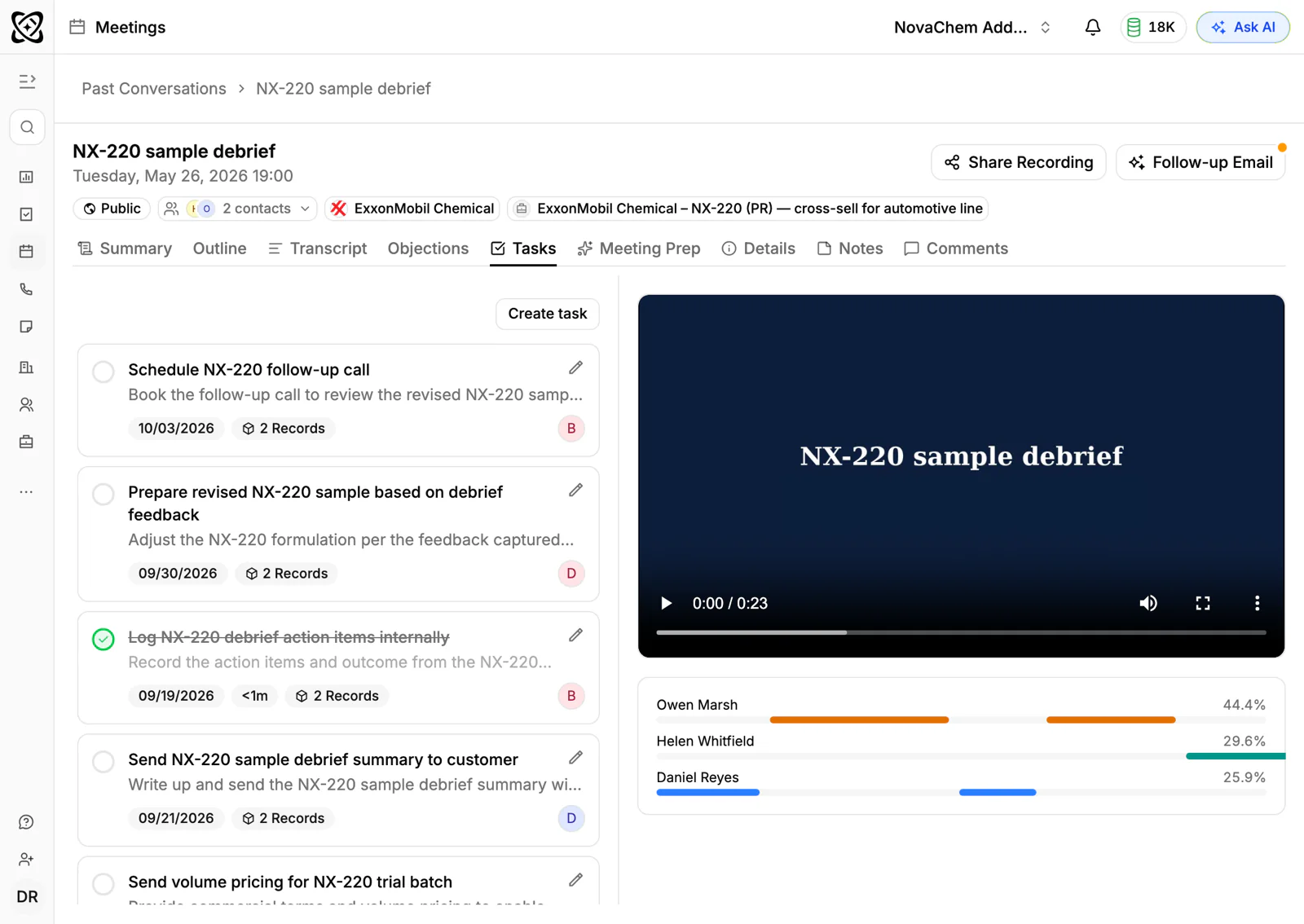
If you hold the meeting on Google Meet, Zoom or Microsoft Teams, PromptLab can record it and write the transcript, an AI summary and an AI follow-up email draft. Action items from the meeting become CRM tasks automatically. Transcription covers 30+ languages, which helps when the team speaks more than one.
Before a customer call that comes out of the meeting, the pre-meeting brief gathers the account's recent history. You can also ask Ask AI a plain question, such as which quotes for an account are still pending, and get the answer without opening five screens. To keep follow-up from slipping, see how to automate sales follow-ups.
Frequently asked questions
How long should a weekly sales meeting be?
Forty-five minutes is enough for most product teams. Smaller teams can finish in 30. If you regularly run past an hour, move updates into writing and keep the meeting for decisions.
What should be on a weekly sales meeting agenda?
Last week's commitments, the numbers, quotes and samples that are waiting, a few deals that need the team, customer and market news, and next week's commitments. Keep the order the same every week.
Should the weekly sales meeting include every deal?
No. Reading every deal aloud wastes the room's time. Pick the three to five deals that need a decision, and let the dashboard cover the rest.
What day is best for a weekly sales meeting?
Monday morning works for planning the week, and Friday afternoon works for review. Pick one and keep it. A fixed slot matters more than the day.
How do I stop reps from being unprepared?
Share the agenda and the chosen deals in advance, and ask reps to update the CRM before the meeting. Run the meeting from the CRM so out-of-date records are visible to everyone.