



















How to manage a remote sales team
How to manage remote B2B sales reps: one source of truth, a fixed weekly rhythm, clear deal stages and coaching from recorded calls, without micromanaging.
 By the PromptLab team24 October 20266 min read
To manage a remote sales team, make the CRM the single place where deals, conversations and next steps live, hold a fixed weekly rhythm, set clear definitions for each deal stage, and coach from recorded calls instead of from rides in the car. Judge reps on results and visible activity on their deals, not on hours online. When everyone can see the same record, you don't need to ask where things stand.
This guide is written for sales managers and founders whose reps cover regions, work from home or sit in different offices. It covers the rhythm, the tools, coaching and the mistakes that make remote teams slow.
What changes when a team is remote
In an office, a manager picks up information by being nearby. You hear a rep on the phone, see a sample box on a desk, and catch a problem in the kitchen. Remote teams lose all of that. What replaces it has to be written down.
The risks follow from that. Deals live in a rep's head or inbox. New reps learn slowly because nobody hears them selling. Time zones stretch a simple question over two days. Problems show up late, because nobody saw them early.
The answer is not more calls. It is a shared record that answers the simple questions without asking, and a rhythm that handles the rest.
Set up one source of truth
Remote teams struggle when information sits in personal places: a private inbox, a rep's notes, a WhatsApp chat on a phone. Pick the CRM and decide that if it isn't there, it didn't happen.
What must be in the CRM
Say a rep is off sick on a Tuesday and a buyer writes asking for a quote status. If the quote, the emails and the sample history are on the account, a colleague can answer in minutes. If they aren't, the buyer waits.
Build a weekly rhythm
A rhythm replaces the chance conversations. Keep it light and keep it fixed.
| When | What | Length |
|---|---|---|
| Monday | Short team call: priorities and blockers | 20 minutes |
| Weekly | Pipeline review on the deals that matter | 45 minutes |
| Weekly | One-to-one with each rep: deals, coaching, problems | 30 minutes |
| Monthly | Month-end review of results | 60 minutes |
| Quarterly | Quarterly business review | 90 minutes |
Run these from the CRM on a shared screen. If a deal isn't updated, the answer to "where is it?" is "I'll update it now", and the meeting moves on.
Define each stage in writing
When you can't look over a shoulder, the stage name has to carry meaning. "Sample sent" should mean a sample is recorded as shipped. "Quote sent" should mean a quote exists with a status. Write one sentence per stage and share it. The deal stage then becomes evidence, not opinion. See how to build a B2B sales pipeline.
Keep one pipeline for the whole team. Where products or regions differ, use deal stages, owners, lists or custom fields to tell them apart.
Coach from recordings
Remote managers can't sit in on calls. Recorded meetings fix this. Listen to or read two or three calls per rep a month. Look at how the rep asks questions, handles price and agrees next steps. Share a good call with the team, with the rep's permission, as an example.
A few rules:
- Tell reps when calls are recorded and who can see them.
- Praise before you correct. A rep who is only corrected stops sharing calls.
- Pick one thing to work on per rep, not five.
- Use summaries to find calls worth hearing in full.
Manage activity without micromanaging
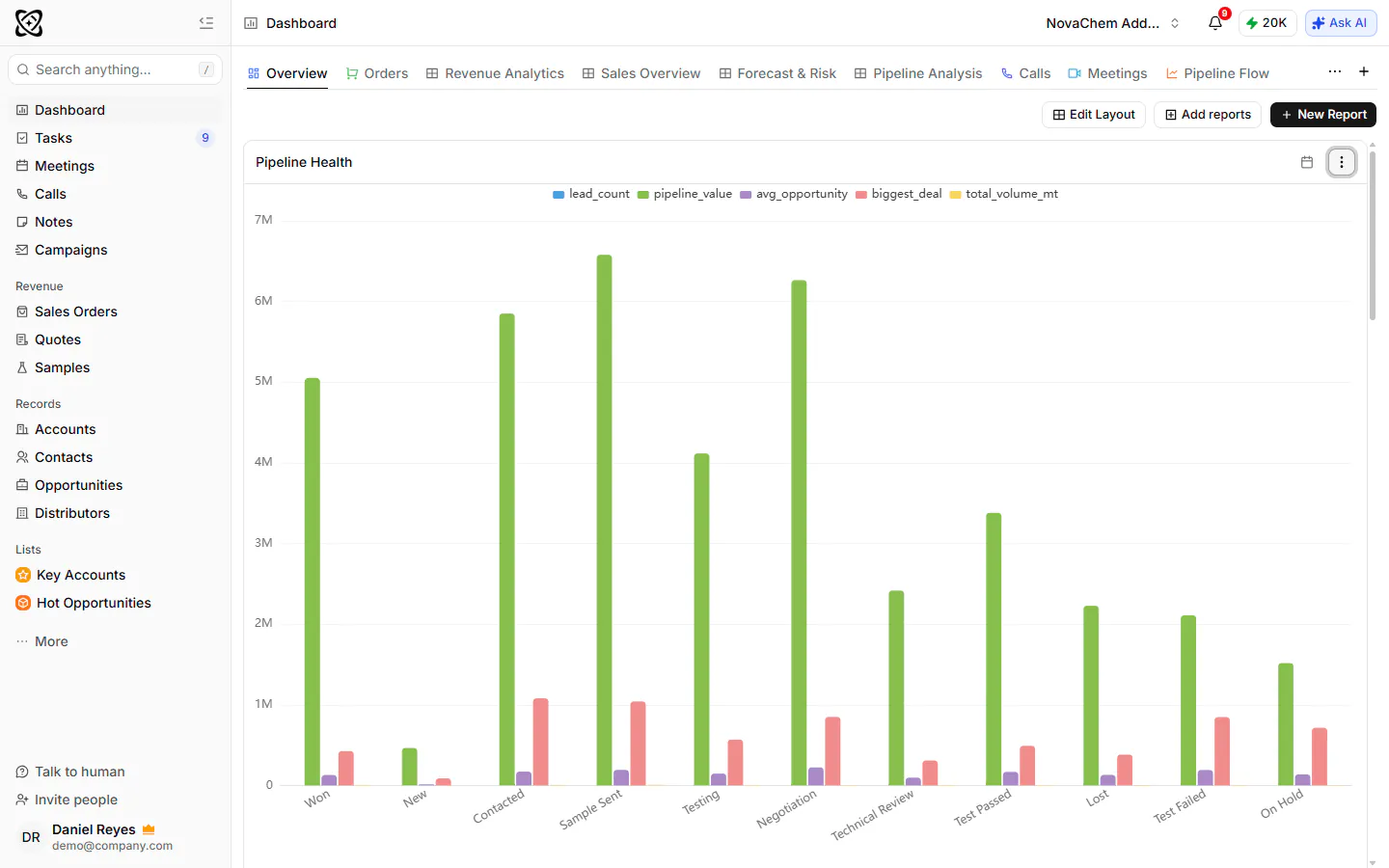
Visibility is not surveillance. Look at results and at the activity on deals: tasks done, meetings held, quotes sent, samples followed up. A team activity dashboard shows who is busy on the right accounts and who is stuck. It does not show how many hours someone sat at a desk, and you shouldn't ask for it.
Use these signals to ask better questions. "I noticed three of your quotes are pending for ten days. What do you need?" is a coaching conversation. "Why aren't you working?" isn't.
Communicate in the right place
Decide where each kind of message goes, and write it down.
- Deal facts go in the CRM, on the deal.
- Quick questions go in chat.
- Alerts the team should see go to a Slack channel.
- Customer messages go through the shared Inbox so a colleague can pick them up.
The rule that matters most is the first one. A fact in chat disappears. A fact on the deal stays.
Onboard new remote reps
A new rep on a remote team needs more structure, not less. Give them a plan for the first 30 days, a buddy, a list of calls to listen to and a short list of accounts. The sales rep onboarding checklist is a good start. Recorded calls and account history let a new hire learn from real conversations without waiting to be invited to one.
How PromptLab helps
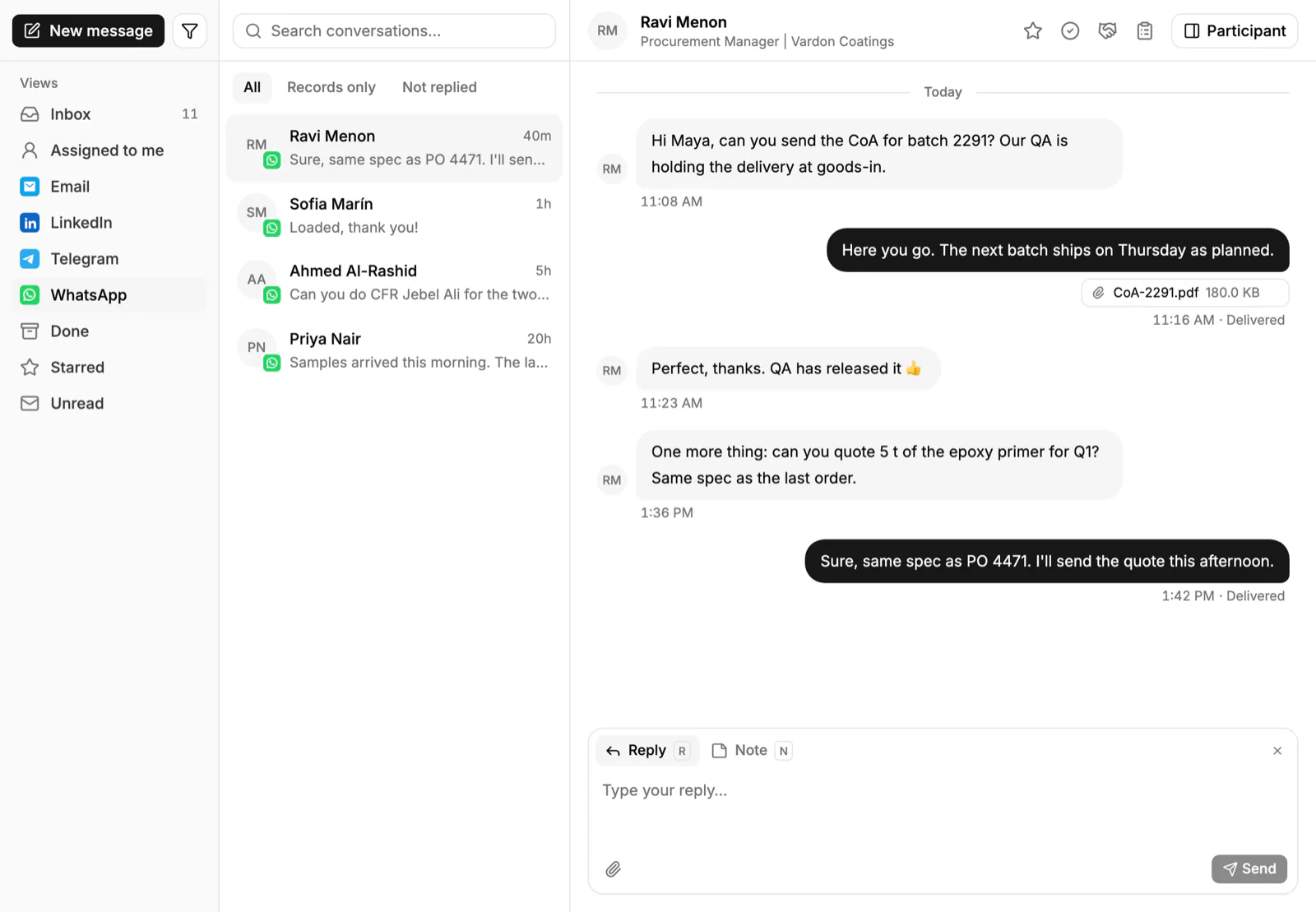
PromptLab puts the work of a remote team in one shared workspace. The shared Inbox holds email, WhatsApp and Telegram conversations on the account, so a colleague can pick up a buyer's message. Meetings are recorded on Google Meet, Zoom and Microsoft Teams, with a transcript, an AI summary, and action items that become tasks.
Dashboard templates include team activity, tasks, win/loss and sales pipeline, so you can see what is happening without asking. Ask AI answers questions about accounts, deals, quotes, sales orders, meetings and email. The Slack integration lets a workflow post to a channel when something needs the team.
Frequently asked questions
How do you manage a remote sales team?
Keep every deal and conversation in the CRM, hold a fixed weekly rhythm, define each stage in writing and coach from recorded calls. Judge reps on results and on activity on their deals, not on hours online.
How often should a remote sales team meet?
A short team call and a pipeline review each week, a one-to-one with each rep, a monthly results review and a quarterly review. Fewer, well-run meetings beat many loose ones.
How do you coach remote sales reps?
Listen to or read two or three recorded calls per rep each month, and give feedback on one thing at a time. Share strong calls with the team, with the rep's permission.
What tools does a remote sales team need?
A CRM that holds deals, conversations, meetings and quotes, a way to record calls, a team chat and a task list. Fewer tools are better, because every extra one is somewhere information can hide.
How do you avoid micromanaging remote reps?
Look at results and at the activity on deals instead of hours online. Use what you see to ask what a rep needs, not to check on them.