



















How to write a B2B sales proposal
Write a B2B sales proposal in seven parts: the buyer's problem, your solution, proof, the price, delivery, terms and a clear next step. Keep it short.
 By the PromptLab team29 October 20265 min read
To write a B2B sales proposal, start from the buyer's problem in their own words, show how your product solves it, back that with proof the buyer can check, state the price and delivery plainly, list the terms, and end on one clear next step. Keep it short enough that a busy buyer can read it in five minutes and an approver who wasn't on the calls can still follow it.
This guide is for sales reps and leaders at manufacturers and distributors who send proposals for larger or more technical deals. A proposal is not the same as a quote. A quote states what you'll supply and at what price. A proposal makes the case for choosing you, and usually contains a quote.
Quote or proposal: which do you need?
Send a quote when the buyer knows what they want and needs a price. Send a proposal when the buyer is still deciding how to solve a problem, when several people have to agree, or when the deal is large enough that they'll compare suppliers on more than price.
| Quote | Proposal | |
|---|---|---|
| Purpose | Give a price | Win the decision |
| Length | One or two pages | Three to six pages |
| Contents | Products, quantities, price, terms | Problem, solution, proof, price, next step |
| Reader | The buyer | The buyer and the people they must convince |
Many deals need both: the proposal explains why, and the quote attached to it carries the numbers.
The seven parts of a proposal
1. The buyer's problem
Open with what you heard on the call, in the buyer's words. "You told us your current supplier's lead time has gone from three weeks to six, and two production runs were held up." This shows you listened and gives every reader the context.
2. Your proposed solution
Say what you'll supply and why it fits. Name the grade, the pack size, the specification and the volume. Keep it to what answers the problem, not your whole range.
3. Proof
Offer evidence the buyer can check: a sample result, a technical data sheet, a certificate of analysis, or a trial on their own line. See what a technical data sheet is. Don't claim numbers you can't back up.
4. The price
Show the price clearly: unit price, quantity, any volume discount and the total. Set out what the price includes. If you offer volume pricing, explain the breaks.
5. Delivery and lead time
State the lead time, the delivery terms and the first ship date you can keep. A date you hit beats a faster date you miss.
6. Terms
Cover payment terms, minimum order quantity, how long the price holds and who pays freight. Keep it short and plain. Have your own team check anything that is a legal commitment.
7. The next step
End with one action and a date. "If this looks right, we'll ship a 25 kg sample on Monday and call on Thursday to agree the trial volume." A proposal without a next step becomes a document nobody answers.
Step by step: write it in an hour
- 1
Pull your notes and the call summary
Read what the buyer said about the problem, the people involved and the deadline. Use their words in the opening.
- 2
Check who decides
Find out who has to approve it. Write the proposal so the least-involved approver can follow it.
- 3
Draft the problem and solution first
Write these two parts in plain sentences before you touch the price. If you can't state the problem in three lines, ask the buyer another question.
- 4
Build the quote from your price list
Take the products and prices from the right customer price list so the numbers match what you've agreed before.
- 5
Add proof and delivery
Attach data sheets or sample results, and state the lead time you can keep.
- 6
Cut it down, then send it with a date to follow up
Remove anything the buyer didn't ask about. Send it, and put the follow-up in your task list the same minute.
Make it easy for several people to read
In B2B, the person you've talked to is rarely the only one who decides. Help them pass it on.
- Put a three-line summary on the first page.
- Use headings so a reader can jump to the price or the terms.
- Keep jargon the buyer uses, and drop yours.
- Make it easy to forward: a link or one PDF, not five attachments.
For the buying side of this, read how to sell to procurement teams.
Common mistakes
- Starting with your company history. Buyers care about their problem first.
- Burying the price. Hiding it makes the buyer suspicious.
- No next step. The proposal ends in silence.
- Copying an old proposal. The wrong customer name or product on page two ends the deal.
- Too long. If it's more than six pages, much of it isn't for this buyer.
How PromptLab helps
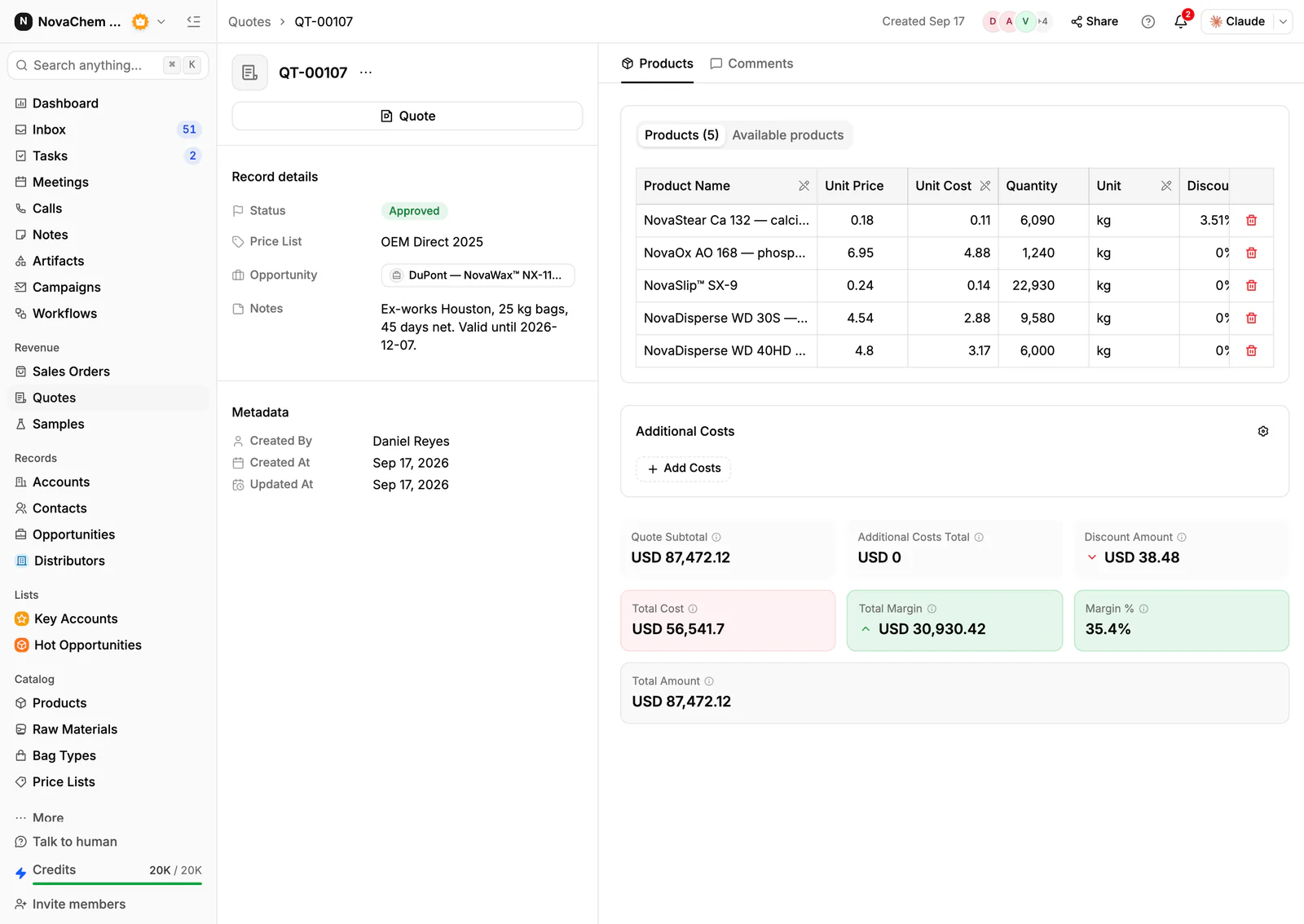
PromptLab has quotes on every plan. You build a quote from your products and the price list picked on that quote, set line discounts, and send a PDF or a public link. Statuses are Draft, Pending and Approved. Because the quote is linked to the deal, and the meeting summaries and samples sit in the same CRM, you write the proposal with everything in front of you.
For the proposal itself, Ask AI can make a document or a slide deck (an artifact) with charts and tables tied to live reports. Export the document as a PDF or the deck to PowerPoint. Meeting transcripts and AI summaries keep the buyer's problem in their own words, and action items become tasks, so the follow-up never slips. See how to speed up quote to order for what happens after a yes.
Frequently asked questions
What should a B2B sales proposal include?
The buyer's problem, your solution, proof, the price, delivery, terms and one clear next step. Add a short summary on page one for readers who won't read further.
How long should a sales proposal be?
Three to six pages is enough for most product deals. A buyer should be able to read it in about five minutes. If it runs longer, move detail into attachments such as data sheets.
What is the difference between a proposal and a quote?
A quote states what you will supply and at what price. A proposal argues for choosing you and normally contains a quote. Send a quote when the buyer knows what they want, and a proposal when they are still deciding.
How soon should I follow up after sending a proposal?
Set the follow-up date inside the proposal itself, and put it in your task list when you send it. A call two or three working days later is common, but match the buyer's own timetable.
Should I put the price at the start or the end?
Put the problem and solution first so the price has context, but don't hide it. A short summary on page one can state the total, with the breakdown in its own section.