









What is sales velocity?
Sales velocity is how much revenue your pipeline produces per day. Learn the four-part formula, a worked example and the four ways to speed it up.
 By the PromptLab team6 October 20263 min read
Definition
Sales velocity
Sales velocity is the amount of revenue your pipeline produces each day. It combines four numbers: how many deals you have, how often you win, how big they are and how long they take.
A higher velocity means your pipeline turns into money faster. Two teams with the same pipeline can have very different velocity if one closes in three weeks and the other takes three months.
Why sales velocity matters
Most sales numbers look at one thing. Velocity puts four of them together, so you can see which one is holding you back.
It also gives you four levers. You can add deals, win more of them, grow the order size or shorten the cycle. Improving any one raises the result.
How to calculate sales velocity
Sales velocity = (open deals × win rate × average deal value) ÷ sales cycle length in days
Where each part comes from:
- Open deals: the number of qualified deals in your pipeline.
- Win rate: the share of closed deals you win.
- Average deal value: the typical size of a won deal.
- Sales cycle length: the average days from a deal's creation to close.
The answer is revenue per day. Multiply by 30 for a monthly figure.
Sales velocity calculator
Sales velocity
$2,000/day
Opportunities × deal value × win rate ÷ cycle days
Per month (30 days)
$60,000
Per quarter (90 days)
$180,000
An example from plastics sales
These figures are made up.
A plastics compounder has 40 open deals. It wins 25% of the deals it closes, its average won deal is $12,000 and a deal takes 60 days to close.
Velocity = (40 × 0.25 × $12,000) ÷ 60 = $120,000 ÷ 60 = $2,000 per day.
Now change one input at a time:
- Add 10 deals (50 total): $2,500 per day.
- Lift win rate to 30%: $2,400 per day.
- Raise average deal value to $14,000: about $2,333 per day.
- Cut the cycle to 45 days: about $2,667 per day.
Shortening the cycle gives the biggest jump here, and it is often the easiest input to change. In product sales, cycle time is often lost waiting for a sample, a quote or a price check.
How to speed up your sales velocity
- Cut dead time between stages. Look for deals that sit for days with no next step.
- Send quotes the same day. A quote built from a customer's own price list is quicker than one built from scratch.
- Ship samples fast and chase feedback. Many cycles stall at the sample stage.
- Drop deals that will never close. They inflate the deal count, so velocity looks better than the revenue that follows.
- Reply where the buyer writes. If your buyer uses WhatsApp, answer there.
Related terms
- Win rate is one of the four inputs.
- Pipeline coverage tells you if the deal count is high enough.
- A sales pipeline is where the deal count comes from.
- Quote-to-order is the stretch of the cycle that is easiest to shorten.
- Sales forecasting can use velocity to estimate future revenue.
How PromptLab handles it
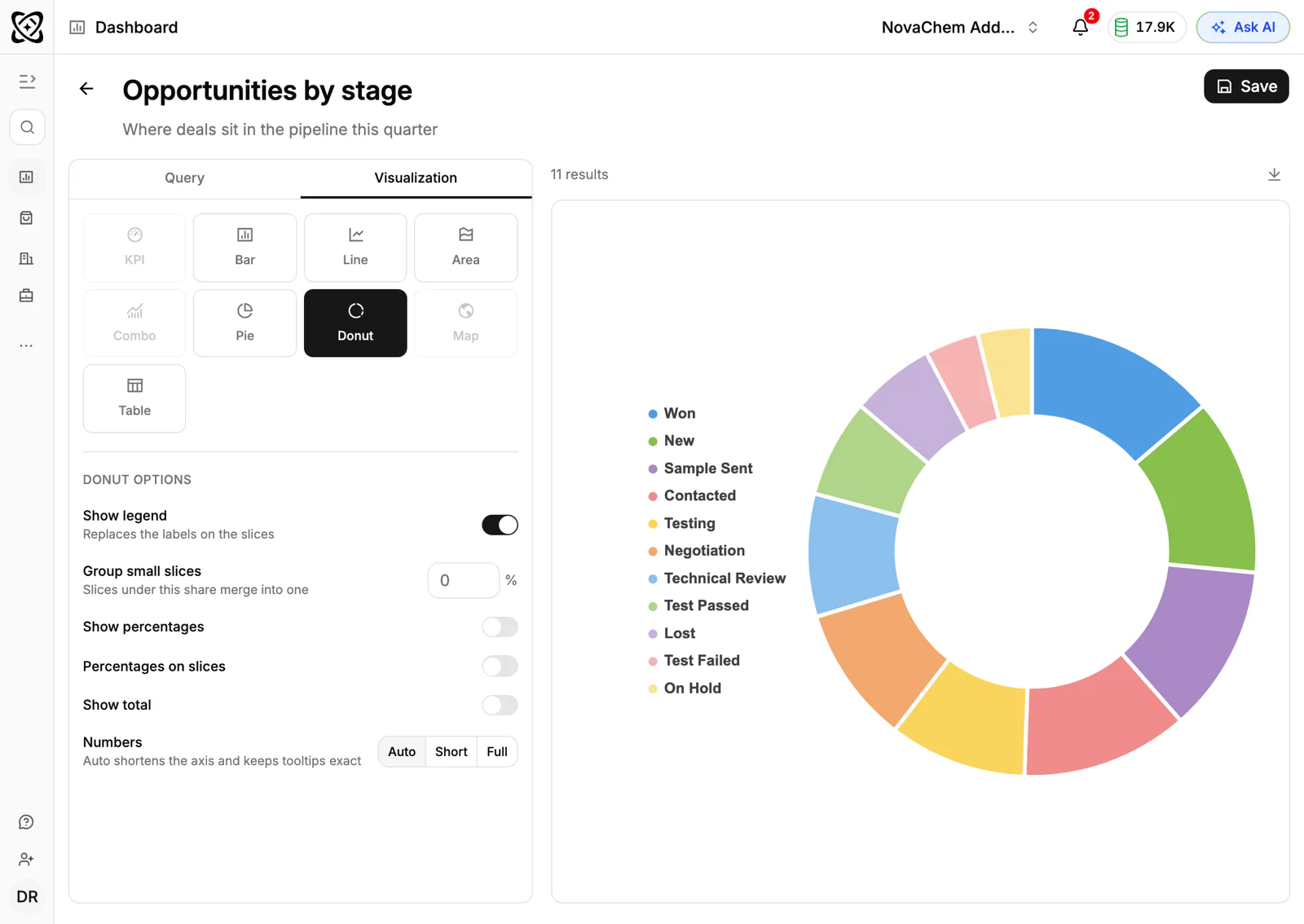
Every PromptLab deal has a stage, a value and a close date, which are the raw material for all four inputs. You can build reports and dashboards on pipeline and revenue to watch them over time. Quotes, samples and sales orders, the steps where a product sale tends to stall, are tracked in the same CRM.
Frequently asked questions
What is the sales velocity formula?
Multiply the number of open deals, your win rate and your average deal value, then divide by the sales cycle length in days. The result is revenue per day.
Is sales velocity the same as sales cycle length?
No. Cycle length is one of its four inputs. Velocity also counts how many deals you have, how often you win and how large the deals are.
Which input should I improve first?
Start with the one that is easiest to change. For many product sellers that is cycle length, because delays in samples and quotes are fixable.
Can I measure velocity per rep?
Yes. Use each rep's own deals, win rate, order size and cycle. It shows who needs help and with which part.