













What is sales forecasting?
Sales forecasting is estimating how much revenue you will close in a future period. Learn three simple methods, a worked example and common mistakes.
 By the PromptLab team6 October 20263 min read
Definition
Sales forecasting
Sales forecasting is estimating how much revenue your team will close in a future period, such as next month or next quarter, using the deals you have now and your past results.
A forecast is a best estimate, not a promise. Its job is to help you plan: how much stock to hold, how many people to hire, whether to push harder this month.
Why sales forecasting matters
Operations need to know what to produce. Finance needs to know what is coming in. Managers need to know early if the quarter is at risk.
For companies that make or distribute products, a bad forecast has a physical cost: too much stock tied up, or too little to fill orders.
How sales forecasting works
There are three common methods. Many teams use more than one and compare them.
1. Stage-weighted pipeline
Give each stage a chance of closing, then multiply by deal value. A deal at the quote stage might count at 40% and one at first contact at 10%. Set the chances from your own history, not guesses. See deal stages.
2. Rep or manager judgement
Each rep gives a view on each deal. This catches things the data misses, like a buyer who said their budget was frozen. It also brings optimism, so check it against the numbers.
3. Historical trend
Look at what you closed in the same period in past years and adjust for known changes. It works for steady repeat business.
An example from industrial distribution
These figures are made up.
A distributor of fasteners has these open deals due to close this quarter:
| Stage | Value | Chance of closing | Weighted value |
|---|---|---|---|
| Sample sent | $60,000 | 20% | $12,000 |
| Quote sent | $90,000 | 40% | $36,000 |
| Negotiation | $50,000 | 70% | $35,000 |
The weighted forecast is $83,000. Add $40,000 of repeat orders it expects from regular customers and the quarter looks like about $123,000.
If the target is $150,000, the manager knows now that about $27,000 is missing, with time left to act.
Common mistakes
- Stale deals. Old deals that nobody has touched inflate the forecast.
- Fixed chances that never change. Update them when your win rate moves.
- Forgetting repeat business. For product sellers, reorders are often a large part of revenue.
- Changing the forecast silently. Keep a record so you can see how accurate you were.
Related terms
- Pipeline coverage checks if you have enough pipeline before you forecast.
- Win rate feeds the chances you use.
- Sales velocity shows how fast pipeline turns into revenue.
- A sales pipeline is the base of every forecast.
For a step-by-step method, read how to forecast sales for a B2B product business.
How PromptLab handles it
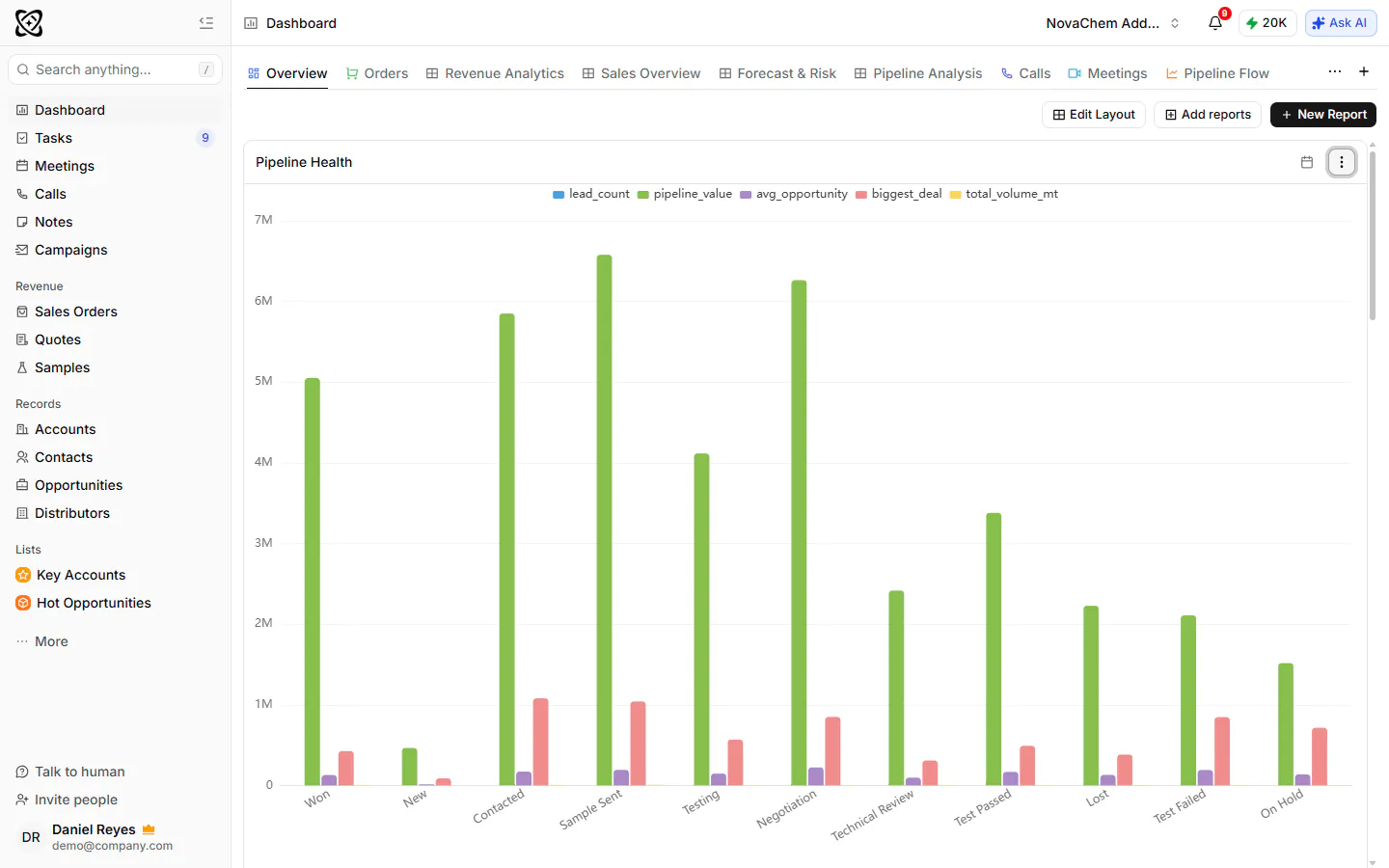
PromptLab gives you reports and dashboards on pipeline and revenue. Deals carry a stage, a value and a close date, and sales orders record what has actually been ordered, so you can set open deals beside real revenue. You build the forecast; PromptLab shows you the numbers to build it on.
Frequently asked questions
What is the simplest way to forecast sales?
Weight each open deal by the chance of closing at its stage, add them up and add expected repeat orders. Then compare the result to your target.
How often should I update a forecast?
Weekly is common. Revisit it in your pipeline review, when deals change stage or slip.
Does PromptLab predict which deals will close?
No. PromptLab gives you reports and dashboards on pipeline and revenue. You decide the chances and build the forecast from them.
Why is my forecast always wrong?
Usually because of stale deals, guessed percentages or missing repeat orders. Clean the pipeline first, then base the percentages on past results.