



















CRM for cotton and yarn traders
How cotton and yarn traders sell lots to spinning and weaving mills, from grades and counts to lab results and Incoterms, and a CRM setup that tracks each deal.
 By the PromptLab team7 November 20266 min read
A cotton or yarn trader sells raw cotton, cotton yarn or blended yarn to spinning, weaving and knitting mills and to garment makers. A CRM for that trade has to hold each mill's counts, grades and lab results, and the offers you made them, because the same buyer reorders against a spec for years.
In PromptLab, quotes are built from your products and a customer price list, samples are tracked on the deal, and a sales order on the account carries the Incoterm, payment terms and planned delivery date. For the manufacturing side of the chain, see CRM for textile manufacturers.
How do cotton and yarn actually sell?
Cotton and yarn are traded differently, so decide which you sell before you design the CRM.
Raw cotton is sold by grade: staple length, micronaire, strength and trash content. Buyers are spinning mills. The crop year drives supply, and prices are often tied to a futures price plus or minus a difference for quality and origin, so an offer has a short life. A lot is a set of bales with a test report.
Yarn is sold by count, ply and type: carded or combed, ring-spun or open-end, and blends. Buyers are weaving and knitting mills and garment makers. They reorder the same counts against a spec, and they care about evenness, strength and consistency between lots. A new yarn buyer starts with cones or a small trial lot.
Either way, the sale is rarely only price. Buyers compare lots, ask for lab data, and move supply to whoever delivers the same quality twice.
Which documents and Incoterms do buyers expect?
Check the list with your forwarder and the buyer, because it depends on origin and destination:
- Commercial invoice and packing list, with bale or carton counts. See what is a commercial invoice and what is a packing list.
- Test or inspection reports for the lot, and a certificate of analysis where the buyer asks for one.
- Certificate of origin. See what is a certificate of origin.
- Sustainability or organic certificates when the product is sold as such. Mills selling to brands often have to prove them.
- Bill of lading for sea freight. See what is a bill of lading.
Sea shipments are commonly FOB, CFR or CIF, and a container or part of one is the unit. See what is FOB and what is CIF. Those are sea-only rules: for a container handed to a terminal before loading, the ICC points to FCA, CPT or CIP, which pass risk at that handover. Payment is typically a letter of credit for new buyers and open credit for old ones. For the latter, see what is a credit limit.
What pipeline stages fit a trader?
PromptLab has one deal pipeline per workspace. Use a custom field for cotton, yarn or blend, and a saved view for each. A workable set of stages:
| Stage | Entry condition |
|---|---|
| Enquiry | A mill has asked for a grade, count or volume |
| Sample or trial lot | A sample is logged on the deal with a lot reference |
| Lab approved | The buyer's test results are in and accepted |
| Offer sent | A quote is out with price, Incoterm and shipment month |
| Contract agreed | Price, volume and payment terms are accepted |
| Shipped | A sales order exists on the account and documents are sent |
What must the CRM track?
- Mills, buyers and technical contacts. The purchasing manager negotiates and the technical manager approves the lot. Record both.
- Product specs, as custom fields on products: grade or count, ply, type, blend and certification.
- Lots and samples, with a lot reference in a custom field, the sent and delivered dates, and the mill's lab verdict as a result status with test notes, so a complaint three months later is traceable to a sample.
- Offers and their price list. A customer price list adds a set amount on top of each product's base price. If your offers move daily, keep the base price current and send a fresh quote.
- Expected volume, expected close date and next follow-up date. Volume and follow-up are built into deals, and an expected close date is a custom date field.
- Every message. Mills write on email, WhatsApp and Telegram, and the price discussion often happens in a chat.
How do you set this up in PromptLab?
- 1
Import accounts and products
Bring in mills, contacts and your product list from CSV or Excel. Add product fields for count, grade and certification, and store the Incoterm each mill prefers as the account's preferred terms, so new orders fill it in.
- 2
Log trial lots as samples
Record each cone set or trial lot as a sample on the deal. How to track product samples covers the routine.
- 3
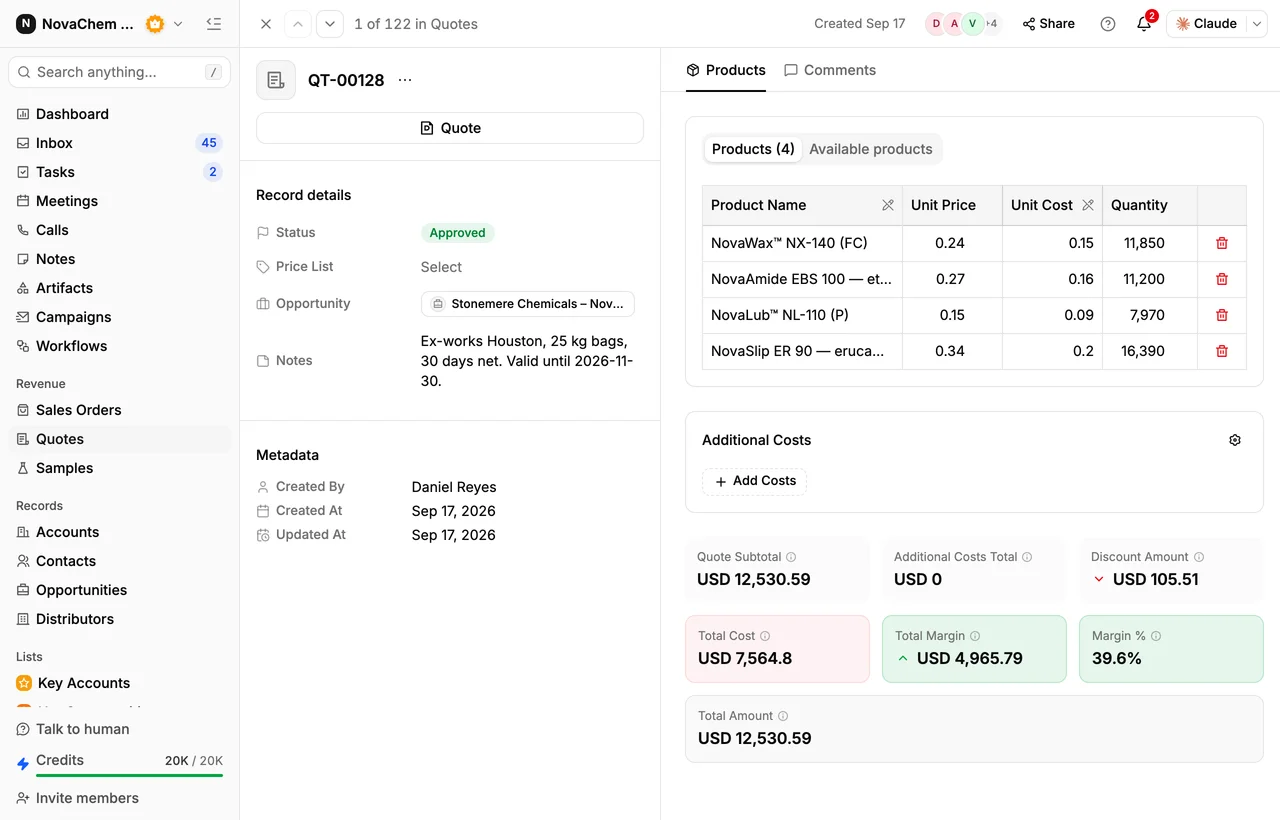
Quote from products
Build the quote from your products and the mill's price list. Put the shipment month and the quality basis in the quote's Notes, which prints on the PDF. A quote has no expiry field, so write the validity date in the Notes.
- 4
Create the sales order
Approving a quote does not create a sales order. Create the order on the account, choose the Incoterm, set payment terms and the planned delivery date, and raise the invoice from it.
- 5
Watch credit
Add a credit-limit custom field on the account and review it before each new order. The credit check checklist lists what to ask.
- 6
Set reorder tasks
Mills reorder on a cycle. Create a follow-up task for the owner a few weeks before the next expected purchase. Tasks don't repeat, so create the next one when you close the last.
How does PromptLab compare for traders?
Swipe the table sideways to see every CRM →
| Checked on 30 September 2026 | PromptLab |  Salesforce |  Close |  Attio |
|---|---|---|---|---|
| Pricing | ||||
| Paid plans, a month | $11.99 – $99per seat | $25 – $550per seat | $9 – $139per seat | $35 – $79per seat |
| Number of plans | 3 | 5 | 4 | 4 |
| Free trial | ||||
| Billing | Billed monthly | Billed annually | Billed annually | Billed annually; free plan for 3 seats |
| Import from CSV and Excel | ||||
| Sales management | ||||
| Deal pipelines | From$35/month | |||
| Quotes | From$100/month | |||
| Sales orders | From$100/month | |||
| Sample tracking | ||||
| Price lists | From$100/month | |||
| Meetings and calls | ||||
| Meeting recording and transcripts | Add-on | From$79/month | ||
| AI meeting summaries | Add-on | From$79/month | ||
| AI follow-up email drafts | Add-on | From$79/month | ||
| Meeting scheduler and call dialer | From$23.99/month | Add-on | ||
| AI and automation | ||||
| CRM fields filled in from calls | From$195/month | From$79/month | ||
| Connect Claude or ChatGPT (MCP) | From$195/month | |||
| Workflow automation | From$99/month | |||
| API and webhooks | From$23.99/month | From$195/month | ||
| Conversations | ||||
| Gmail and Outlook email sync | ||||
| WhatsApp conversations | Add-on | |||
| Telegram conversations | ||||
| Save LinkedIn profiles | Via marketplace | Via marketplace | ||
| Privacy and security | ||||
| Single sign-on (SSO) | From$99/month | Google only | Enterprise plan |
Salesforce is the most configurable CRM there is, with five editions from $25 to $550 a user a month, billed annually. For a team selling products, quotes, sales orders and price lists start on Pro Suite at $100 a user a month, and samples aren't modelled, so tracking them means a custom object someone has to build.
Close is a calling-first CRM priced from $9 to $139, billed annually. Quotes, samples and price lists are missing, pipelines start at $35 a seat and workflows at $99. Attio is a well-designed AI-native CRM, $35 to $79 a seat billed annually, with a free plan for 3 seats, but you design quotes, price lists and orders yourself. See the Salesforce and Attio comparisons. Prices are as checked on 30 September 2026.
Frequently asked questions
What should a CRM for a yarn trader include?
Accounts and contacts for each mill, products with count and type fields, samples for trial lots, quotes with a price list, and sales orders. It should also keep every message in one place. PromptLab includes these on every plan.
Can PromptLab track lots and lab results?
Yes, on the sample: set its result status (positive, conditional or negative), write the lab figures in its test notes, and keep the lot reference in a custom field. PromptLab is not a warehouse or inventory system, so stock stays in your own system.
How do I handle prices that change daily?
Keep your products' base prices current and send each offer as a fresh quote with the validity date in its Notes. Editing a customer price list reprices only its Draft quotes.
Can I store Incoterms for each mill?
Yes. A sales order has Trade terms from the 11 Incoterms 2020 rules, and an account can store its preferred terms, which fill in a new order.
Is there a free trial?
Basic and Professional come with a 14-day free trial, with no card needed. There is no free plan.
Sources
Prices and features of other CRMs come from each vendor's own pages, on the dates below.
- Salesforce, checked on 30 September 2026: Sales Cloud pricing, Sales Engagement pricing, Agentforce MCP support
- Close, checked on 30 September 2026: Pricing, Facts for AI agents, Security, Developer platform, Exporting data
- Attio, checked on 30 September 2026: Pricing, Call Intelligence, AI, MCP server, Exporting lists and views