



















How to create a key account plan
How to create a key account plan for a B2B customer: map the buyers, set goals, find growth by product, plan actions and review it every quarter.
 By the PromptLab team6 November 20265 min read
A key account plan is a one- to two-page document for a single customer that says who you deal with, what they buy, how much more they could buy, what you will do about it and when you will review it. Write one per key account, keep it in the CRM beside the account, and review it every quarter.
This guide is for sales leads at manufacturers and distributors who have a handful of accounts that matter more than the rest. For the wider practice, read how to manage key accounts and what is key account management.
What goes in the plan
Seven short sections are enough:
- Account snapshot. What they do, where, size, what they buy from you, and since when.
- People. Who buys, who specifies, who approves, who pays, and your contact for each.
- Current business. Products bought, volume, order frequency and revenue over the last 12 months.
- Opportunity. What else they could buy, from you or from competitors.
- Risks. Rivals, price pressure, a single contact, late payments.
- Goals. Targets for the next 12 months.
- Actions. Who does what by when.
Keep it short. A 20-page plan is never read.
Step by step: write the plan
- 1
Pick the account for a reason
Choose by revenue, growth potential or strategic value. Say a paint manufacturer buys $240,000 a year from your resin range and could buy twice that. That earns a plan. A customer who buys one drum a year does not.
- 2
Pull the facts from your records
List orders, quotes, samples and open deals from the last 12 months. Note the last order and the trend. Pulling this from the CRM takes ten minutes; relying on memory takes a week and gets it wrong.
- 3
Map the buying group
Name each person and their role: technical, purchasing, finance, production. Mark who you know well and who you have never met. A single contact is a risk, so add a task to meet a second person.
- 4
Find the whitespace
Compare what they buy from you with what they could. If they buy resins but also buy additives elsewhere, that is a gap. Ask "what else do you buy for this process?" on the next call.
- 5
Set two or three goals
Make them specific. "Grow from $240,000 to $300,000 by December by adding the matting agent" is a goal. "Strengthen the relationship" is not.
- 6
List actions with owners and dates
Each action has one person and a date: "Book technical visit with the plant manager by 15 March", "Send sample of grade C by 28 February", "Quote annual volume pricing by 31 March".
- 7
Put the review in the calendar
Review every quarter: progress against goals, what changed, what is next. Use the key account review checklist for the meeting.
A short example
Account: a coatings maker that buys two resin grades and a solvent, $240,000 a year, with a three-year relationship.
People: the purchasing manager (strong), the technical director (met once), the plant manager (unknown).
Opportunity: a matting agent they buy from another supplier. A technical trial could win it.
Risk: one supplier contract renewal in May; our price on the solvent is above a rival's.
Goal: $300,000 by year end, one new product, and a second contact at technical level.
Actions: sample of the matting agent by 28 February, technical meeting by 15 March, solvent price review by 30 April.
Mistakes to avoid
- Plans on every account. Keep it to the few that matter.
- Written once, filed. Review it quarterly or throw it away.
- Only about selling. Include service issues, deliveries and payment, because they decide renewals.
- One contact only. If the plan names one person, fix that first.
- Vague goals. If you cannot measure it, you cannot review it.
How to keep the plan alive
A plan decays when nobody opens it. Three habits help. First, put the account's goals at the top of every pipeline review, so the plan is part of the weekly rhythm. Second, update the people section after every meeting, because contacts change jobs and the plan should show it. Third, write the next three actions as tasks with dates, not as paragraphs. Tasks show up in a rep's day; paragraphs do not.
When a goal is hit or missed, write one line on why. After a year you will have a record of what worked with this customer, and that is worth more than the plan template.
How PromptLab helps
The account page in PromptLab shows contacts, open deals, quotes, samples, sales orders, notes, tasks and a Files tab, so the facts for step two are in one place. The account's Overview shows its last order. The account already stores its preferred trade terms (Incoterms), which fill in its new sales orders; add custom fields for tier or renewal date, and a task for each action. Before a quarterly review meeting, the AI pre-meeting brief on the meeting's Prep tab gathers the account's history.
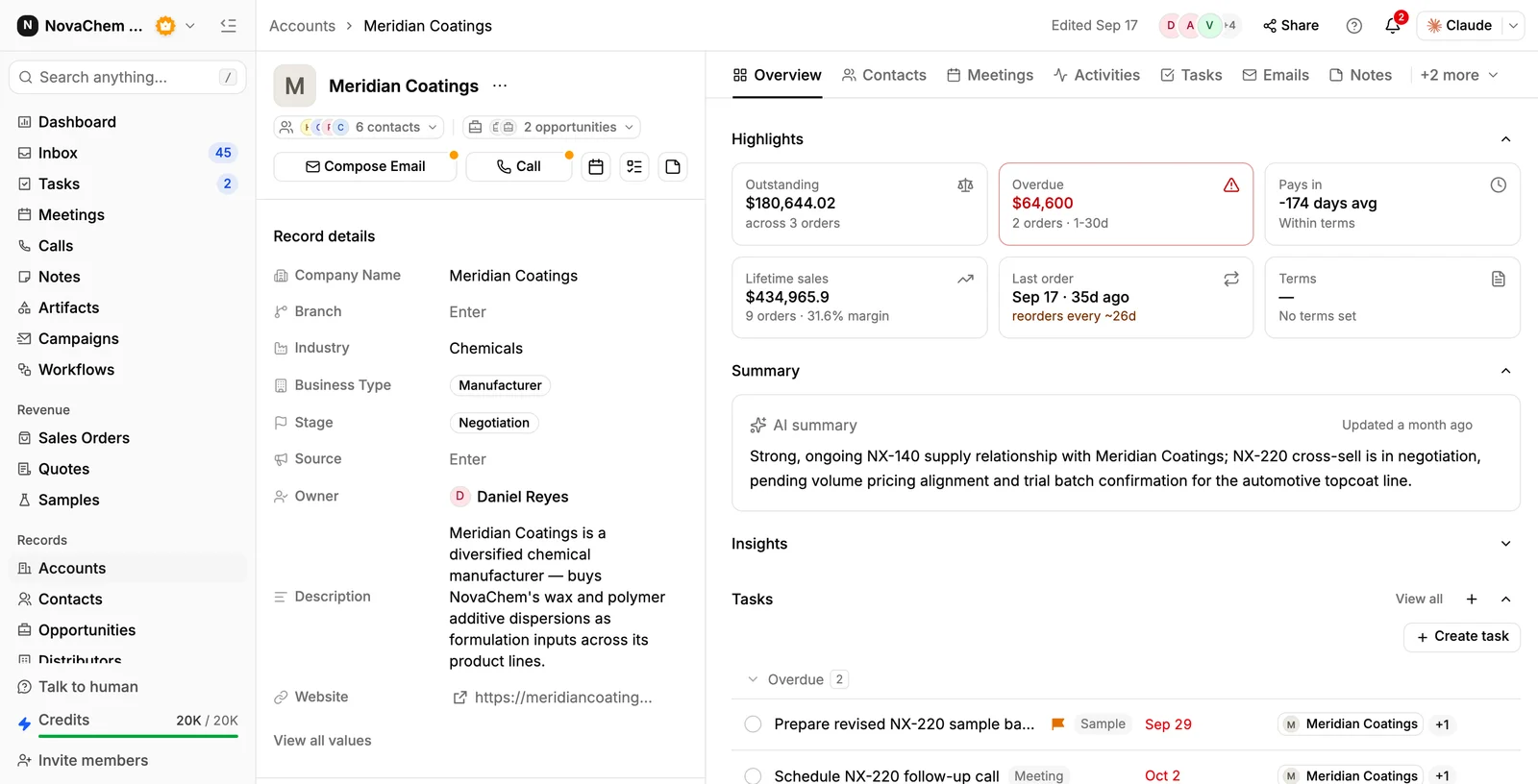
Keep the plan itself in the account's Files tab or as a note, and link tasks to the account so the next action is always visible.
Frequently asked questions
What is a key account plan?
A short document for one important customer covering the people, current business, growth opportunity, risks, goals and actions. It turns account management from habit into a plan with dates.
How long should a key account plan be?
One to two pages. If it is longer, people stop reading and updating it.
How many key accounts should one rep manage?
It depends on the size of the accounts and the contact needed. A rep with five to ten real key accounts can plan each properly. Many more and the plans are paper.
How often should you review a key account plan?
Quarterly for the full review, with a quick check monthly on the actions. Update it after any big change, such as a lost contact or a new competitor.
Who should see the key account plan?
The account owner, their manager and a named back-up. Share it internally; do not send the full plan to the customer, though you can share the joint goals.