








How to build a B2B sales pipeline
Build a B2B sales pipeline for physical products with seven stages, from enquiry to order, with exit rules, worked examples and a setup checklist.
 By the PromptLab team6 October 20265 min read
A B2B sales pipeline for physical products needs seven stages: enquiry, qualified, sample sent, trial, quote, negotiation and order. Each stage is a fact about the customer, not a feeling about the deal. A deal moves forward only when something real has happened, such as a spec confirmed, a sample delivered or a quote accepted.
The generic "lead, opportunity, proposal, closed" pipeline in most CRMs hides the part that matters in your sale: the sample and the trial. This guide shows how to build a pipeline that matches how chemicals, coatings, plastics, ingredients and packaging are actually sold.
The seven stages of a product sales pipeline
Here is the pipeline we recommend as a starting point. Rename the stages to suit your trade.
| Stage | What is true when a deal enters it |
|---|---|
| 1. Enquiry | Someone asked about a product, by email, WhatsApp, at a show or by phone |
| 2. Qualified | You know the application, the volume, the buyer and the timeline |
| 3. Sample sent | A sample has shipped to the customer |
| 4. Trial | The customer is testing it and has agreed what a pass looks like |
| 5. Quote | The trial passed and you have sent a priced quote |
| 6. Negotiation | The customer is discussing price, terms or volumes |
| 7. Order | A purchase order or sales order is confirmed |
Add "Lost" as a closed outcome, with a required reason. Lost reasons such as "price", "failed trial" and "went with incumbent" tell you more than any dashboard.
How to set up your pipeline
- 1
Write down how your last ten orders happened
List the steps each one went through, in order. You will usually find the same five or six, with the sample and trial in the middle. Start the stages from this list, not from a textbook.
- 2
Name each stage after what happened
"Sample sent" is checkable. "Interested" is not. A rep should be able to point to an email, a tracking number or a document that proves the deal belongs in the stage.
- 3
Write an exit rule for every stage
Decide what must be true before a deal moves on. For qualified, it might be "application, annual volume and decision maker recorded". For quote, "trial result positive or conditional".
- 4
Keep it to seven or fewer stages
Every extra stage is another click for your reps and another place for deals to stall unseen. Combine stages before you add them.
- 5
Give each deal an owner, a value and a next action
A deal with no dated next action is not in the pipeline, it is in a pile.
Stage by stage: what to do and what to record
Enquiry
Record the product, the source and the contact. Reply fast. For leads from a show, see how to follow up after a trade show.
Qualified
Qualify on the facts that decide a product sale: the application, the volume per year, the current supplier, who approves a change and when they would switch. How to qualify B2B leads goes deeper. A lead without volume or an application stays at enquiry.
Sample sent
Create the sample record on the day it ships, on the customer's account. How to track product samples covers the fields and statuses. Set a task to check delivery.
Trial
This is the longest stage for most product sellers, so watch it closely. Agree the test and the pass criteria in writing. Log the customer's feedback on the sample record and note the result on the deal.
Quote
Send a priced quote only after the trial result is in. The quote attaches to the deal. For what to put in it, read how to write a sales quote.
Negotiation
Keep every revision on the deal. Know your margin floor before the call, not during it.
Order
Raise the sales order once the quote is accepted. Record the order value on the deal so your revenue reports match.
A worked example
Say a coatings supplier has 12 deals in the pipeline. Five are at "sample sent", three at "trial", two at "quote", one in "negotiation" and one at "enquiry".
The pile-up is at "sample sent". Checking the sample records, the sales manager finds two samples that were delivered three weeks ago, with no test date agreed. A call to each of those two accounts is worth more than any new lead this week.
That is the point of the pipeline: it shows where deals stall, so you know which conversation to have.
Review the pipeline every week
A pipeline that nobody reviews decays. Hold a 30-minute review each week, stage by stage, starting from the right: negotiation first, enquiry last. Ask of each deal what the next step is and when. The weekly pipeline review guide has the agenda, and the pipeline review checklist is a printable version.
Pipeline setup
How PromptLab helps
In PromptLab the pipeline is a board of columns, one per stage, each showing its deal count and total value. Each card shows the owner, source, amount and how long the deal has sat in the stage. Drag a card to move the deal.
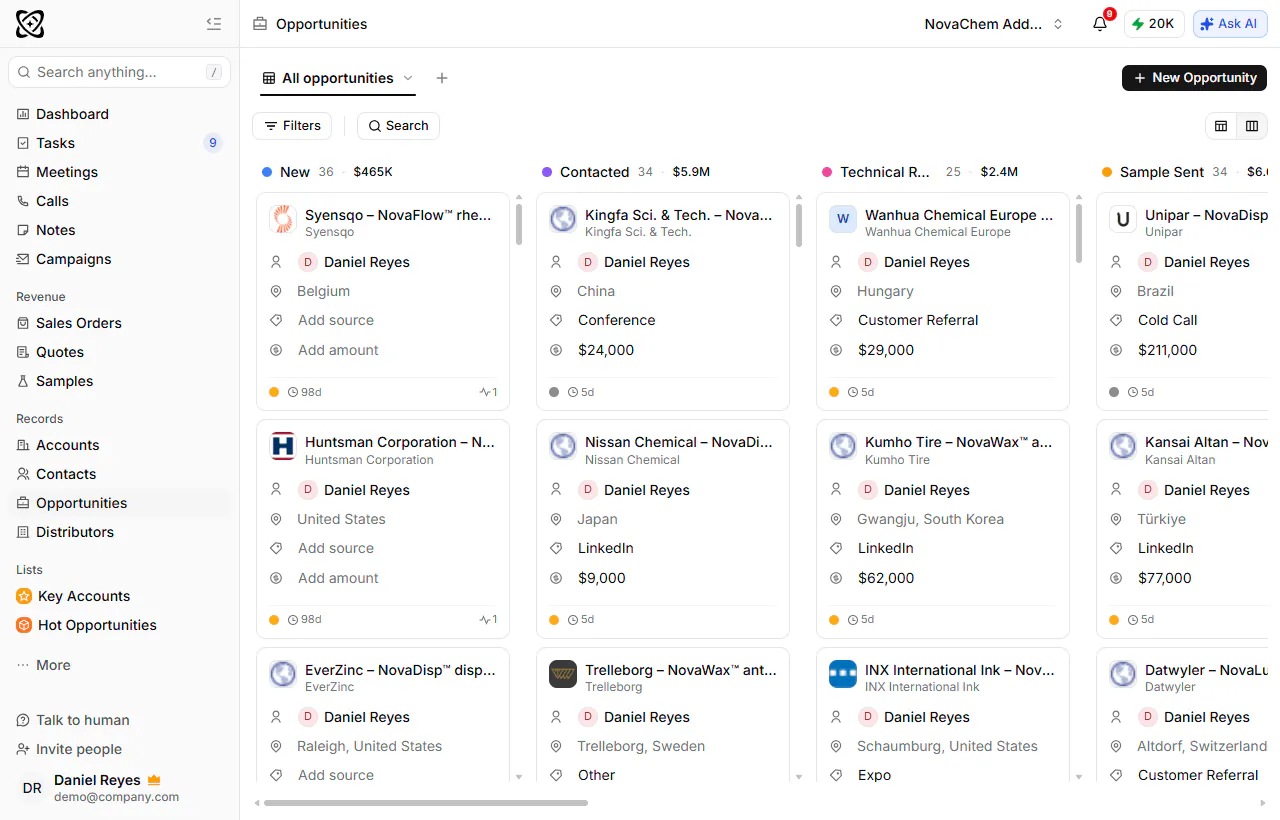
Emails, calls and meetings log themselves against the account and the deal, so the Last Activity columns stay current. Stage changes stay yours, or you can automate what follows them: a workflow can create a task or post to Slack when a deal changes stage.
Quotes attach to the deal automatically, and you can follow samples through to the customer's result. Reports and dashboards show pipeline and revenue by stage. If you run another CRM today, Salesforce and HubSpot two-way sync lets you move across gradually. See pricing and the quotes and samples page.
Frequently asked questions
How many stages should a B2B sales pipeline have?
Five to seven for most product sellers. Fewer than five hides where deals stall. More than seven means reps skip stages or argue over which one a deal is in.
What is the difference between a lead and a deal?
A lead is a person or company that might buy. A deal is a specific opportunity with a product, a value and a next step. A qualified lead becomes a deal when you have enough facts to put a value on it.
Where should samples go in the sales pipeline?
Between qualified and quote. A sample is a commitment of your stock and time, so only qualified deals earn one, and only a trial result earns a quote.
How do I know when a deal should move stages?
When the exit rule for its current stage is met by a fact you can point to: a tracking number, a test result, a sent quote. If you cannot point to it, the deal has not moved.
Can I use the same pipeline for new and repeat customers?
Often not. Repeat orders skip the sample and trial. Many teams run a second, shorter pipeline for reorders: enquiry, quote and order.