



















How to reactivate dormant B2B accounts
How to reactivate dormant B2B accounts when you sell products: define dormant, find out why they stopped, pick who to chase and make an offer worth answering.
 By the PromptLab team16 October 20267 min read
To reactivate a dormant B2B account, find out why it went quiet, then give the buyer a specific reason to order again. Start with the accounts that used to buy often, check the history before you write, and make the first contact useful: a changed price, a new grade, a delivery fix. A message that only says "just checking in" gets the same silence as before.
Dormant accounts are the cheapest revenue you are not collecting. They already know your product, have been through your approval process and sit in your records. This guide shows how to decide which ones to chase and how to run the effort. For message wording, see our win-back email templates. For the wider problem, read what customer churn is.
What counts as dormant
A dormant account is a customer that used to order and has stopped, without telling you it has left. The point is that nobody decided it. The reorder just never came.
"Dormant" depends on how your customers buy. A packaging buyer who orders every month and has missed three months is dormant. A buyer of industrial machinery who orders every four years is not. So set the line from each account's own pattern:
- Regular buyers: no order for two of their usual cycles.
- Seasonal buyers: no order in the season they normally buy.
- Project buyers: no contact since the project ended, and no new project known.
Write the rule down, so that "dormant" means the same thing to every rep.
Step 1: Build the list from your orders
- 1
List accounts by last order date
Pull every customer with an order in the past two years, sorted by the date of the last one. Your sales orders are the best source, because an open quote or a friendly email does not make an account active.
- 2
Add what they used to buy
For each account, note the products, typical order size and how often they reordered. A chemical distributor who took 10 tonnes a quarter is a different target from one who bought a single pallet.
- 3
Rank by what they were worth
Say an account used to order around $40,000 a year and another around $3,000. Work the first one personally and give the second a lighter touch. You will not have time to chase everything.
Step 2: Find out why they stopped
The message depends on the reason, so look before you write. Read the account history first: the last quote, the last complaint, the last sample, the last person who replied. Common reasons in product sales:
| Likely reason | What the history shows | What to offer |
|---|---|---|
| Price | A quote that was never answered, or a price rise | A review of the price list, or a volume tier |
| Service | A late delivery or a complaint with no clear close | An honest fix and a named contact |
| Product | A failed sample, or a spec change on their side | A new grade or a fresh sample |
| Competitor | A new supplier mentioned in the last call | A reason to dual-source with you |
| Contact left | The buyer's email now bounces | A new introduction at the same company |
| Nothing | Orders just faded | A simple, useful check-in |
If you cannot tell from the records, that is itself a finding. Ask a colleague who worked the account, or ask the buyer directly.
Step 3: Make a reason to reply
A good reactivation message has one specific hook. The buyer should be able to answer in a line.
- A price or terms change: "Our freight terms to your region changed. Your 25 kg drums now ship on a lower minimum."
- A new product: "We now supply the low-odour version of the resin you used to buy."
- A problem fixed: "The delay on your last two deliveries came from one warehouse. It has been changed, and I would like to prove it."
- A reorder prompt: "You last took 5 tonnes in March. Do you need a refill before year end?"
Subject: Your [Product] supply, [Company]
Hi [First name],

I noticed we have not shipped [Product] to [Company] since [Month]. Before that you took about [quantity] every [period].

[One specific thing that has changed, such as price, lead time or grade.]

Is this still a product you use? If it is, I can send an updated quote today. If something went wrong last time, I would like to hear it.

[Your name]
Keep it short and name a person who owns the answer. Do not offer a discount in the first message. Learn why they left first, because a discount aimed at the wrong reason just lowers your price.
Step 4: Use more than one channel and more than one contact
Email is the default, but dormant buyers often answer a different route. If you have talked to them on WhatsApp or Telegram, a short message there can get a reply that a third email will not. Wait for a normal moment and keep it light.
Also look for a second contact at the account: the production manager, the purchasing assistant, the person who signed the last order. A buyer who is silent may have changed jobs. Our guide to building a B2B pipeline covers how to track several contacts per account.
Step 5: Set a cadence and a stopping point
Reactivation is a short project, not a permanent chase. A simple rhythm:
- First contact with a specific hook.
- A follow-up after about a week, with something new: a data sheet or a price.
- A call, if the account is worth one.
- A final note that leaves the door open.
After that, move the account to a slow list and stop. Resist the urge to keep messaging a buyer who has said no, since that turns a quiet customer into an annoyed one. Win-back templates for each stage are in our win-back email templates.
Step 6: Turn a reply into an order quickly
When a dormant buyer answers, move fast. Send the quote the same day, using their current price list, and offer a sample if the product has changed. Then book a next step with a date.
Once they order, treat them as a new customer for a few weeks: confirm delivery, check the first shipment and ask how it went. A returning buyer who has a bad second experience will not give you a third. For the ongoing habit, read how to increase repeat orders and use reorder reminder templates.
Dormant account reactivation
Mistakes to avoid
- Treating every account the same. A big lapsed account needs a call. A small one needs one good message.
- Writing before reading the history. If the last interaction was a complaint, "just checking in" sounds careless.
- Leading with a discount. Fix the reason first.
- Only trying one contact. The buyer may have moved on.
- Never closing the loop. Mark the outcome on the account so the next review starts from facts.
How PromptLab helps
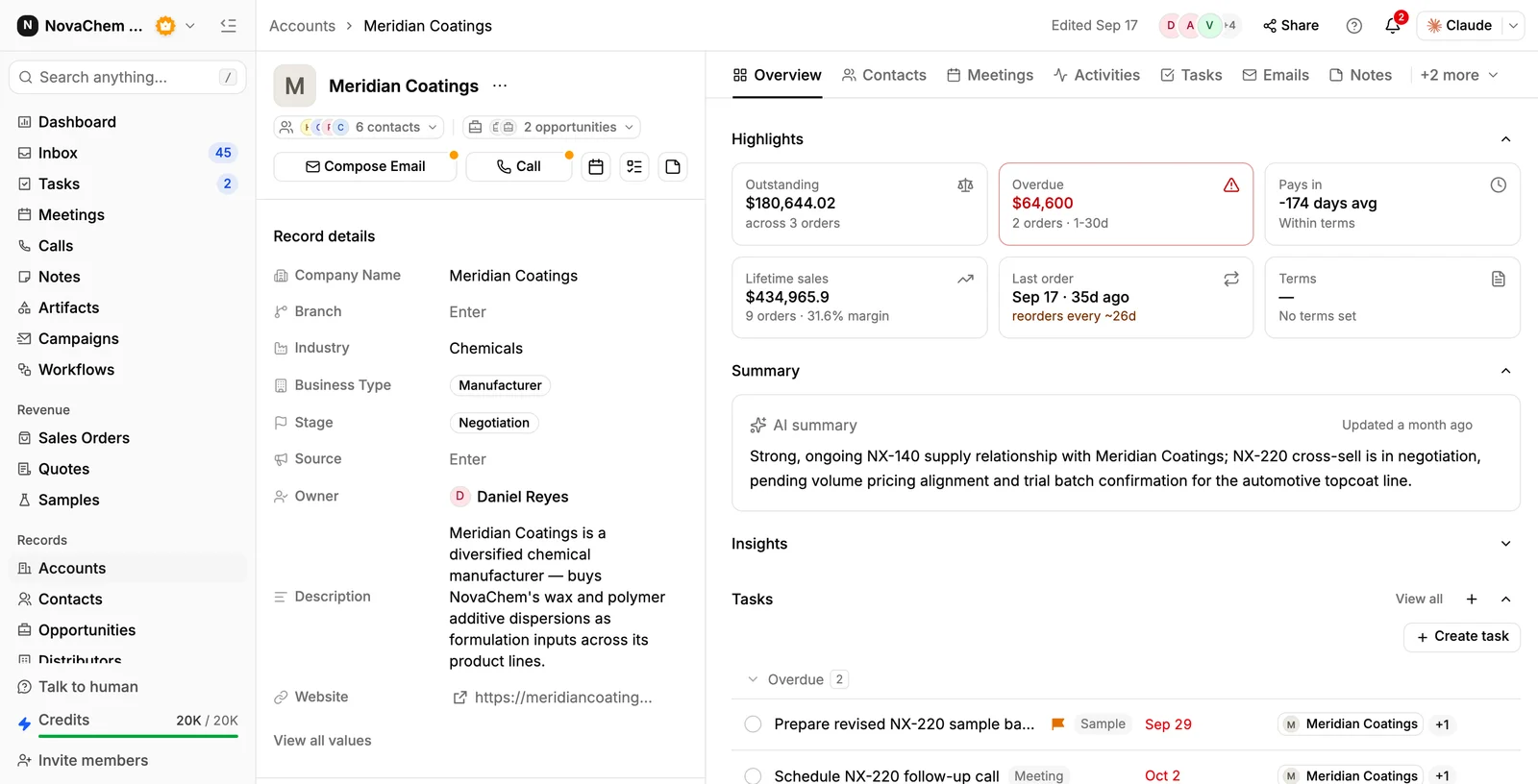
PromptLab flags accounts with no recent engagement, so the quiet ones show up without a rep having to remember them. You open the account and see its sales orders, quotes, sample history, emails and meetings in one place, which is the history you need before writing the first message.
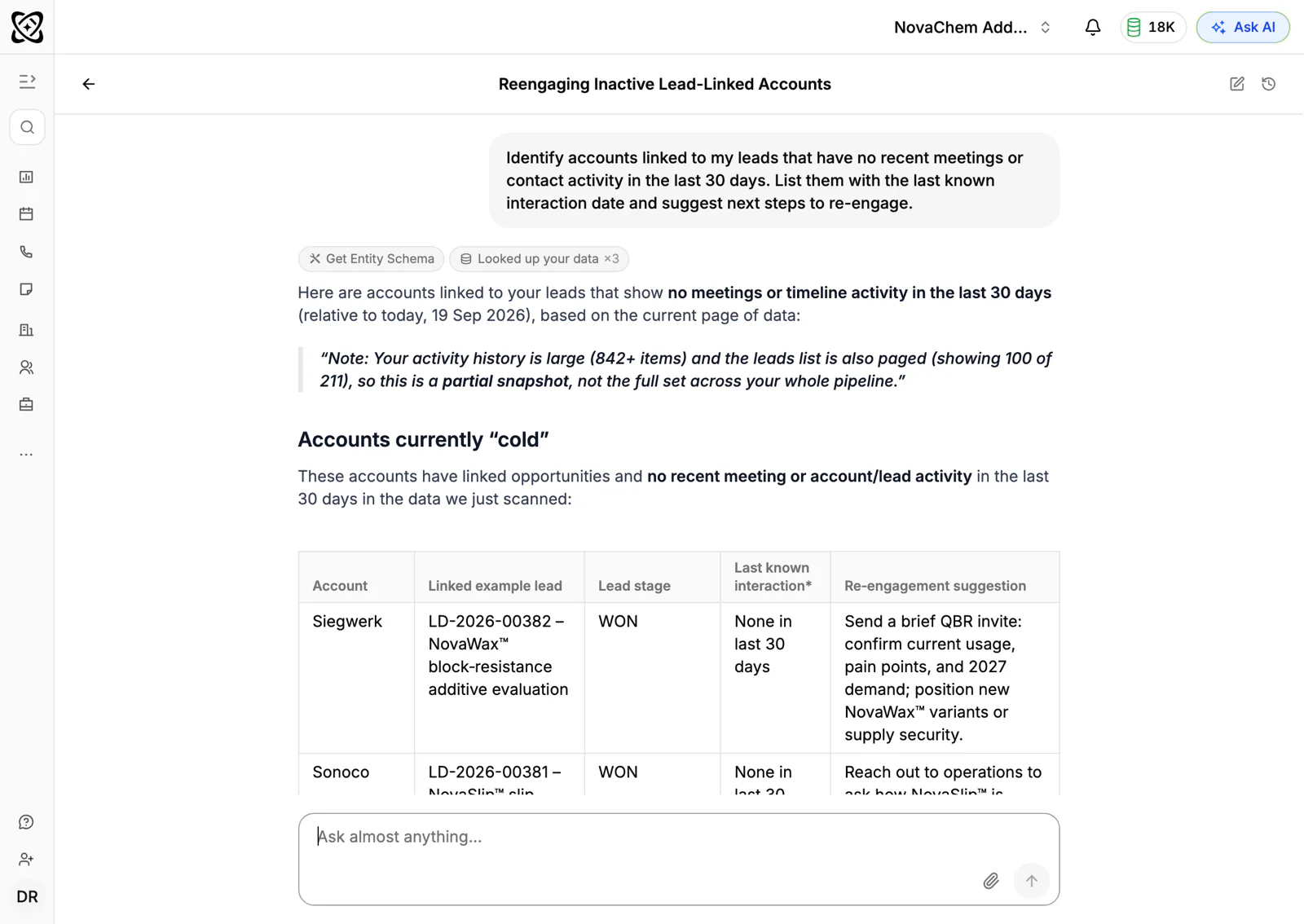
From there you can build a quote from the customer's price list, create a task on the account or the deal, and reply from the shared Inbox if the buyer answers by email, WhatsApp or Telegram. You can also ask Ask AI a plain question, such as which accounts have not ordered in six months, and read the answer from your own records.
Frequently asked questions
How long before an account is considered dormant?
It depends on how often the customer normally buys. A good rule is no order for two of their usual buying cycles. A monthly buyer is dormant after two quiet months, while a yearly buyer is not dormant until well after their normal date.
What is the best way to reach a customer who has stopped ordering?
Start with a short, specific message to the person who last ordered, and mention something that has changed. If there is no reply, try a second contact at the same company and a different channel, such as a call or a chat message.
Should I offer a discount to win back a dormant account?
Not first. Find out why they stopped. If the reason was price, a review of their price list or a volume tier may work. If it was service or product, a discount will not fix it.
How many times should I contact a dormant customer?
Three or four attempts over a few weeks is enough: a first note, a follow-up with something new, a call and a closing message. After that, move them to a slow list.
Is reactivating customers worth more than finding new ones?
Often it is cheaper, because the buyer already knows your product and has passed your approval. It is not either-or. Reactivation is a good job for the weeks between new-business pushes.