



















How to reduce customer churn in B2B
How to reduce B2B customer churn: define it for repeat orders, spot warning signs early, fix the causes, run reviews and win back accounts that slip.
 By the PromptLab team31 October 20265 min read
To reduce customer churn in B2B, first define what churn means for your sales model, then watch for the warning signs (slower orders, fewer contacts, a new supplier), fix the causes you find, and keep a regular rhythm of contact with every account that matters. Catching a drop in orders early is far cheaper than winning the customer back.
This guide is for suppliers whose customers buy repeatedly: coatings, packaging, ingredients, industrial supplies and similar. There is no subscription to cancel, so churn is quiet. A buyer simply orders less, then stops. For the definition, see what customer churn is. This post is about prevention.
Define churn for your business
Without a subscription, you have to choose the rule. Look at your normal reorder cycle and set a threshold. Say a customer usually orders every six weeks. You might call an account "at risk" at ten weeks without an order and "lost" at six months.
Track two kinds of loss:
- Full churn: the account stops buying altogether.
- Partial churn: the account still buys but moves part of its volume to another supplier. This is often the harder one to see.
Count both, by account and by revenue. Losing one big account can matter more than losing ten small ones.
Learn the warning signs
Customers rarely leave without a signal. Common ones in product sales:
- Orders get smaller or the gaps grow longer
- Your main contact goes quiet, moves on or is replaced
- Complaints about delivery, quality or invoices go unanswered for days
- The buyer asks for a competitor's spec or a price comparison
- Payment slows down
- They stop answering email, or only answer through someone junior
Write the list down and share it. A rep who knows the signs can act at the first one.
Find out why they leave
Fixing churn starts with causes, not guesses. Gather the reasons from three places:
- Lost-account calls. Ring accounts that have gone quiet and ask plainly what changed.
- Your notes. Search the account history for complaints and issues before the drop.
- Your loss reasons. For lost deals, PromptLab requires one of Price, Competitor, Timing, No budget, Product fit or Other. For churned accounts, add a custom field on the account with the same choices, so both can be counted the same way.
After a quarter, you will see a pattern. Perhaps late deliveries explain most of it, or a price gap on one product line, or a single rep who left. Fix the biggest cause first.
Build a rhythm of contact
Some accounts leave simply because nobody called. Set a contact plan by account size:
| Account type | Contact rhythm |
|---|---|
| Key accounts | A call or visit each month, and a quarterly business review |
| Regular accounts | A check-in every one or two months, and a reorder reminder |
| Small accounts | A short email or message each quarter |
Make each contact useful: a market note, a new grade, a price warning, a technical tip. A call that only asks "anything to order?" gets a polite no.
Make reordering easy
Some churn is friction. A buyer who has to chase a quote, wait for a price or ask for the same document again will test another supplier. Keep their price list current, send quotes the same day, and prompt the next order before they run out. How to increase repeat orders goes further.
Look at churn by account group
A single churn figure hides the story. Split it by customer group, region, product line and owner. Say churn is steady overall, but every account that left this year bought one product line and was served by one rep who has since moved on. That points to a handover problem, not a market problem. How to hand over accounts when a rep leaves helps when ownership changes, so no account is left without a contact.
Review the split every quarter with the account owners in the room. Ask each owner to name the three accounts they worry about most, and agree one action for each. The list takes ten minutes and often finds the problem before the numbers do.
Fix problems fast
How you handle a problem decides whether a complaint ends the relationship. Reply within a working day, name one owner, say what you will do and by when, and then do it. Tell the customer when it is done. A well-handled failure can build more trust than a smooth run.
Win back accounts that slip
Do not write off an account at the first gap. Contact it with a reason: a new product, a price change, a fix to the issue they raised. How to reactivate dormant accounts gives a step-by-step plan.
How PromptLab helps
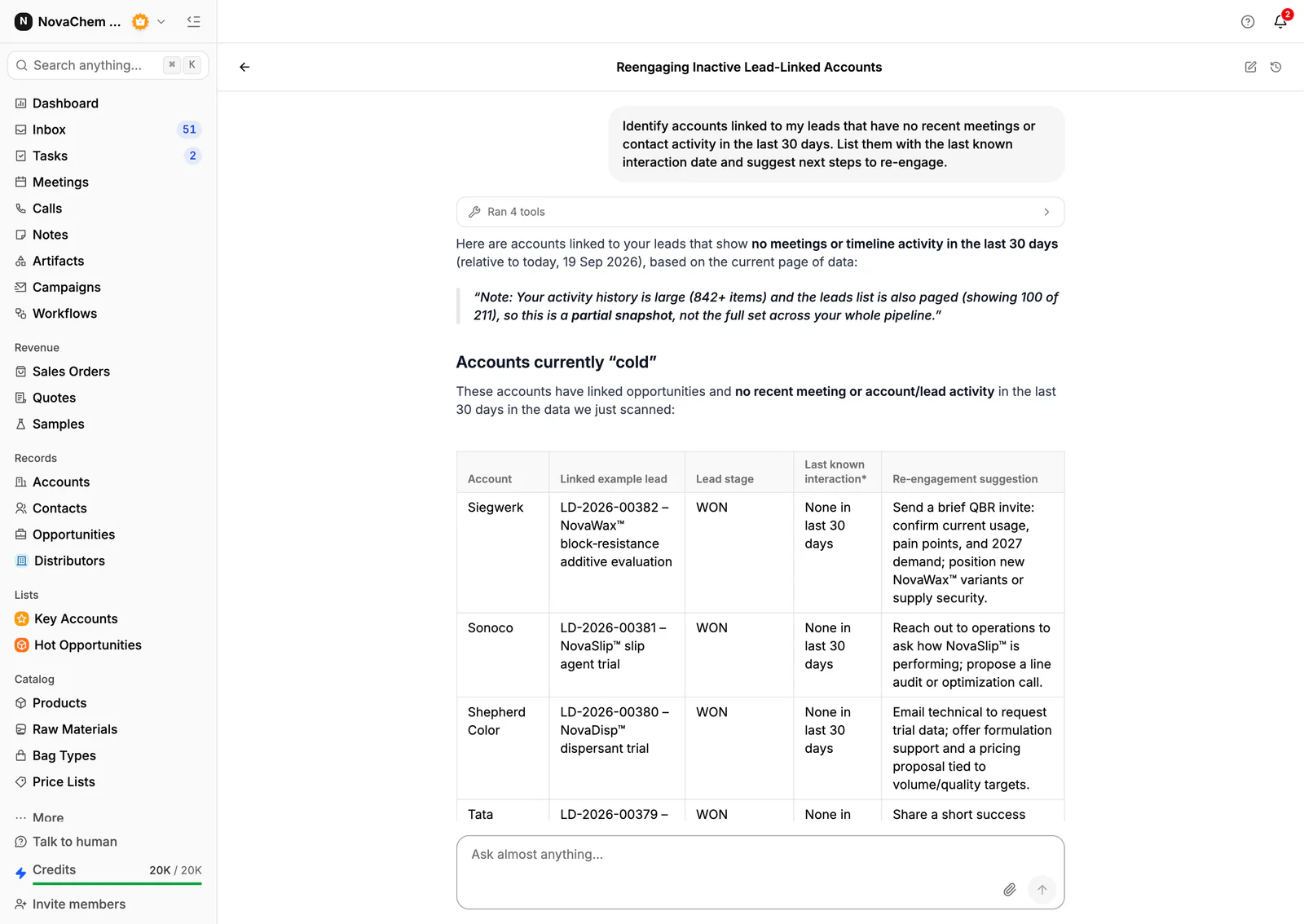
Every sales order, quote, meeting and message lands on the account, so the history behind a quiet customer is one page. Use a saved view of accounts with last activity and owner as columns, and review it weekly; each account's overview shows its last order. A workflow can create a task for the owner when a deal changes stage, and tasks give each check-in a date. Ask AI answers questions in plain words about accounts, sales orders and email, such as which accounts have not ordered recently.
Frequently asked questions
What is a good churn rate in B2B?
It depends on your market, product and reorder cycle, so compare against your own past figures rather than a general number. Track it by account count and by revenue, and aim to see it fall over time.
How do you measure churn when customers do not have contracts?
Set a rule based on the normal reorder cycle. For example, an account that has not ordered for twice its usual gap is at risk, and one that has not ordered for six months is lost. Adjust the thresholds for your product.
What is the biggest cause of B2B churn?
It varies, and the honest answer is to ask your lost customers. Common causes are poor service, late delivery, a price gap, a change of contact on the buyer's side and plain neglect.
Is it cheaper to keep a customer than to win a new one?
Usually, yes. A current customer already knows you, has a price list and has a buying habit. Winning a new one takes prospecting, samples, quotes and trust. Do not rely on a fixed ratio; check your own costs.
Who should own customer retention?
The account owner, with a manager who reviews the at-risk list each week. Make retention part of the owner's normal routine, not a separate project.