



















How to upsell to B2B customers
How to upsell B2B customers: find accounts ready for a bigger or better order, time the offer, show the saving or gain, and record what works.
 By the PromptLab team7 November 20265 min read
To upsell a B2B customer, offer a bigger, better or longer version of what they already buy, at a moment when they can see the gain: a larger pack with a lower unit cost, a higher grade that fixes a problem, or a contract that fixes supply. You upsell when you make the same purchase worth more. Selling a different product is cross-selling, covered in how to cross-sell to existing customers.
This guide is for account managers at manufacturers and distributors. For the definition, see what is cross-selling for the contrast, and how to increase repeat orders for the wider routine.
What an upsell looks like in product sales
- A larger pack or volume. Drums to IBCs, pallets to full truckloads, with a better unit price.
- A higher grade or specification. A food-grade version, a longer-lasting coating, a cleaner ingredient.
- A longer commitment. A twelve-month supply agreement with fixed monthly call-offs.
- A service on top. Faster delivery, own-label packing or on-site stock.
The test is simple: does the customer get something they value, and does your average order grow?
Step by step: run an upsell
- 1
Start with the accounts that are ready
Look for customers who order often at a steady rate, have grown, or have complained about something your premium option solves. A customer who has bought drums every month for a year is a candidate for an IBC offer.
- 2
Understand what they use and why
Ask how they use the product, what their volumes will be and what annoys them: waste, handling time, quality variation or stock-outs. An upsell that fixes a stated problem is not a push.
- 3
Work out the customer's gain in their numbers
Calculate the saving or benefit in terms they recognise: price per kilo, fewer changeovers, fewer rejects. Say your current price is $2.10 a kilo in drums and $1.95 in IBCs. On 4,000 kilos a month, that is $600 a month saved. Use their volume, not a generic example.
- 4
Time it to a natural moment
Good moments are a reorder, a quote renewal, a delivery issue, a product launch on their side or the end of a price period. Cold upsells, with no reason for today, feel like pressure.
- 5
Offer one option, and a trial
Present the upsell as a clear alternative: "Here's the IBC option next to your drum price." Offer a sample of the better grade or a single trial delivery. Keep the old option available so saying no is easy.
- 6
Agree the next step
Name it: "I'll send a quote for IBCs by Friday and call you Monday." Add a follow-up date for yourself immediately.
- 7
Record the result
Whether it was accepted or declined, note the reason. Over time you will see which customers and offers fit.
When not to upsell
- The customer has a cash-flow problem or an overdue invoice.
- The larger volume would break their storage or their payment terms.
- Your better grade solves a problem they do not have.
- They have just changed their buyer, and trust is still being built.
An upsell that overloads a customer comes back as a cancellation. The aim is a bigger relationship that lasts.
How to phrase the offer
Lead with the customer's situation, not your wish to sell more. "You've been ordering 25 kg bags every month. At that volume, a bulk bag would cost you less per kilo and cut handling. Do you want me to price it?" This is a question about their cost, and the customer can answer it.
Avoid urgency you cannot back up. If a price is genuinely changing on a date, say so. If it is not, do not invent a deadline.
How to measure upselling
Track the average order value by account over time, the share of accounts that moved up a pack size or grade, and the reasons customers declined. If average order value rises while repeat orders hold, your upsells are working. If repeat orders fall, you pushed too hard.
A worked example
Say a plastics distributor sells a moulding compound in 25 kg bags to a small manufacturer, an average order of about $3,000 every month. The account manager notices the customer has doubled the number of moulds in use. She asks about volumes: they now use about a tonne a month. She quotes a bulk bag at a lower price per kilo and an agreement of monthly call-offs for six months. The customer's cost drops, their handling time drops, and the average order rises. She records the move on the account and sets a task to review the agreement at month five.
How PromptLab helps
PromptLab links quotes, samples, sales orders and invoices to the account. For a customer, the account's Overview shows lifetime sales, the last order and roughly how often they reorder, which is where you spot a customer who orders steadily or has grown. Customer price lists hold the prices you agreed: a list adds a set amount on top of each product's base price, and you pick the list on each quote, so a volume or contract price can be its own list with a smaller amount added, or a line discount. You build the upsell as a new quote from products and the price list, with line discounts, a PDF and a public link to send. Note that approving a quote does not create a sales order, so create the order on the account once the customer agrees.
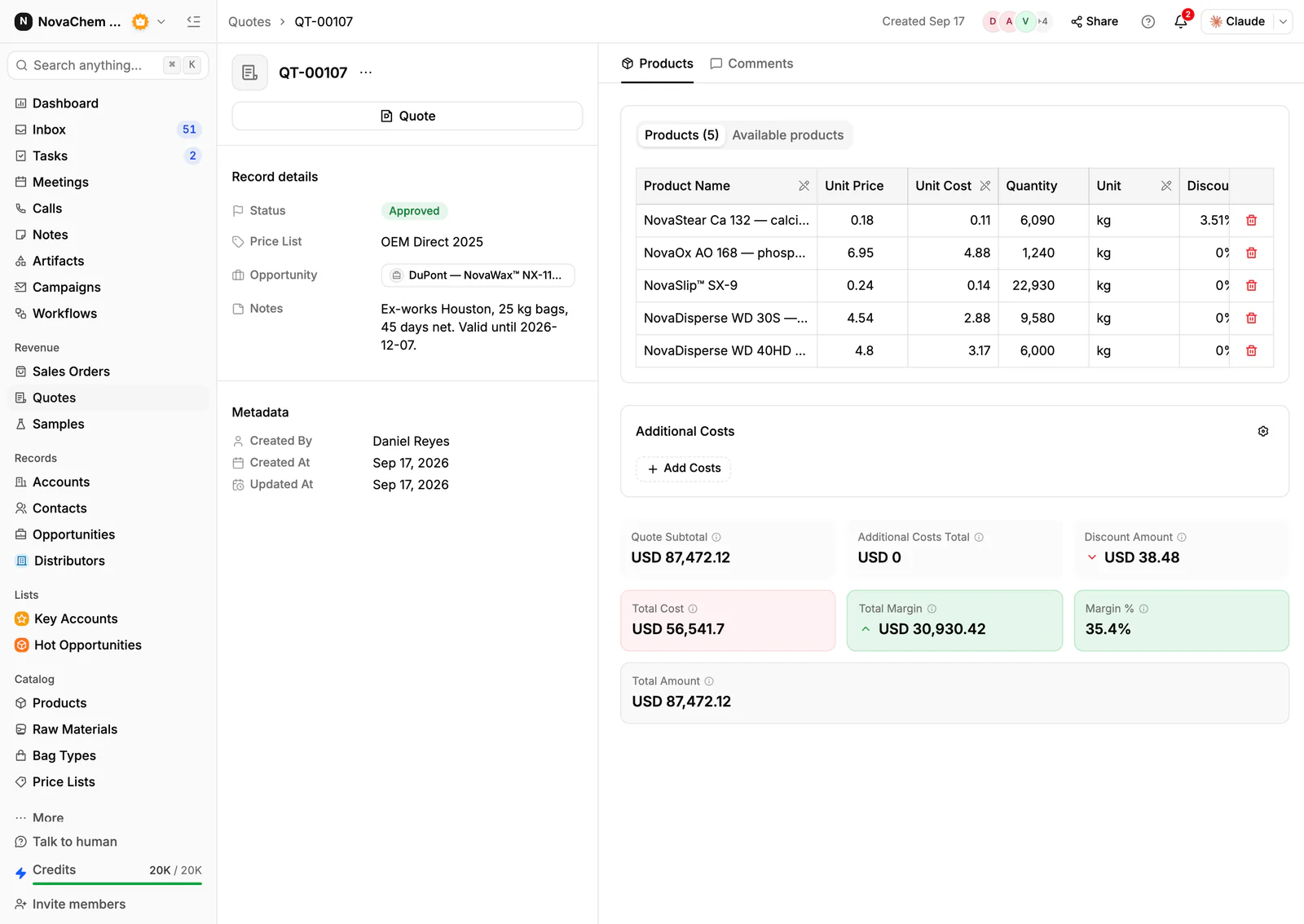
Use a deal for the upsell, with an estimated value and a next follow-up date. Ask AI answers plain-word questions about your sales orders, such as which accounts ordered most last quarter.
Frequently asked questions
What is the difference between upselling and cross-selling?
Upselling offers a bigger, better or longer version of what the customer already buys. Cross-selling offers a different product alongside it.
When is the best time to upsell a B2B customer?
At a natural moment: a reorder, a quote renewal, growth on their side, or after a problem your better option solves. Avoid times when there is an open complaint.
How do I upsell without discounting?
Show the gain in the customer's own numbers: cost per unit, handling time, rejects. A better-value offer is not the same as a lower price on the same product.
How do I decide which customers to upsell?
Look for steady, growing buyers, and those with a problem your premium option fixes. Avoid anyone with overdue invoices or a recent complaint.
What if the customer says no?
Ask what would need to change, record the reason and set a follow-up date. A no today is often a yes at the next volume step.