











What is a customer price list?
A customer price list sets the agreed prices for one customer or group. Here is why B2B sellers use them, how they work, and how to keep them accurate.
 By the PromptLab team6 October 20262 min read
Definition
Customer price list
A customer price list is a set of agreed prices for one customer or one group of customers. It overrides your standard prices, so each buyer is quoted what you have agreed with them.
In B2B product sales, there is rarely one price. The same drum of solvent may cost one buyer one price and another buyer a different one, because of volume, history or contract.
Why customer price lists matter
Without a list, prices live in a rep's head or a spreadsheet. Two reps quote the same customer differently. A buyer notices, and either feels cheated or pushes for the lower number.
A shared list fixes that. Everyone quotes the agreed price, and a manager can see exactly what has been promised to whom. It also protects margin, since discounts are deliberate rather than accidental.
How a customer price list works
You start with your standard prices, then record exceptions for each customer:
- A fixed price per product, for example agreed for the year.
- A discount off the standard price.
- Volume breaks, where a bigger order gets a lower unit price.
- Dates, so an agreement starts and ends when the contract says.
When a rep builds a quote, they use the customer's list rather than the standard one. Our guide on managing customer-specific price lists covers the practice in detail.
What goes wrong
Lists go stale. A price rise is agreed with one customer and never recorded, so the next quote uses the old number. Review lists on a schedule, and keep one owner for them. If you are raising prices, our price increase letter templates help.
An example from product sales
A chemicals distributor sells citric acid to three customers. The food maker has a contract price per tonne for the year. The cleaning-product brand gets a volume discount. The small retailer pays list price. When a rep quotes the food maker, the contract price is the one to use, and the margin on that line should still be visible before the quote goes out.
Related terms
- Quote-to-order: where prices from the list are used.
- CPQ: software that automates pricing rules.
- Sales order: the order that records the final price.
- CRM: the system that should hold the lists.
How PromptLab handles it
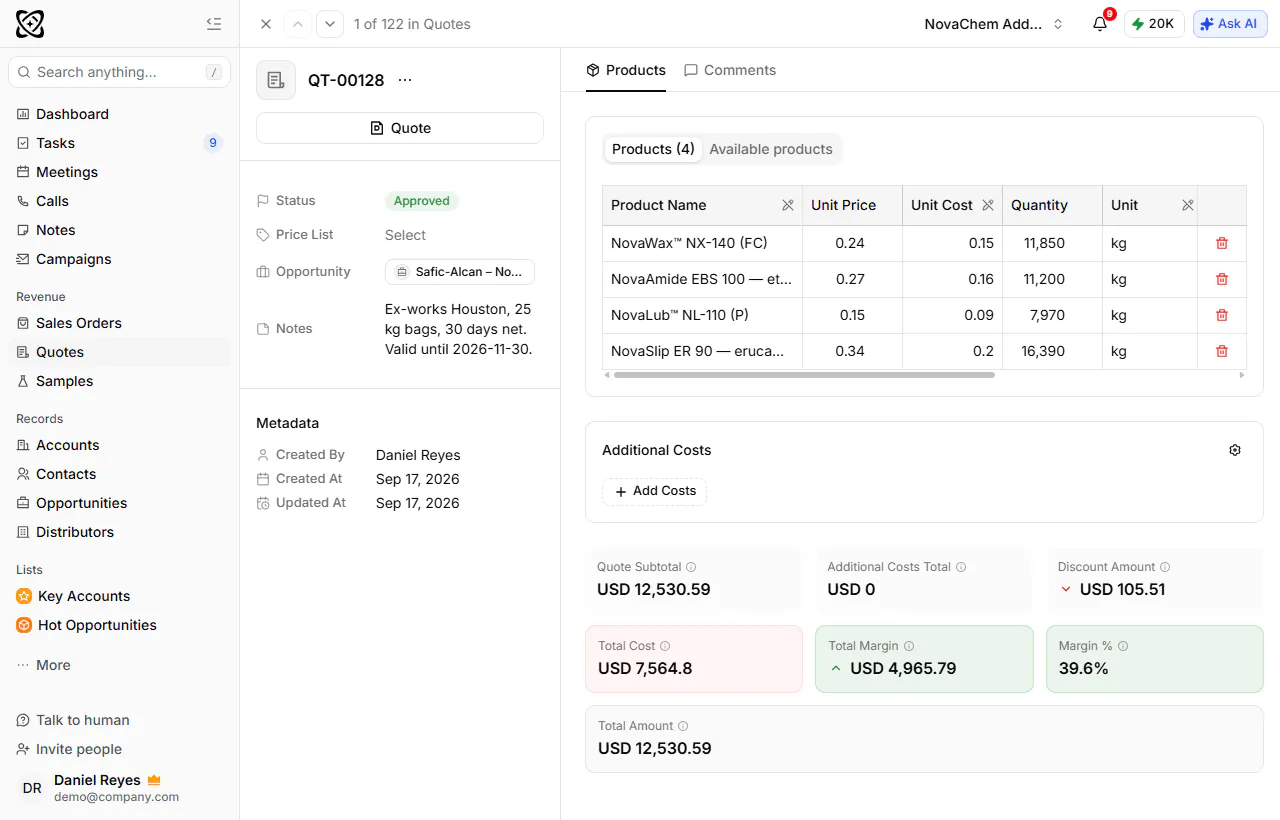
Customer price lists are in PromptLab on every plan, in the same CRM as accounts, quotes and sales orders. When you link a price list to a quote, the quote offers only the products on that list, at that customer's prices. Each line shows unit cost beside unit price, so a rep sees the margin before sending.
Frequently asked questions
What is the difference between a price list and a quote?
A price list holds standing prices for a customer. A quote is a one-off offer for specific products and quantities, priced from that list.
Can one customer have more than one price list?
It can, for example one per contract period. Keep the dates clear so reps use the right one.
How often should I update customer price lists?
At least once a year and whenever you agree a change. A quarterly check catches the ones that slipped.
Do I need a CRM for price lists?
A spreadsheet works for a few customers. Once several reps quote, a CRM keeps everyone on the same prices.