



















What is a sales cycle?
A sales cycle is the time and steps from first contact with a buyer to a closed deal. Here is how to measure it, why it varies, and how to shorten it.
 By the PromptLab team24 October 20263 min read
Definition
Sales cycle
A sales cycle is the series of steps, and the time they take, from first contact with a buyer to a closed deal. Its length is usually counted in days, from the day a deal is created to the day it is won.
People use the term in two ways. It can mean the stages a deal goes through, or it can mean how long the whole thing takes. This post covers both.
Why the sales cycle matters
A long cycle ties up your reps and delays revenue. It also makes forecasting harder, because a deal started now may not close for months.
Knowing your cycle helps you plan. If deals take about 60 days, a deal that has been open for 150 days needs a closer look. It helps you hire and set targets too, since a rep who joins today will not close much for a while.
How the sales cycle works
A cycle in product sales often moves through these steps: a first enquiry, a call or meeting, a sample sent for testing, feedback on the sample, a quote, negotiation, and an order. The exact steps change from one company to another. In PromptLab they are the deal stages on your one deal pipeline.
How to measure its length
Take the days between creation and close for each won deal, then average them. Use won deals only, or the average will mix in deals that were lost early.
Look at the spread as well as the average. If most deals close in 30 days and a few take 200, the average hides both groups. Check the longest and shortest.
What lengthens it
- A sample that takes weeks to test.
- Several people on the buyer's side who must approve.
- Waiting for a quote or a price from your own team.
- Buyers who only buy at set times of the year.
An example from product sales
A plastics supplier looks at five deals it won last quarter. They took 30, 45, 60, 75 and 90 days. The average is (30 + 45 + 60 + 75 + 90) ÷ 5 = 60 days.
The rep splits the time by stage and sees that deals spend about half their life waiting at the sample stage. So the team starts chasing sample feedback a week after delivery. That is the stage to fix, rather than the whole process.
The cycle also feeds sales velocity, which is open deals × average deal value × win rate ÷ cycle days. A shorter cycle raises it. You can try this with the sales velocity calculator.
Related terms
- Sales velocity: how fast the pipeline turns into revenue, with the cycle as one input.
- Sales pipeline: the stages the cycle moves through.
- Sample management: the step that often holds deals up in product sales.
How PromptLab handles it
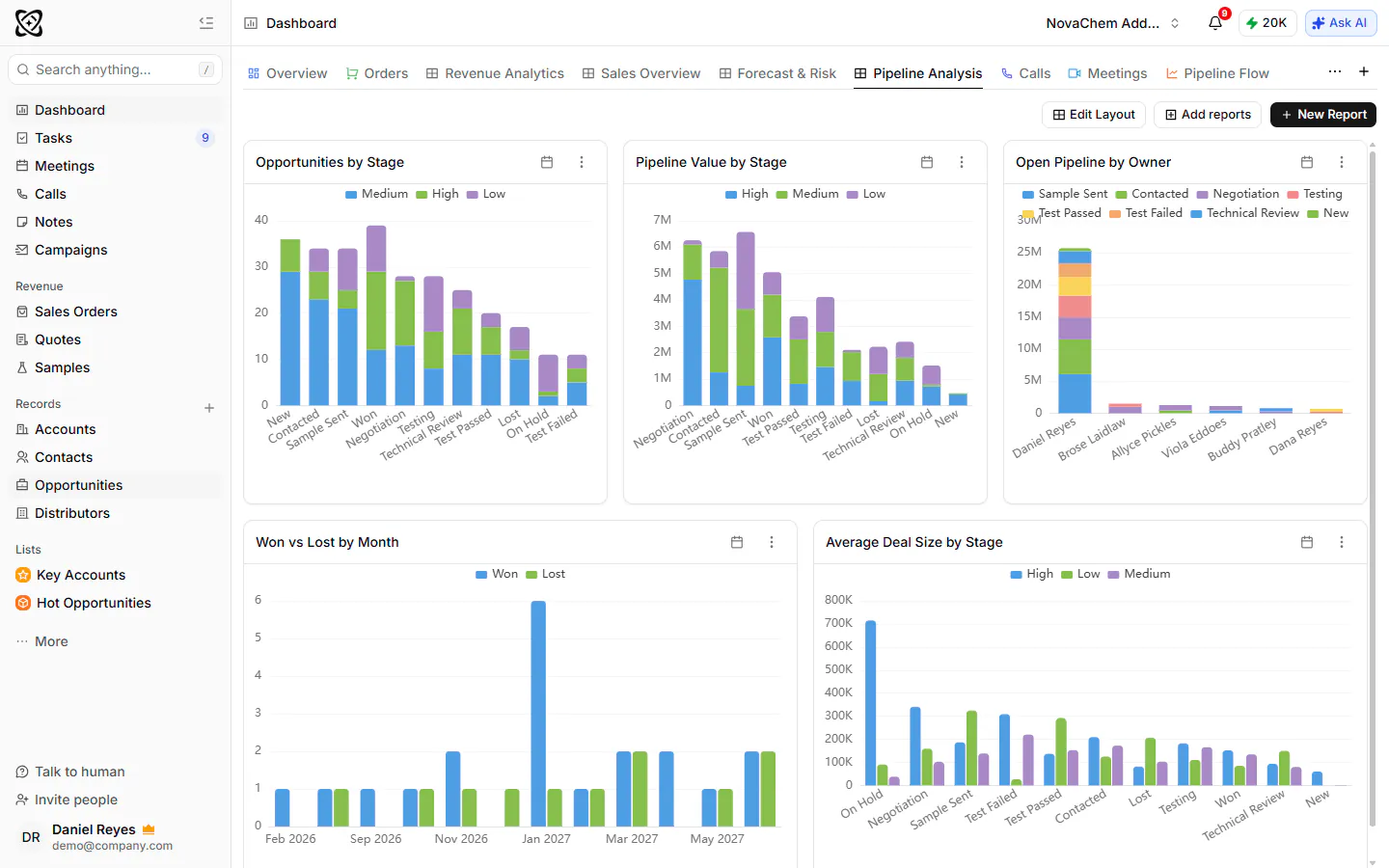
Every deal in PromptLab sits on the one deal pipeline, in a stage, with an owner. Sample requests are tracked with a status and linked to the account and deal, and quotes attach to the deal. Dashboards and the report builder show the pipeline by stage, so you can see where deals wait.
Frequently asked questions
How long is a typical sales cycle?
It depends on what you sell. A reorder of a stocked product may close in days, while a new custom product with samples and approvals can take months. Measure your own won deals rather than relying on a general figure.
How do you calculate the length of a sales cycle?
Count the days from deal creation to close for each won deal, then average them. Exclude lost deals so that early losses do not pull the number down.
What is the difference between a sales cycle and a sales pipeline?
The pipeline is the set of stages and the deals in them. The cycle is the time a deal takes to travel through those stages.
How can I shorten my sales cycle?
Find the stage where deals wait longest and fix that first. In product sales it is often the sample or the quote. Follow up on a set day, and give buyers a clear next step.
Should I measure the cycle for lost deals?
Track them separately. Knowing how long lost deals stayed open shows where time is wasted, but mixing them with won deals gives a misleading average.