









What is sample management?
Sample management is tracking product samples from request to feedback to order. See why it matters in chemicals and coatings and how to do it well.
 By the PromptLab team6 October 20263 min read
Definition
Sample management
Sample management is tracking every product sample you send a prospect: who asked, what you sent, when it shipped and what the buyer said. It ties each sample to a deal so you know which ones lead to orders.
In many industries a buyer will not order until they have tested your product. Chemicals, coatings, plastics, ingredients and packaging all work this way. The sample is the sale, in miniature.
Why sample management matters
Samples cost money to make and ship. They also cost time, because the buyer is waiting. If requests sit in a spreadsheet, three things happen:
- A sample goes out late and the buyer tries a competitor first.
- Nobody asks for feedback, so the deal goes quiet.
- You cannot tell which products or customers turn samples into orders.
Managing samples properly turns a cost into a measurable step in the sale.
How sample management works
A good process has five parts:
- Request. Record who wants which product, grade or pack size, and why.
- Approval and preparation. Someone checks stock and prepares it.
- Shipping. Log the date and any tracking details.
- Feedback. Ask the buyer how the test went, and write down the answer.
- Outcome. Link the result to the deal: quote, reorder or lost.
Every step needs an owner and a status, so nothing waits for a nudge.
An example from a plastics supplier
This example is made up.
A masterbatch supplier gets a request for a black masterbatch sample from a moulder. The rep logs it on the deal with the grade and the 5 kg quantity. The warehouse ships it on Wednesday. The status changes to "sent".
A week later the rep sees the sample is still waiting for feedback and calls the buyer. The test passed, but the buyer wants a price for 2 tonnes. The rep sends a quote from the same deal. Without the status, the follow-up would have been missed.
What to measure
- Time from request to shipment. Slow shipping loses deals.
- Share of samples with feedback. Silence means chase.
- Samples that turn into orders. This is your sample-to-order rate, and it shows which products and customers deserve samples.
Related terms
- Quote-to-order is what comes after a good sample.
- A deal stage often includes a "sample sent" step.
- A sales order is the end of the sample journey.
- Win rate shows how well samples turn into sales.
Our guide on how to track product samples goes step by step.
How PromptLab handles it
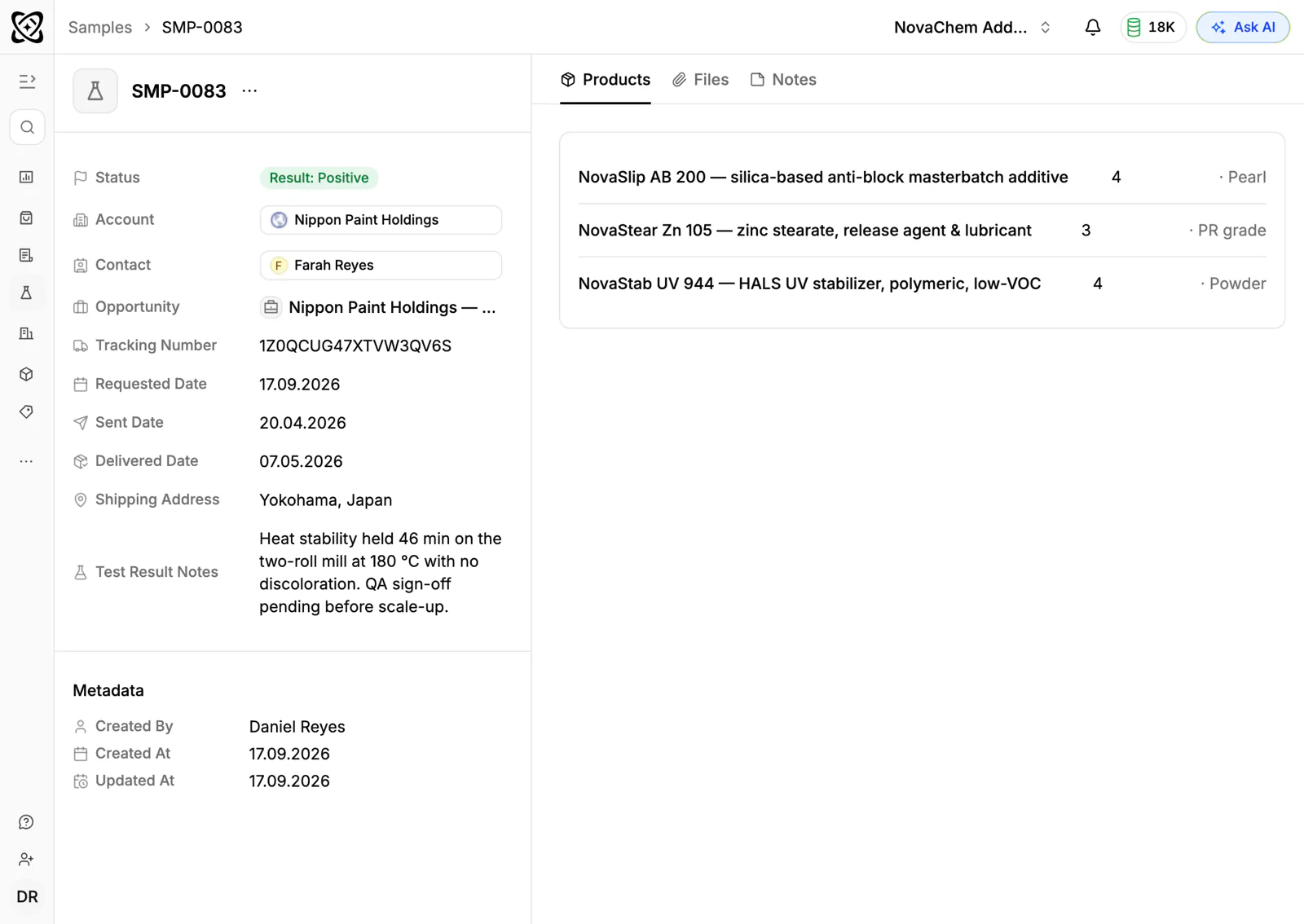
PromptLab has sample tracking built in on every plan. Each sample record holds the account, contact, product, quantity, shipping address, tracking number, and the requested, sent and delivered dates. Its status runs from Requested through Preparing, Sent, In Transit and Delivered to Under Evaluation, and ends at a positive, negative or conditional result with the test notes. The same CRM holds customer price lists, quotes and sales orders, so the move from sample to order does not leave the system. See quotes and samples.
Frequently asked questions
Why track samples in a CRM and not a spreadsheet?
A CRM links each sample to the account and contact, next to their quotes and orders. A spreadsheet cannot remind anyone to chase feedback or show which samples became orders.
Should we charge for samples?
It depends on your market and the cost of the product. Whatever you decide, record it, so you can compare cost against orders won.
How long should a sample take to ship?
As fast as you can manage. Set an internal target, such as shipping within a few working days, and measure against it.
Can Claude or ChatGPT read my sample records?
Yes, if you connect them to PromptLab over MCP. The assistant can list sample requests, look one up with its status and update it, for example to record the trial result. See how to connect Claude to your CRM.