



















What is a sales quote?
A sales quote is a written offer that states the products, quantities, prices and terms a seller will supply. Here is how it differs from an estimate.
 By the PromptLab team16 October 20263 min read
Definition
Sales quote
A sales quote is a written offer from a seller to a buyer. It lists the products, quantities, prices and terms the seller will supply, and it is usually valid for a set period. If the buyer accepts it, the seller is expected to deliver on those terms.
A quote answers one question for the buyer: "What exactly will this cost me, and on what terms?" It is the step between a conversation and an order.
Why a sales quote matters
A quote turns interest into something the buyer can approve. Without one, the buyer is working from a chat message or a remembered price, and nobody can sign that off.
It also protects the seller. A clear quote with an expiry date means you are not held to a price after your raw material costs change.
What a sales quote contains
The usual contents are:
- The customer, the contact and the date
- Product lines with quantity, unit and unit price
- Any discount, tax, freight or packaging charges
- Payment terms and delivery terms
- How long the quote stays valid
- A reference number, so both sides can find it later
For a step-by-step method, see how to write a sales quote.
Quote versus estimate, pro forma and sales order
These documents sit close together and get mixed up.
| Document | What it is | Binding? |
|---|---|---|
| Quote | A firm offer at stated prices and terms | Yes, until it expires |
| Estimate | A rough guide to the likely price | No |
| Pro forma invoice | A preliminary invoice sent before shipping, often to arrange payment or customs paperwork | Depends on the terms |
| Sales order | The record of what the buyer accepted | Yes, once confirmed |
The short version: an estimate is a guess, a quote is an offer, a pro forma invoice is a preview of the bill, and a sales order is the accepted deal.
How a quote moves through a sale
A quote is drafted, sent, and then waits. While it waits it has a status, such as draft, sent, accepted or expired. The buyer may accept it, ask for changes, or go quiet.
When the buyer accepts, you create a sales order with the quote's lines and prices. Check them against the quote, so the order matches what the buyer approved. This is the heart of quote-to-order.
An example from product sales
A chemicals distributor gets a request for 4 drums of a solvent. The rep checks the customer's agreed prices, then sends a quote for 4 drums at that price, with delivery in ten days and payment in 30 days. The quote is valid for 14 days. The buyer replies "yes, go ahead" on day six, and the rep creates the sales order with the same lines.
Related terms
- RFQ: the buyer's request that usually triggers a quote.
- Customer price list: where the prices on the quote come from.
- Quote-to-order: the process from quote to confirmed order.
- Sales order: the record created once the quote is accepted.
How PromptLab handles it
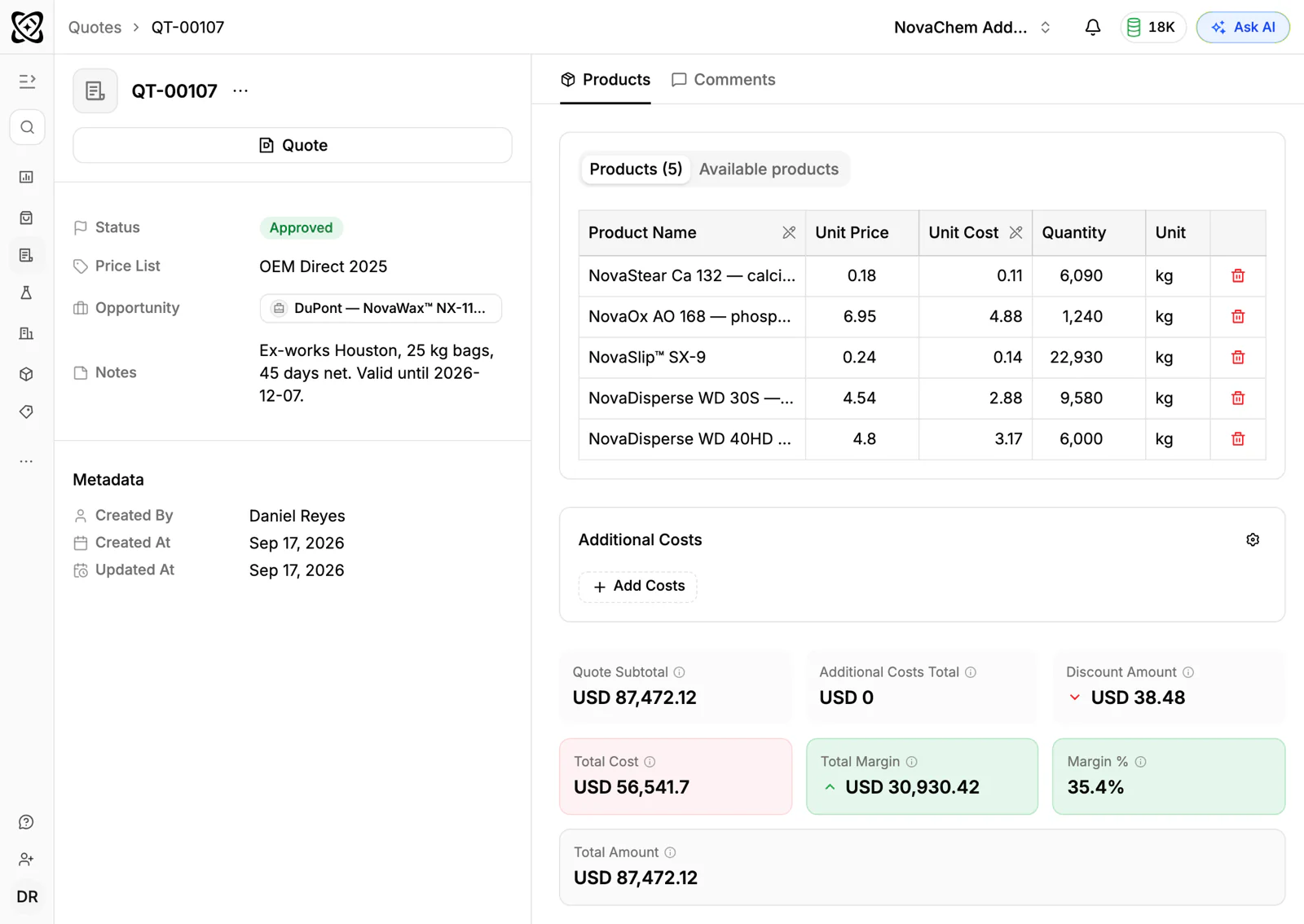
Quotes are part of PromptLab on every plan. A quote is linked to the customer's price list, which sets their prices, and it shows the margin on each line. It has a status you can track and it attaches to the deal. A workflow can create a task or post to Slack when a quote changes status. When it is approved, you create the sales order with the same lines, on the same account.
Frequently asked questions
Is a sales quote legally binding?
A quote is an offer, and in most cases the seller is expected to honour it while it is valid. The exact effect depends on your terms and local law, so check your own terms and take advice if it matters.
What is the difference between a quote and a quotation?
Nothing in practice. Quotation is the longer word and quote is the everyday one. Both mean a priced offer.
How long should a quote be valid?
Long enough for the buyer to decide, and short enough that a price change does not hurt you. Many sellers choose a few weeks. Shorter suits products with volatile raw material prices.
Can I change a quote after sending it?
Yes, but send it as a revised version and say what changed. The buyer should never be unsure which version is current.