











CRM for food ingredient suppliers
How food ingredient sales works, from samples and specs to certification documents, application labs and seasonal volumes, and how to set up a CRM for it.
 By the PromptLab team6 October 20265 min read
A food ingredient supplier needs a CRM that links a sample to a specification, a specification to a document pack and a document pack to an order. The buyer is a food manufacturer with its own quality rules, and the ingredient has to pass them before price is even discussed.
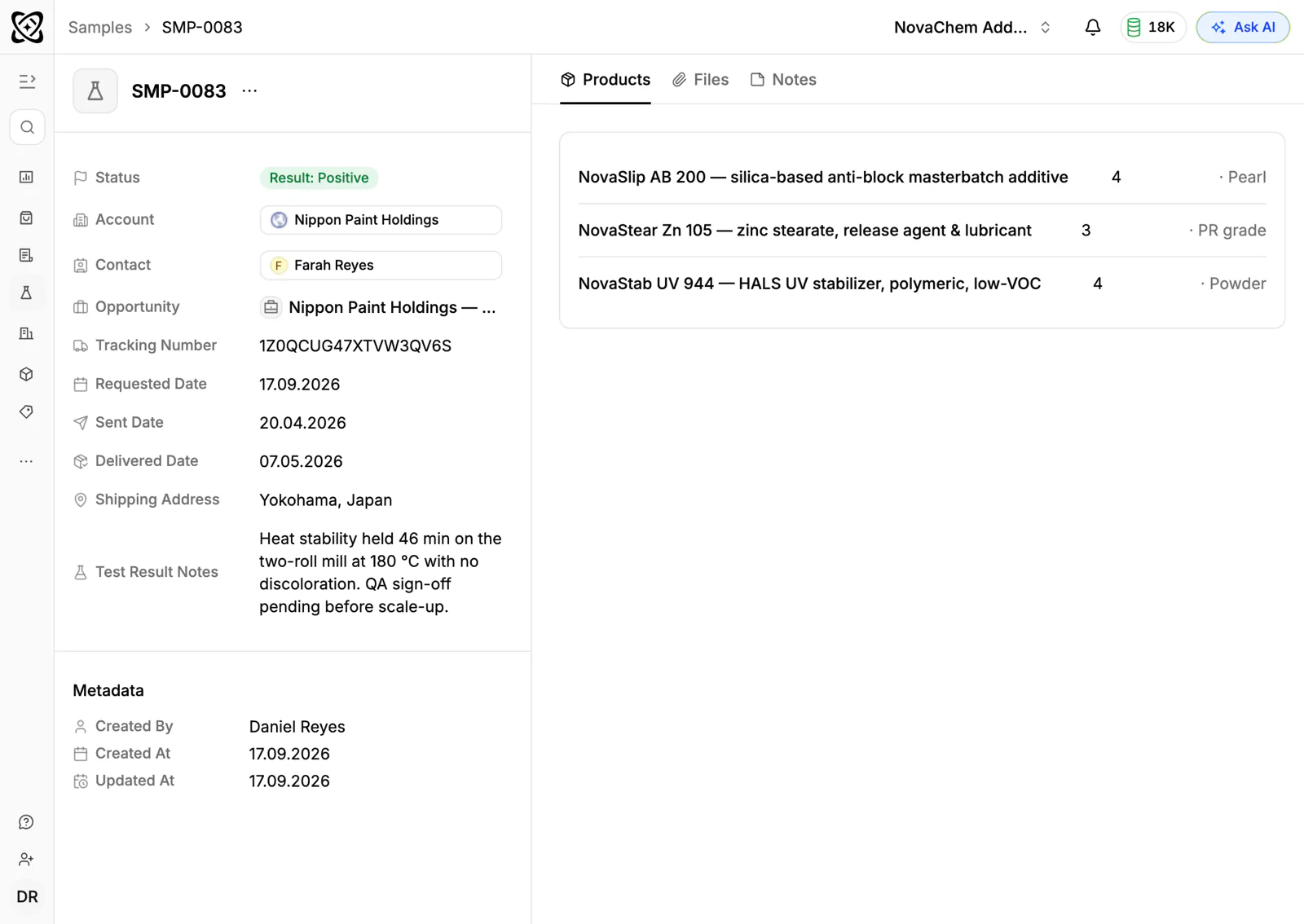
In PromptLab, the sample, the spec pack and the order sit on one account: samples in sample tracking, certificates as documents, and quotes from the customer's price list. The distributors page shows the quoting side.
How does an ingredient sale actually work?
Ingredient buyers are product developers, quality managers and procurement, usually in that order. A developer at a bakery, a beverage maker or a meat processor is reformulating, and asks for a sweetener, an emulsifier, a flavour or a protein that does a specific job.
You send a sample, with a specification sheet. The developer tests it in a bench batch, and the result feeds into a pilot at the plant. Only then does quality ask about origin, allergens, shelf life and certificates, and only then does procurement ask for a price.
The sale is therefore a sequence of small yeses from different departments. A rep who only talks to procurement will find the deal stuck at a stage they cannot see.
Why are documents and certifications part of the sale?
Quality teams ask for the same paper again and again: the specification, the allergen statement, the certificate of analysis for a batch, and the certificates your site holds. Sending an old version is worse than sending nothing, because an audit can pick it up.
The CRM should keep the current document pack on the account, with a note of who received which version and when. When a certificate is renewed, you want to know which accounts to send it to. That is a document problem and a contact problem at once, and a spreadsheet solves neither.
What does an application lab do for the sale?
Many ingredient suppliers run an application lab that makes a prototype with the customer's recipe: a sauce with your thickener, a drink with your stabiliser. The lab result is often the most persuasive thing you can send.
That means a lab request is a task with an owner, a due date and a result that goes back to the account. If the request lives in email, the lab does not know the deadline and the rep does not know the answer.
What pipeline stages fit ingredient sales?
| Stage | Entry condition |
|---|---|
| Brief | A developer described the application or reformulation |
| Sample sent | A sample and spec are logged with a date |
| Bench trial | The customer confirmed they are testing |
| Application work | Your lab is making a prototype, or a pilot is booked |
| Quality review | Documents sent, questions from quality open |
| Price and volume | A quote is out, with the volume forecast |
| Listed | The ingredient is approved and the first order is placed |
| Repeat supply | Orders follow the customer's production plan |
Seasonal businesses add one more habit: a review before each season, as volumes for ice cream, beverages or confectionery follow the calendar. A task per key account two months ahead gives the rep time to ask for the forecast.
What must a food ingredient CRM track?
- Samples, with product, lot, quantity, date and the developer's feedback.
- Specifications and documents, attached to the account and to the deal, with dates.
- Contacts by function: developer, quality, procurement.
- Seasonal volume, as a field or on the sales orders, with the customer's forecast date.
- Customer price lists by pack size, such as 25 kg bags, drums and totes.
- Quotes and sales orders, so the first listed order is visible against the sample that started it.
How do you set this up in PromptLab?
- 1
Build the eight-stage pipeline
Use the stages above. The "Quality review" stage is the one to watch, because it is where a deal can stall without any complaint.
- 2
Keep documents on the account
Upload the specification, allergen statement and certificates as documents on the account and the deal. When you send a new certificate, add a note on the account saying who received it and when.
- 3
Log every sample with its lot
Log the product, quantity and contact with sample tracking, and note the lot, so the developer's feedback traces back to the batch they tested. The guide to tracking samples and the sample follow-up templates cover the follow-up routine.
- 4
Create lab tasks
Create a task on the deal for the application lab, assigned to the lab lead, with the customer's due date. The task sits beside the deal, so the rep can see when the prototype is due.
- 5
Add contacts by function
Add the developer, the quality manager and the buyer as separate contacts on the account. Each can have a note on what they check.
- 6
Capture the calls and messages
Record the bench-trial review in Google Meet, Zoom or Microsoft Teams, and let the summary attach to the account. Connect WhatsApp and Telegram in the Inbox for the quick questions from international buyers.
How does PromptLab compare for ingredient suppliers?
Swipe the table sideways to see every CRM →
| Checked on 30 September 2026 | PromptLab |  monday CRM monday CRM |  Pipedrive Pipedrive |  Salesforce Salesforce |
|---|---|---|---|---|
| Pricing | ||||
| Paid plans, a month | $11.99 – $99per seat | $12 – $28per seat | $14 – $79per seat | $25 – $550per seat |
| Number of plans | 3 | 4 | 4 | 5 |
| Free trial | ||||
| Billing | Billed monthly | Billed annually; Ultimate is custom-priced | Billed annually | Billed annually |
| Import from CSV and Excel | ||||
| Sales management | ||||
| Deal pipelines | ||||
| Quotes | From$59/month | From$100/month | ||
| Sales orders | From$100/month | |||
| Sample tracking | ||||
| Price lists | From$100/month | |||
| Meetings and calls | ||||
| Meeting recording and transcripts | From$17/month | Add-on | ||
| AI meeting summaries | From$17/month | Add-on | ||
| AI follow-up email drafts | From$17/month | From$59/month | Add-on | |
| Meeting scheduler and call dialer | From$23.99/month | From$17/month | From$39/month | Add-on |
| AI and automation | ||||
| CRM fields filled in from calls | From$17/month | From$195/month | ||
| Connect Claude or ChatGPT (MCP) | From$195/month | |||
| Workflow automation | From$17/month | From$39/month | ||
| API and webhooks | From$23.99/month | From$17/month | From$195/month | |
| Conversations | ||||
| Gmail and Outlook email sync | From$17/month | From$39/month | ||
| WhatsApp conversations | From$39/month | Add-on | ||
| Telegram conversations | ||||
| Save LinkedIn profiles | Via marketplace | Via marketplace | ||
| Privacy and security | ||||
| Single sign-on (SSO) | From$99/month | Enterprise plan |
monday CRM's boards are flexible enough to run a lab request queue, and its $12 Basic plan, billed annually, includes quotes and invoices. Sales orders, sample tracking and customer price lists aren't there, so the sample and the spec pack would sit on extra boards you build and maintain, and the AI notetaker starts on Standard at $17.
Pipedrive's Nova assistant records the bench-trial review on every plan from $14 a seat a month, billed annually, but it has no samples or price lists, and quotes wait for Premium at $59. Salesforce can model a full spec and approval process for a large ingredients group, given an admin or a partner to build it. Its quotes and price lists start on Pro Suite at $100 a user a month, billed annually. The monday CRM comparison goes through it line by line.
Frequently asked questions
What is the best CRM for a food ingredient supplier?
One that tracks samples, documents, price lists and orders together. PromptLab does, from $11.99 per user per month, and records the meetings where specs and trials are discussed.
Can a CRM store certificates and specification sheets?
Yes. PromptLab includes documents on every plan, attached to accounts and deals. Keep each certificate's renewal date in a field, with a task to send the new version to every account that holds the old one.
How do I handle seasonal volumes?
Record the customer's forecast on the account or the sales order, and set a task for each key account before the season starts. Reports and dashboards show pipeline and revenue by period.
Can I track samples in a CRM?
Yes. PromptLab's sample tracking records each sample's status and feedback, and links it to the deal. See what is sample management.
Does PromptLab work for overseas buyers?
Meeting transcripts cover 100+ languages, and the Inbox takes WhatsApp and Telegram, which many international buyers use. Telegram works through your company's own bot, which the buyer messages first.
Sources
Prices and features of other CRMs come from each vendor's own pages, on the dates below.
- monday CRM, checked on 30 September 2026: Pricing, CRM overview, monday.com for Enterprise
- Pipedrive, checked on 30 September 2026: Pricing, MCP server, Nova, Exporting data
- Salesforce, checked on 30 September 2026: Sales Cloud pricing, Sales Engagement pricing, Agentforce MCP support