



















CRM for pharmaceutical distributors
How pharmaceutical distributors sell to pharmacies, hospitals and clinics, from tenders to credit terms, and a CRM setup for the commercial side.
 By the PromptLab team7 November 20266 min read
A pharmaceutical distributor buys medicines from manufacturers and sells them to pharmacies, hospitals, clinics and smaller wholesalers. The sale is regulated, the margins are thin, and the customer base is large. A CRM for that trade handles the commercial side: who buys what, on which price and credit terms, and who is due a call.
In PromptLab, customer price lists give each account its own pricing, quotes are built from your products, and sales orders and invoices are linked to the account. The CRM is not a quality system or a stock system, and this post shows where that line sits. For the ingredient side, see CRM for pharmaceutical ingredients suppliers.
How does pharmaceutical distribution actually sell?
Customers fall into three groups. Pharmacies order often, in small baskets, and care about availability and delivery speed. Hospitals and clinics buy in larger volumes, often through tenders or framework agreements with set prices and periods. Smaller wholesalers and chains buy on price and credit terms.
Reps sell on service more than product. A pharmacy buys from the distributor that has the item, delivers on time, and handles returns and expiry without a fight. The rep's visit is about assortment, new supplier lines, price changes and overdue balances.
Credit is central. Pharmacies and hospitals often pay in 30 to 90 days, depending on the market and the customer, so the receivable is a large part of the business. See what is a credit limit and what is Net 30.
What rules shape the sale?
Pharmaceutical distribution is regulated, and the rules depend on the country. Typical examples are a wholesale distribution licence, good distribution practice for storage and transport, temperature control for cold-chain products, batch and expiry traceability, and extra rules for controlled substances. Customers must also be authorised to buy, such as a licensed pharmacy.
None of this belongs in the CRM's rule engine, and PromptLab does not verify any of it. What the CRM can do is hold the facts your team needs at the point of sale:
- A custom field on each account for the customer's licence number, and a date field for its expiry, so a rep sees when it needs renewing.
- A custom field on products for storage condition, such as cold chain, and for whether the product is restricted.
- Notes and files on the account for the due-diligence documents you collected.
What pipeline stages fit a distributor?
PromptLab has one deal pipeline per workspace. Use a deal for each new account, new product line or tender, and a custom field to tell pharmacy, hospital and wholesale apart. A workable set of stages:
| Stage | Entry condition |
|---|---|
| Lead | A pharmacy, clinic or hospital shows interest |
| Account approved | Licence and credit checks are done by your team |
| Price list agreed | A customer price list is set for the account |
| Quote or tender submitted | A quote or the tender response is out |
| Won | The first order or the framework is agreed |
| Active | Orders flow; the rep owns the reorder rhythm |
Most of the revenue is in the active accounts, so the work after "won" matters most. Saved views of accounts by owner and region help, and each account's Overview shows its last order.
What must the CRM track?
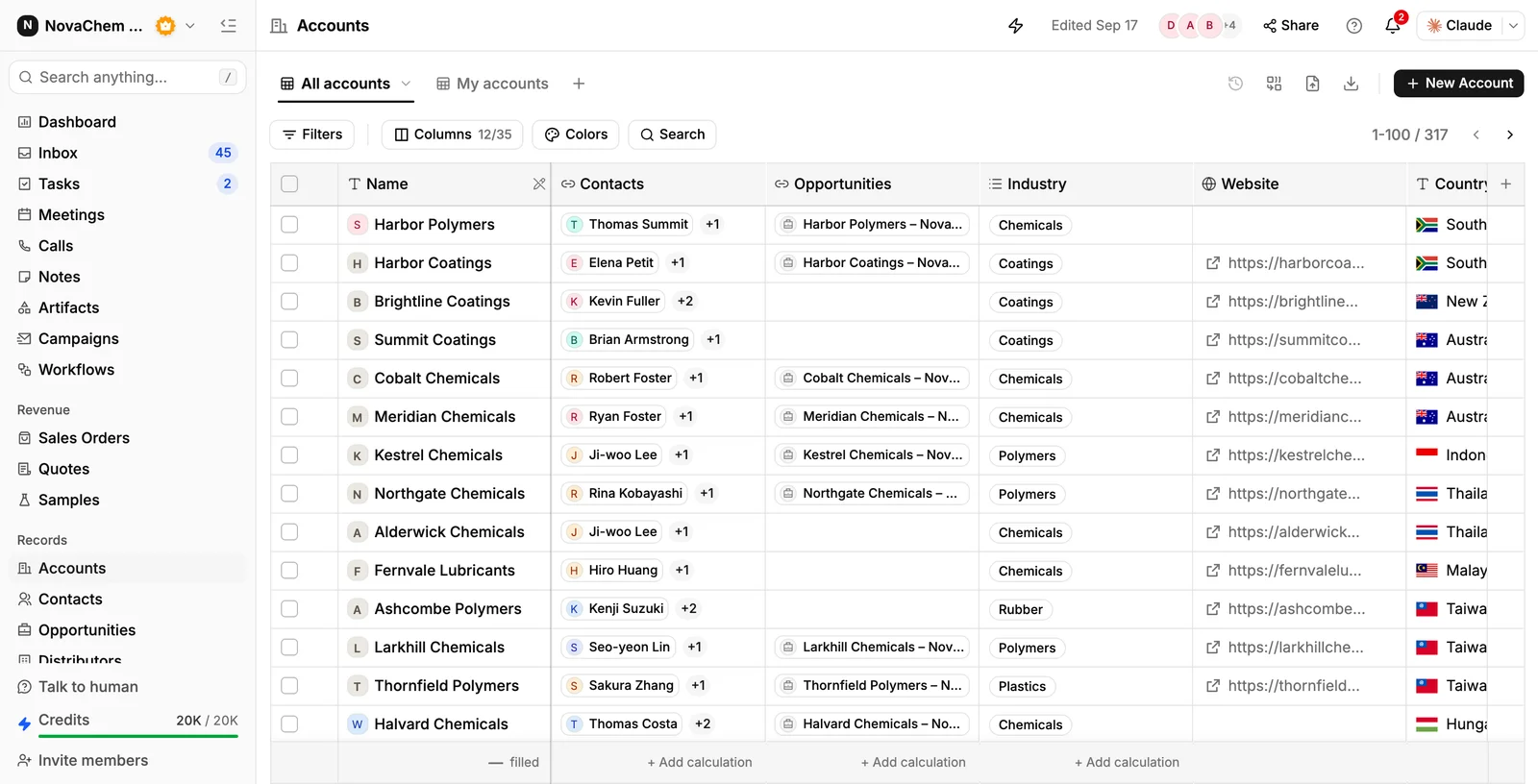
- Customers and contacts. The pharmacist in charge orders, the owner decides, and accounts pay. Record each role.
- Customer price lists. A list adds a set amount on top of each product's base price, so it can't go below base. See what is a customer price list.
- Tender and framework details as deal fields: the authority, the period, and the next follow-up date. An expected close date is a custom date field.
- Credit terms and balances. Payment terms sit on the sales order. For a customer, the account's Overview shows its outstanding and overdue order amounts and its last order, and the daily digest lists overdue invoices.
- Messages. Pharmacies order and ask for availability on WhatsApp and Telegram as well as email.
- Returns and complaints, as notes on the account with a task for the owner.
How do you set this up in PromptLab?
- 1
Import accounts and products
Bring in customers, contacts and your catalogue from CSV or Excel. Add account fields for licence number, licence expiry and customer type, and product fields for storage condition.
- 2
Build price lists
Create a customer price list for each tier, such as chains, hospitals and independent pharmacies. See how to manage customer price lists.
- 3
Quote and respond to tenders
Build quotes from your products and the account's price list. Put delivery terms and validity in Notes, since a quote has no expiry field. Send as a PDF or a public link.
- 4
Create sales orders and invoices
Approving a quote does not create a sales order. Create the order on the account with payment terms and the planned delivery date, then raise the invoice from it.
- 5
Chase renewals and balances
Create tasks for licence renewals and overdue balances. A workflow can create a task when a deal changes stage, and tasks don't repeat, so create the next one when you close the last.
- 6
Connect the Inbox
Connect email, your WhatsApp Business number and your company Telegram bot. Pharmacy orders and questions then land in the shared Inbox, on the contact and in the account's activity.
How does PromptLab compare for distributors?
Swipe the table sideways to see every CRM →
| Checked on 30 September 2026 | PromptLab |  Salesforce |  Zoho CRM |  HubSpot |
|---|---|---|---|---|
| Pricing | ||||
| Paid plans, a month | $11.99 – $99per seat | $25 – $550per seat | $14 – $52per seat | $7 – $150per seat |
| Number of plans | 3 | 5 | 4 | 4 |
| Free trial | ||||
| Billing | Billed monthly | Billed annually | Billed annually | Billed annually, plus a $1,500–$3,500 onboarding fee |
| Import from CSV and Excel | ||||
| Sales management | ||||
| Deal pipelines | ||||
| Quotes | From$100/month | From$23/month | Add-on | |
| Sales orders | From$100/month | From$23/month | ||
| Sample tracking | ||||
| Price lists | From$100/month | From$23/month | ||
| Meetings and calls | ||||
| Meeting recording and transcripts | Add-on | Via marketplace | From$90/month | |
| AI meeting summaries | Add-on | |||
| AI follow-up email drafts | Add-on | From$23/month | From$90/month | |
| Meeting scheduler and call dialer | From$23.99/month | Add-on | Via marketplace | |
| AI and automation | ||||
| CRM fields filled in from calls | From$195/month | From$40/month | From$90/month | |
| Connect Claude or ChatGPT (MCP) | From$195/month | |||
| Workflow automation | ||||
| API and webhooks | From$23.99/month | From$195/month | ||
| Conversations | ||||
| Gmail and Outlook email sync | ||||
| WhatsApp conversations | Add-on | Add-on | ||
| Telegram conversations | ||||
| Save LinkedIn profiles | Via marketplace | From$23/month | From$150/month | |
| Privacy and security | ||||
| Single sign-on (SSO) | From$99/month | From$40/month | From$150/month |
Salesforce is the most configurable CRM there is, with five editions from $25 to $550 a user a month, billed annually. For a team selling products, quotes, sales orders and price lists start on Pro Suite at $100 a user a month. Zoho CRM has quotes, sales orders and price books from $23 a user a month, billed annually, but it doesn't model samples at any tier.
HubSpot is a polished all-in-one suite with a Starter plan from $7 a seat a month, billed annually. For product sales, quoting sits in the separate Revenue Hub, and sales orders and price lists aren't there. See the Salesforce and HubSpot comparisons. Prices are as checked on 30 September 2026.
Frequently asked questions
Is PromptLab a GDP-compliant system?
PromptLab makes no compliance claim. It is a sales CRM. Keep batch, expiry, storage and licence checks in your quality and ERP systems, and use the CRM for customers, prices, quotes and orders.
Can I set a different price for each pharmacy?
Yes. Create a customer price list for each account or tier. A list adds a set amount on top of each product's base price, so it can't go below base.
Can the CRM handle tenders?
Track each tender as a deal with the authority, the period and a next follow-up date, and build the response as a quote. Put the expected close date in a custom date field.
How do I track overdue balances?
Invoices are created from a sales order or on their own, and the daily digest in Slack, Telegram or WhatsApp lists overdue invoices. It does not replace your accounting system.
Is there a free trial?
Basic and Professional come with a 14-day free trial, with no card needed. There is no free plan.
Sources
Prices and features of other CRMs come from each vendor's own pages, on the dates below.
- Salesforce, checked on 30 September 2026: Sales Cloud pricing, Sales Engagement pricing, Agentforce MCP support
- Zoho CRM, checked on 30 September 2026: Pricing, Features, WhatsApp integration, MCP
- HubSpot, checked on 30 September 2026: Sales Hub pricing, Revenue Hub quote software, WhatsApp integration, MCP servers, Single sign-on (SSO)